Best Bright Data alternative for scraping many APIs (2026)

Bright Data is the right tool when you collect data at serious scale, need control over your proxies, or need compliance paperwork signed before you can scrape anything. A pay-per-request API is the right tool when you want a few sources back as JSON at a price you know before you call.
Bright Data prices each product on its own: proxies by the gigabyte, unlockers and scrapers per thousand requests. AnyAPI is one price per successful call, and the response is clean JSON, so there's no HTML to parse and no proxy to set up.
Prices were checked September 5, 2026.
Built on AnyAPI
402 scraping and data APIs behind one key.
Every endpoint in this post is one call away. Pay per request in USD from a prepaid wallet, with automatic failover when a provider breaks. No subscription, no card to start.
Get ~150 free requests$0.10 of credit on signup.Bright Data is the biggest name in web data infrastructure. It runs one of the largest proxy networks in the world, sells tools that get through the toughest anti-bot defenses, and has the compliance team and signed agreements that large companies need. It's also one of the four providers behind AnyAPI's page scraper, the expensive one that runs when the cheaper ones get blocked.
It's built for scale, and that's the catch for a lot of people. If you have a small job, the front door is designed for a much bigger one: you pick between five products, choose a proxy type, clear an identity review for residential IPs, and parse the HTML that comes back yourself. None of that is Bright Data doing anything wrong. It's what an enterprise platform looks like.
Here's where Bright Data is the right call, where paying per request wins, and what the same job costs either way.
Where Bright Data is strong
Bright Data earns it when collecting data at scale is the job itself.
- Scale and control. Residential, ISP, mobile, and datacenter proxies with precise geo-targeting and session control. If you run big crawls and need to control exactly how your requests look, little else competes.
- It gets through the hard targets. The Web Unlocker and Scraping Browser are built for heavy anti-bot defenses at volume. That's exactly why it's AnyAPI's last-resort provider: when three cheaper scrapers come back blocked, Bright Data usually doesn't.
- Enterprise compliance. An identity and use-case review for the residential network, a compliance team, GDPR and CCPA policies, and signed agreements. If your company needs that paperwork before you can scrape anything, Bright Data has it ready.
- A free tier you can actually use. The Web Unlocker, SERP API, and Web Scraper API each come with 5,000 free requests a month, no card required, and Bright Data was matching first deposits up to $500 in September 2026.
If that's your job, Bright Data deserves its place. The rest of this post is for when you want the data from a few sources without building a collection stack to get it.
Where AnyAPI wins
If you're not collecting at scale, most of that platform is setup you don't need. Here's what changes when you call one API instead.
Nothing to clear before your first call
Because Bright Data is built for scale, it asks scale-sized questions up front. You sign up, clear a review for the residential network, pick which of five products fits, set up a proxy zone, and then parse whatever comes back. For a large ongoing operation that setup pays for itself. For a small job it's a wall.
- Step 1Sign up, clear the KYC and use-case review for residential IPs
- Step 2Pick a product: Unlocker, Scraping Browser, Scraper API, SERP API, datasets
- Step 3Choose a proxy type and set up a zone
- Step 4Wire it up and parse the HTML yourself
- ResultYour first row of data
Paying per request skips all of it. You sign up, add a few dollars, and make the call. There's no minimum to commit to and no review to pass, so your first row is minutes away.
A known price per call
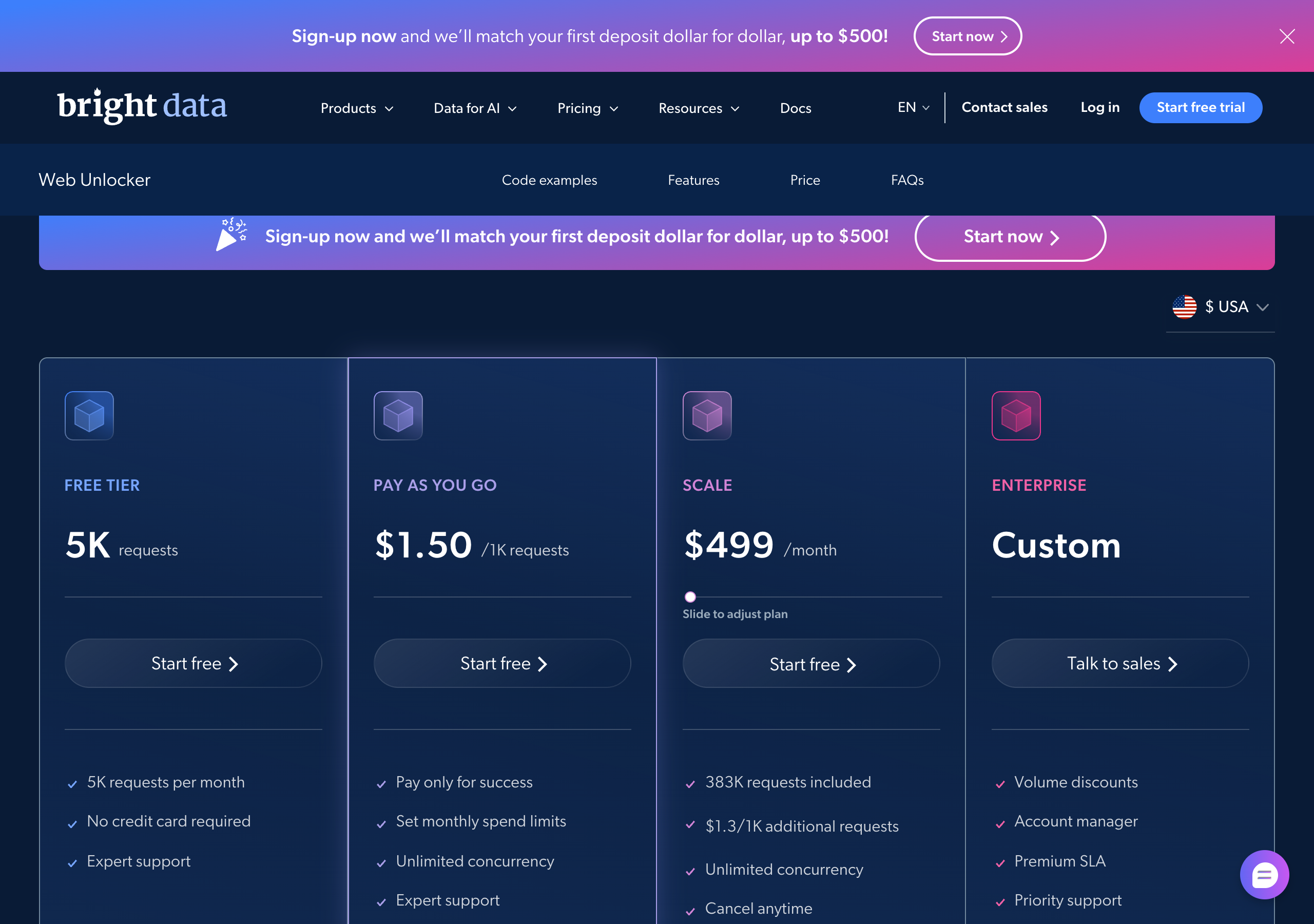
Bright Data prices every product separately. Residential proxies were $4 per GB pay as you go in September 2026 (listed as half off the usual $8), dropping to $3.50, $3, and $2.50 per GB on $499, $999, and $1,999 monthly plans. The Web Unlocker and SERP API are $1.50 per 1,000 requests pay as you go, or $499 a month for 383,000 requests. The Web Scraper API starts around $0.75 to $1 per 1,000 records.
The proxy bill is the tricky one. You pay for bandwidth, so the same job costs wildly different amounts depending on how heavy the pages are, and you don't know that until you've fetched them.
Paying per request takes page size out of the picture. You pay a set price per successful call, whatever the page weighs and however many retries it took behind the scenes. Multiply it by your number of calls and that's your bill.
One endpoint, nothing to assemble
With Bright Data you design the setup: which product, which proxy type, and how to parse the HTML that comes back. That control is the point of the platform, and it's also work. Pulling from six sites can mean six different setups.
Call AnyAPI and it's one endpoint per source. Same key, same request format, and the response comes back as clean JSON, so there's nothing to parse and no selectors to fix when a site changes its layout. To add a source, you change the endpoint name.
If a source breaks, it falls back
Sites change and block, and every scraper has bad days. With Bright Data, getting unblocked is something you tune yourself: rotate proxies, switch products, adjust the browser settings. That's control when you want it and a chore when you don't.
AnyAPI handles that for you. Its page scraper has four providers behind it. The cheapest costs $0.70 per 1,000, Bright Data costs $1.50, and Bright Data only runs when the cheaper ones fail. You're charged for the attempt that worked, and a blocked or failed call costs nothing.
One call, any source
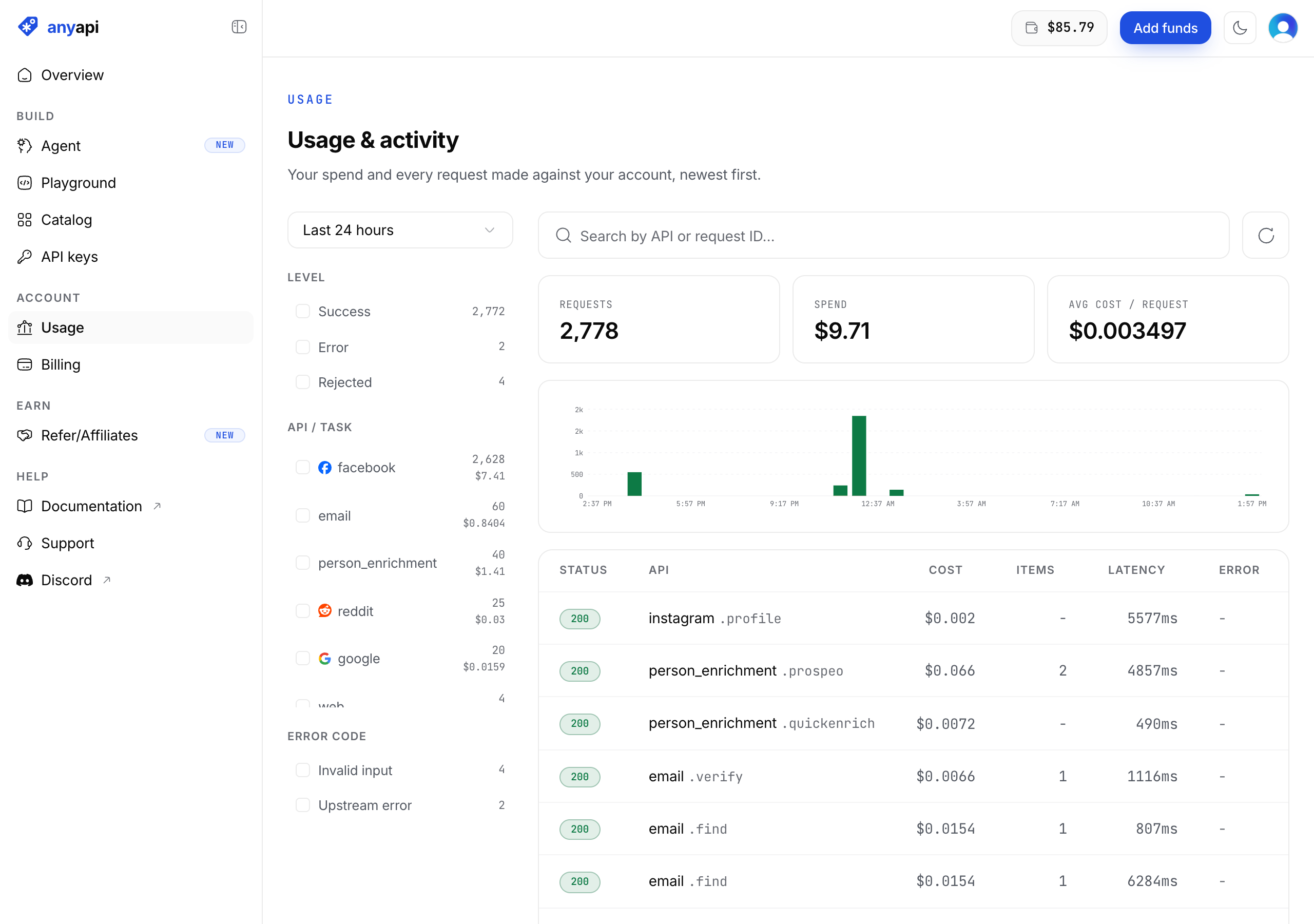
Here's the call, and what it cost: a full page of Google results for $0.0009, on September 5, 2026. Bright Data's SERP API charges $1.50 per 1,000 for the same query and returns a page you parse yourself.
curl https://api.getanyapi.com/v1/run/google.search \
  -H "Authorization: Bearer $ANYAPI_KEY" \
-d '{"query": "wireless earbuds"}'import os, requests
r = requests.post(
"https://api.getanyapi.com/v1/run/google.search",
headers={"Authorization": f"Bearer {os.environ['ANYAPI_KEY']}"},
json={"query": "wireless earbuds"},
)
body = r.json()
print(body["costUsd"], body["data"]["results"][1]["title"])
# 0.0009 The 6 Best Wireless Earbuds of 2026const r = await fetch("https://api.getanyapi.com/v1/run/google.search", {
method: "POST",
headers: { Authorization: `Bearer ${process.env.ANYAPI_KEY}` },
body: JSON.stringify({ query: "wireless earbuds" }),
});
const { costUsd, data } = await r.json();
console.log(costUsd, data.results[1].title); // 0.0009 The 6 Best Wireless Earbuds of 2026The same call works for anything in the catalog. To switch sources you change the endpoint name and the input. Same key, same JSON, same wallet, no proxy to configure and no product to choose first.
Bright Data vs paying per request, at a glance
| What you deal with | Bright Data | Paying per request |
|---|---|---|
| Getting started | Identity and use-case review for residential, then pick a product | Sign up, top up, call |
| How you pay | Per GB for proxies, per 1k requests or records for the rest | One price per successful call, in USD |
| Free tier | 5,000 requests or records a month on the API products | About 100 free requests on signup |
| Minimum | Pay as you go, lower rates need a $499+ monthly plan | None |
| What you pick between | Unlocker, Scraping Browser, Scraper API, SERP API, datasets, proxy types | One endpoint per source |
| What comes back | Raw HTML or a rendered page on the proxy products | Clean JSON |
| Adding a source | A new product or scraper setup | Change the endpoint name, same call |
| If a call fails | You tune proxies and retries | Falls back to another provider, no charge |
| Built for | Large-scale, compliance-heavy collection | Getting the data from many sources |
Limitations and tradeoffs
Just want the data from a handful of sources? Pay per request. You don't want to clear a review, size a monthly plan, or pick between five products to fetch a few pages. You want one key, a known price per call in dollars, and JSON you don't have to parse.
Running large-scale collection, or need the compliance paperwork and proxy control? Stay on Bright Data. At real volume, against hard targets, with signed agreements, that's what it's built for. Plenty of teams run both, and so does AnyAPI: Bright Data for the pages nothing else gets through, cheaper providers for everything else.
One limit on the API side. A page scraper, AnyAPI's included, can sometimes return a bot-wall page as a success because the site answered with a normal status code. Bright Data's Unlocker is better at telling the difference, which is the whole reason it's in the rotation.
If you're comparing a scraper marketplace instead of an infrastructure platform, see the best Apify alternative and the best RapidAPI alternative. If you're weighing two proxy APIs against each other, ScrapingBee vs ScraperAPI puts them head to head. And if you're wiring this up for an AI agent, paying per call is what lets an agent buy data with no account.
Frequently asked questions
- How much does Bright Data cost in 2026?
- Bright Data prices each product separately. Residential proxies were $4 per GB pay as you go on September 5, 2026, with $499, $999, and $1,999 monthly plans at $3.50, $3, and $2.50 per GB. The Web Unlocker and SERP API are $1.50 per 1,000 requests pay as you go or $499 a month for 383,000 requests. The Web Scraper API starts around $0.75 to $1 per 1,000 records. Each API product has a free tier of 5,000 requests or records a month.
- Does Bright Data require KYC?
- Yes, for its residential and mobile proxy networks. Bright Data runs a Know Your Customer review where you verify your identity and describe your use case before you get access. The API products like the Web Unlocker and SERP API have a lighter signup and a free tier with no card.
- Is there a minimum spend on Bright Data?
- There's a pay-as-you-go option with no commitment, but the lower per-unit rates come with monthly plans that start at $499. Paying per request has no minimum: you top up a wallet and spend it per call.
- What is the difference between Bright Data's Web Unlocker and Scraping Browser?
- The Web Unlocker is an API you send a URL to and get the unblocked page back, billed per 1,000 requests. The Scraping Browser is a hosted browser you drive with Puppeteer or Playwright for sites that need clicks and interaction, billed per gigabyte. Both handle anti-bot defenses, and both return a page you still parse yourself.
- Does Bright Data return parsed JSON or raw HTML?
- It depends on the product. The Web Unlocker and Scraping Browser return the page, as HTML or a rendered DOM, that you parse yourself. The Web Scraper API and prebuilt datasets return structured records for the sources they cover. AnyAPI returns clean JSON for every source, and Markdown for arbitrary pages, so there's nothing to parse.
Use data responsibly and follow AnyAPI's Acceptable Use Policy.