Best RapidAPI alternative for multi-source API access (2026)

If you need one niche API and nothing else, RapidAPI is still a fine place to subscribe to it. If you're pulling from several sources, pay per request instead: one wallet, one response format, and nothing that keeps billing after you stop.
Every paid API on RapidAPI is its own monthly subscription with its own quota, and every plan adds a bandwidth fee past 10 GB a month that can double the cost of media-heavy APIs. RapidAPI has been part of Nokia since late 2024, and the hub's front page now leads with Nokia's own network APIs.
Prices were checked September 5, 2026.
Built on AnyAPI
402 scraping and data APIs behind one key.
Every endpoint in this post is one call away. Pay per request in USD from a prepaid wallet, with automatic failover when a provider breaks. No subscription, no card to start.
Get ~150 free requests$0.10 of credit on signup.RapidAPI is a marketplace. Tens of thousands of APIs from thousands of publishers, one account, one key, and a subscription for each API you want to use. If you've ever needed some odd piece of data fast and didn't want to go vet a vendor, you've probably ended up there. It's genuinely good at that.
Where it gets expensive is when you use more than one or two. Each API is a separate plan with its own price, quota, and renewal date, and they all keep billing until you turn them off. Here's what that costs in practice, with a real bill, and what changes when you pay per request instead.
Where RapidAPI is strong
RapidAPI earns it as the fastest way to find and try an API, especially one odd thing you don't want to research a vendor for.
- The marketplace is enormous, and it's one place to look. Tens of thousands of APIs across every category sit in the RapidAPI Hub. If you need something niche, the odds someone has already published it are good.
- One key, one gateway. You sign in once and call everything you've subscribed to with the same key. That part is genuinely nice, and it's the thing a single pay-per-request provider gets right too.
- The listing stats help you choose. Every listing shows a popularity score, typical response time, and a success rate. No other marketplace gives you that for free, and it's the first thing to read when you're shortlisting.
- Free tiers make it cheap to try. Most listings have a free Basic plan with a small quota, so you can test an API before paying. A good TikTok listing's Pro tier was $9.99 a month for 200,000 calls in September 2026, which is hard to beat for a single source you use steadily.
If a single niche API is all you need, RapidAPI is a fine place to get it. The rest of this post is for the other case: you're pulling from several sources and you just want the data.
Where AnyAPI wins
Once you're using more than one or two APIs, the subscription model starts to cost you in both money and attention. Here's what changes when you pay per request.
Nothing to forget to cancel
Every paid API on RapidAPI renews monthly on its own. That's fine when you use it every month. It's a slow leak when you don't.
Here's a real example. A YouTube transcript API on the $11-a-month Pro plan, subscribed in March for a side project that lasted about a week. It quietly billed through June before anyone noticed.
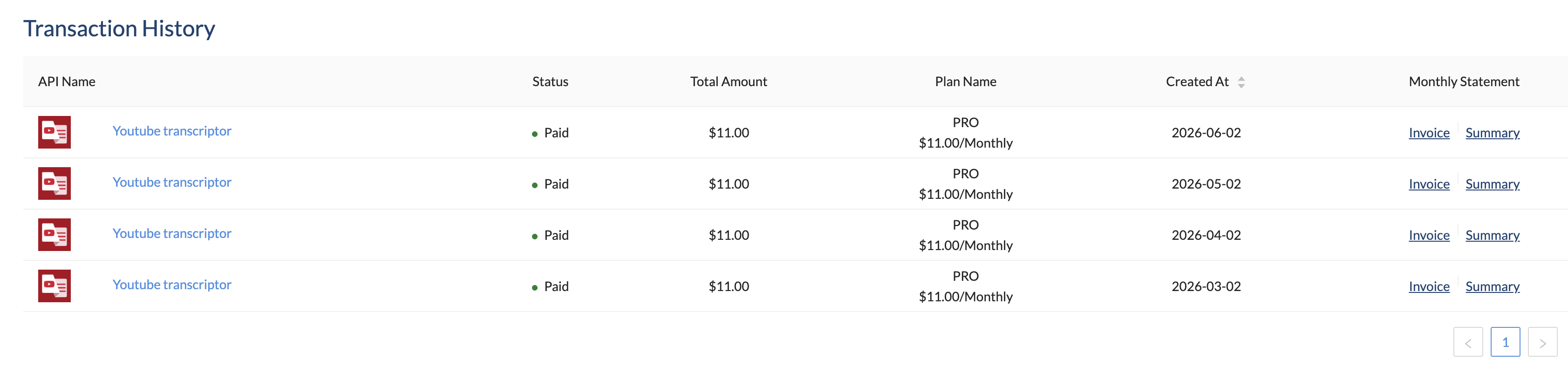
Eleven dollars isn't a lot. But it was one subscription among several, and nothing about it stops on its own. RapidAPI's billing docs even note that you can't remove your card until every subscription on the account is cancelled.
Paying per request doesn't have this problem. There's no plan and nothing to renew, so an API you stop using costs exactly $0 the next month. You can't be billed for something you aren't calling.
One wallet for everything
RapidAPI plans usually come in four tiers (Basic, Pro, Ultra, Mega), each with a monthly fee, a quota, and an overage rate once you pass it. Pick a tier that's too big and you pay for headroom you never use. Pick one that's too small and you either get cut off or pay overages. Multiply that by every API you subscribe to and you're doing quota math across a stack of plans.
There's also a fee most people don't know about. Every plan includes 10 GB of response data a month. Past that, RapidAPI charges $0.001 per MB on top of your plan. That sounds like nothing, but the responses from media-heavy APIs are big. On one Instagram listing, a single reels feed response was 444 KB, which works out to about $0.44 per 1,000 calls in bandwidth alone, on top of whatever the plan charges.
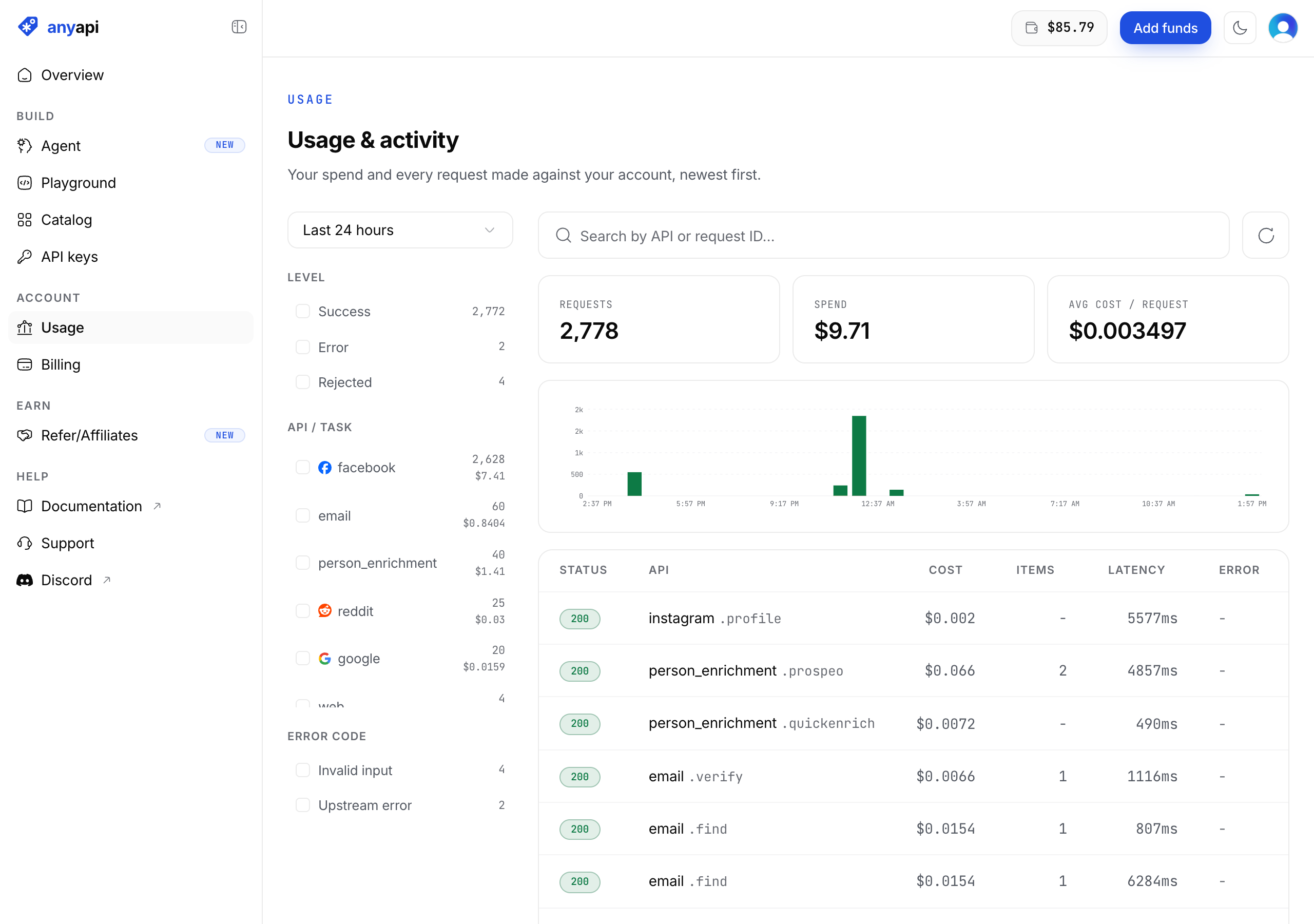
Paying per request is one wallet in dollars. You top it up once and spend it across every source at a price you know before you call. No tiers to size, no overage to watch, no bandwidth fee. AnyAPI's Instagram profile lookup is $0.50 per 1,000 whatever the response weighs, and the endpoint page says so up front.
One response shape across sources
Every API on RapidAPI is published by a different person, so each one returns data in whatever format its author chose. Two YouTube transcript APIs on the marketplace give you two different formats. Pull from six APIs and you've written six parsers, and you own all six the day a publisher changes their output.
Some of what comes back is also wrong in ways you won't notice until later. One popular Instagram listing returned a post count of zero for an account with more than 30,000 posts, and a TikTok listing's search returned an empty list with a normal status code on every query. Nothing on the listing page tells you that, and the success-rate score counts those as successes.
Call AnyAPI and every source comes back in one consistent format. The code that reads one source reads the next, and there's no publisher in the middle deciding the format this week.
If a source breaks, it falls back
APIs on RapidAPI are run by third parties. They get deprecated, they degrade, and sometimes a publisher just disappears. When the one you depend on breaks, you find another listing and integrate it from scratch.
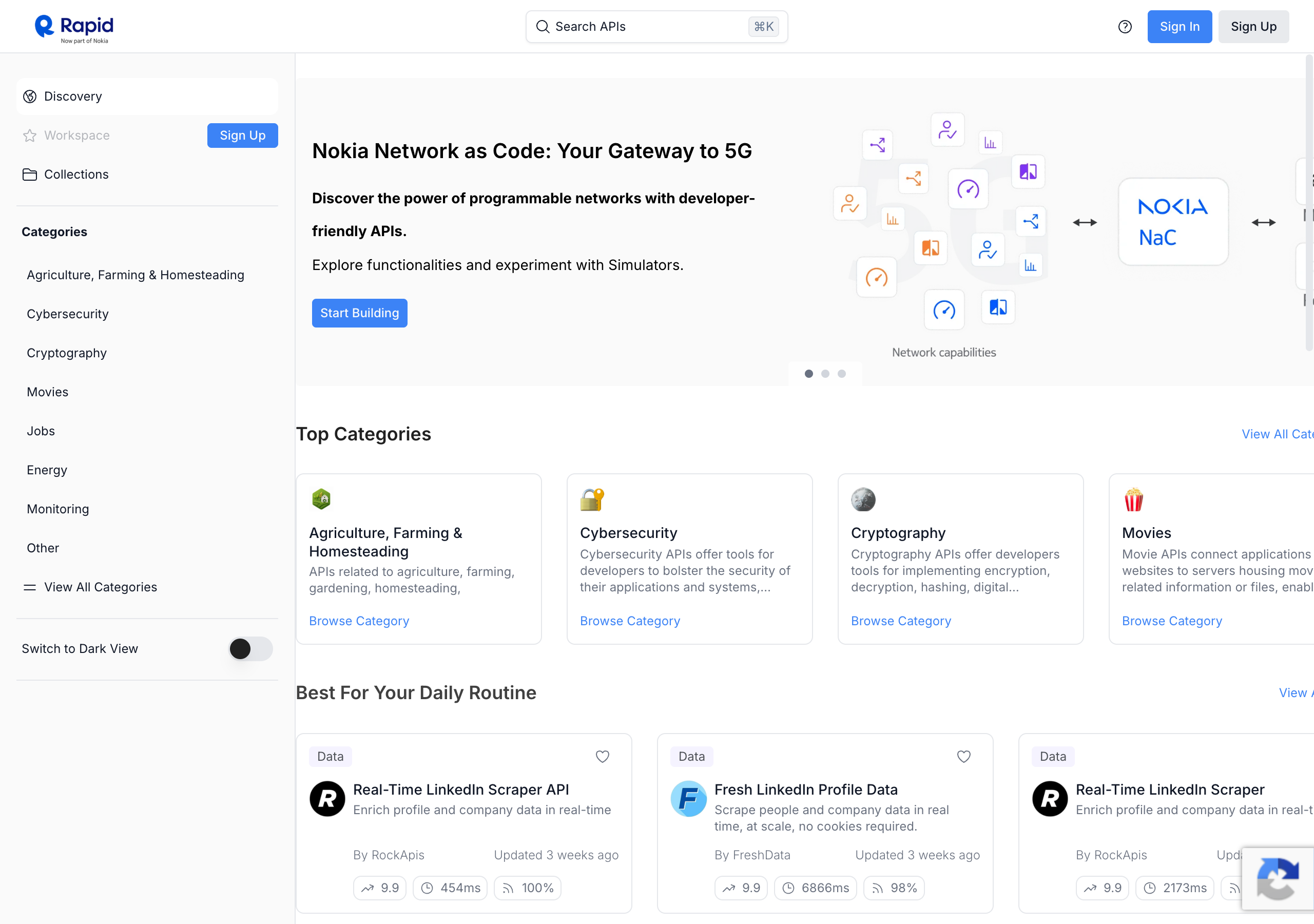
There's a bigger shift happening too. Nokia bought RapidAPI's parent company in late 2024 to build a network-API business. The logo now reads "Now part of Nokia", and the hub's front page leads with Nokia's own products rather than the third-party listings.
One more thing worth knowing as a buyer: the biggest publishers usually sell the same API on their own website, without RapidAPI's 25% cut or the bandwidth fee. The listing name is often the giveaway, because it matches the publisher's own domain. Two of the publishers behind AnyAPI's catalog started out as RapidAPI listings, and both were cheaper direct.
AnyAPI falls back to another provider for the same data without you changing your code. A blocked or failed call also costs nothing, so a bad day for one publisher isn't a line on your bill.
One call, any source
Here's the call, on the same kind of API as the forgotten subscription above. It returned 61 timed transcript segments for $0.00125 on September 5, 2026. That's $1.25 per 1,000 transcripts, and the month you don't call it, it's $0.
curl https://api.getanyapi.com/v1/run/youtube.video_transcript \
  -H "Authorization: Bearer $ANYAPI_KEY" \
-d '{"url": "https://www.youtube.com/watch?v=dQw4w9WgXcQ"}'import os, requests
r = requests.post(
"https://api.getanyapi.com/v1/run/youtube.video_transcript",
headers={"Authorization": f"Bearer {os.environ['ANYAPI_KEY']}"},
json={"url": "https://www.youtube.com/watch?v=dQw4w9WgXcQ"},
)
print(r.json()["costUsd"], len(r.json()["data"]["segments"]))
# 0.00125 61const r = await fetch("https://api.getanyapi.com/v1/run/youtube.video_transcript", {
method: "POST",
headers: { Authorization: `Bearer ${process.env.ANYAPI_KEY}` },
body: JSON.stringify({ url: "https://www.youtube.com/watch?v=dQw4w9WgXcQ" }),
});
const { costUsd, data } = await r.json();
console.log(costUsd, data.segments.length); // 0.00125 61The same call works for anything in the catalog. To switch sources you change the endpoint name and the input. Same key, same parsing, same wallet, and nothing to subscribe to first, so nothing to remember to cancel later.
RapidAPI vs paying per request, at a glance
| What you deal with | RapidAPI | Paying per request |
|---|---|---|
| How you pay | A monthly subscription per API, plus overage | One price per successful call, in USD |
| Bandwidth | 10 GB a month included, then $0.001 per MB | Included in the price |
| Adding a source | Subscribe to another API's plan | Change the endpoint name, same call |
| When you stop using one | Keeps billing until you cancel | Costs $0, nothing to cancel |
| Quotas | Per-API daily or monthly quota | None |
| Response format | A different one per publisher | The same across a source |
| If an API breaks | Find and integrate another listing | Falls back to another provider |
| Billing across many APIs | One invoice, many plans to track | One wallet, one balance |
| Discovery breadth | Tens of thousands of listings | A curated catalog of 363 endpoints |
Limitations and tradeoffs
Pulling data from more than one or two sources? Pay per request. You're tired of tracking a subscription per API, you've been burned by a plan that kept billing after you moved on, or you're maintaining a different parser for every publisher. You want one key, one balance in dollars, and calls that cost nothing the month you don't make them.
Need one specific niche API that only lives on RapidAPI? Subscribe to it there. The breadth is real, and for a single source you use steadily at volume, a good Pro plan can be cheaper per call than paying per request. Plenty of people run both: RapidAPI for the one odd listing, a pay-per-request API for the common sources they pull all the time.
One limit on AnyAPI's side: it covers 363 endpoints across the sources people ask for most, not every category on a marketplace. If you need agriculture data or a cryptography API, RapidAPI has it and AnyAPI doesn't.
If you're wiring this up for an AI agent, paying per call is what lets an agent buy data with no account. If you're weighing a scraping platform rather than a marketplace, see the best Apify alternative, or the best Bright Data alternative if it's enterprise infrastructure you're sizing up.
Frequently asked questions
- How does RapidAPI pricing work in 2026?
- You subscribe to a plan per API. Each API sets its own tiers, usually Basic, Pro, Ultra, and Mega, with a monthly fee, a daily or monthly quota, and an overage rate once you pass it. Every plan also includes 10 GB of response data a month, then charges $0.001 per MB. Subscriptions renew monthly until you cancel. RapidAPI keeps 25% of what the publisher charges.
- How do I cancel a RapidAPI subscription?
- In the RapidAPI dashboard, open the API, go to its pricing or your subscriptions, and unsubscribe or downgrade to the free Basic plan. Each API is separate, so you cancel each one you no longer use. You can't remove your card from the account until every subscription is cancelled.
- Who owns RapidAPI now?
- Nokia acquired RapidAPI's parent company, Rapid, in November 2024. The marketplace still runs under the RapidAPI brand, with 'Now part of Nokia' on the logo, and the hub's front page now promotes Nokia's network APIs alongside the third-party listings.
- Are APIs on RapidAPI reliable?
- It varies. Listings are published by third parties, so quality, uptime, and support differ a lot, and some get deprecated or abandoned. The success-rate score on a listing counts an empty response as a success, so read it as a floor. There's no automatic fallback: if the API you depend on breaks, you find and integrate another one yourself.
- Is it cheaper to buy direct from a RapidAPI publisher?
- Often, yes. The larger publishers sell the same API on their own website without RapidAPI's 25% cut or the bandwidth fee, and the listing name frequently matches their own domain. A pay-per-request provider does that shopping for you and shows one price per call.
Use data responsibly and follow AnyAPI's Acceptable Use Policy.