Best Apify alternative for multi-source API scraping (2026)

If you build and run your own scrapers, Apify is still the best place to do it. If you just want data back from sites other people already scrape, a pay-per-request API costs less and is much easier to budget.
Apify charges a monthly plan, plus usage, plus each scraper's own fee, and any plan credit you don't use is gone at the end of the month. Paying per request is one price per successful call, in dollars, with nothing to prepay.
Prices in this post were checked September 5, 2026.
Built on AnyAPI
403 scraping and data APIs behind one key.
Every endpoint in this post is one call away. Pay per request in USD from a prepaid wallet, with automatic failover when a provider breaks. No subscription, no card to start.
Get ~150 free requests$0.10 of credit on signup.Apify is a platform for running scrapers. Its Store has a ready-made scraper (Apify calls them Actors) for almost any website, you can run them on a schedule and keep the results, and you can write your own when nothing fits. It's a good product. About a hundred of the data sources behind AnyAPI run on Apify Actors, so this comparison comes from paying Apify's bill every month, not from reading its pricing page once.
The thing is, Apify is built for people who run scrapers, and a lot of the people who end up there don't want to run anything. They want a list of TikTok videos or a YouTube transcript back as JSON so they can get on with their actual project. For that job, the plan, the usage fees, and the per-scraper setup are all overhead.
Here's where Apify is the right call, where paying per request wins, and what the bill looks like either way.
Where Apify is strong
Apify earns its place when scraping is part of what you're building, not a chore you want done with.
- There's a scraper for almost anything. The Apify Store lists over 68,000 Actors. If you need an obscure site pulled and someone has already built a working scraper for it, nothing else comes close.
- You can run it on a schedule and keep the results. Scheduled runs, stored datasets, webhooks, monitoring. If scraping is a job you run every day, those are things you'd otherwise have to build.
- You can change how the scraper works. If an Actor is close but not quite right, you fork it or write your own with Crawlee and a headless browser. When the crawl is genuinely custom, that control matters.
- It keeps improving. Apify now takes x402 payments, so an AI agent can run an Actor and pay per run, and its MCP server plugs the Store into Claude and ChatGPT.
If that's you, stay on Apify. The rest of this post is for the other case: you just want the data.
Where AnyAPI wins
If you're not running a scraping operation, most of that platform is setup and upkeep you don't need. Here's what changes when you call one API instead.
No monthly plan, and no credit that expires
Apify's pricing has three parts: a monthly plan, usage fees for the computing time and proxies a scraper burns through, and the scraper's own fee, usually a price per 1,000 results.
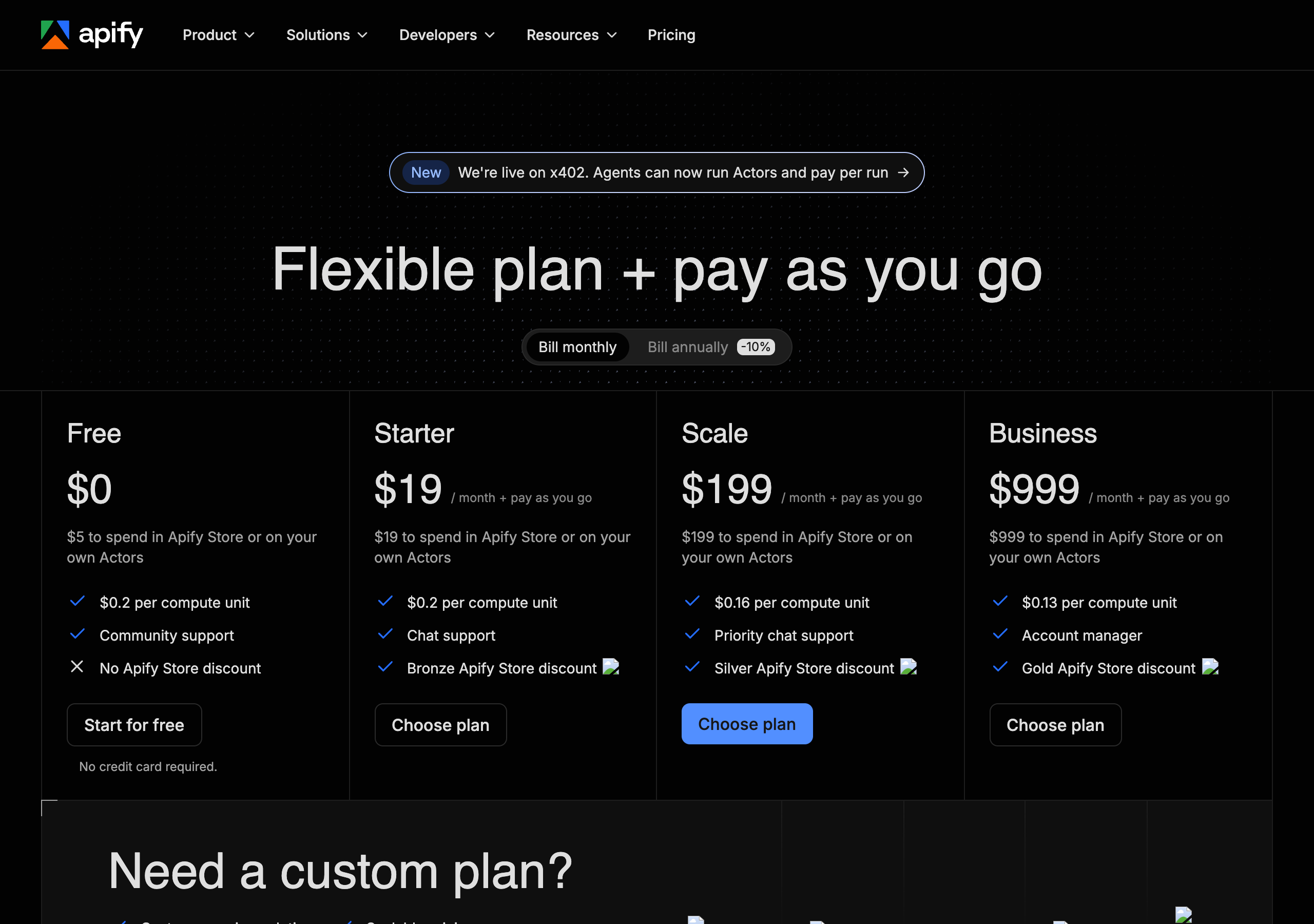
The plan is the part that stings in a quiet month. Starter is $19, Scale is $199, Business is $999, and the plan price is also your prepaid usage. Don't use it and you've lost it. Apify's own pricing page says unused credit doesn't roll over.
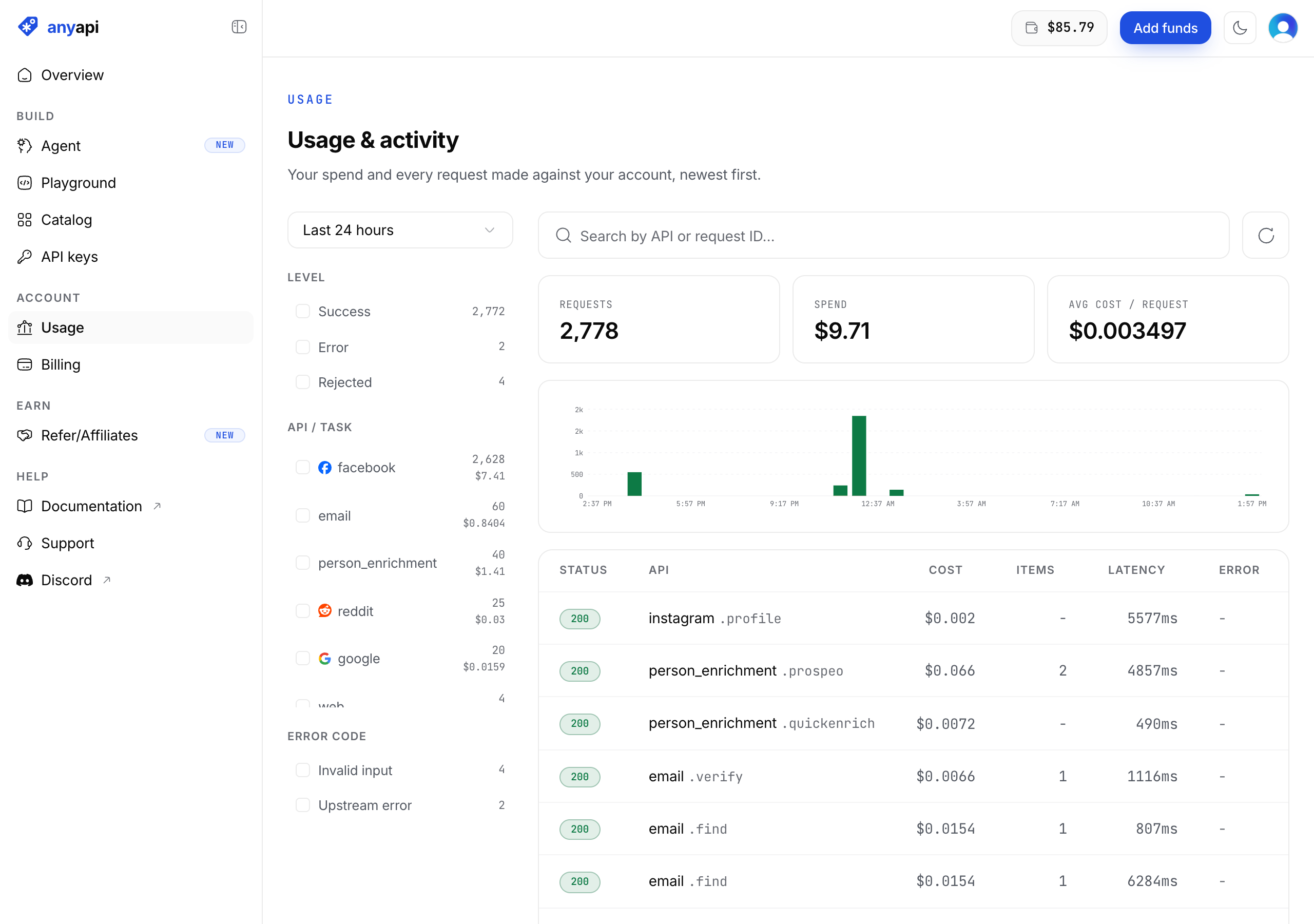
Paying per request has no plan. A month with no calls is $0, and a busy month is just the calls you made at the price shown on each endpoint page. The response tells you what each call cost.
The advertised price is the top-plan price
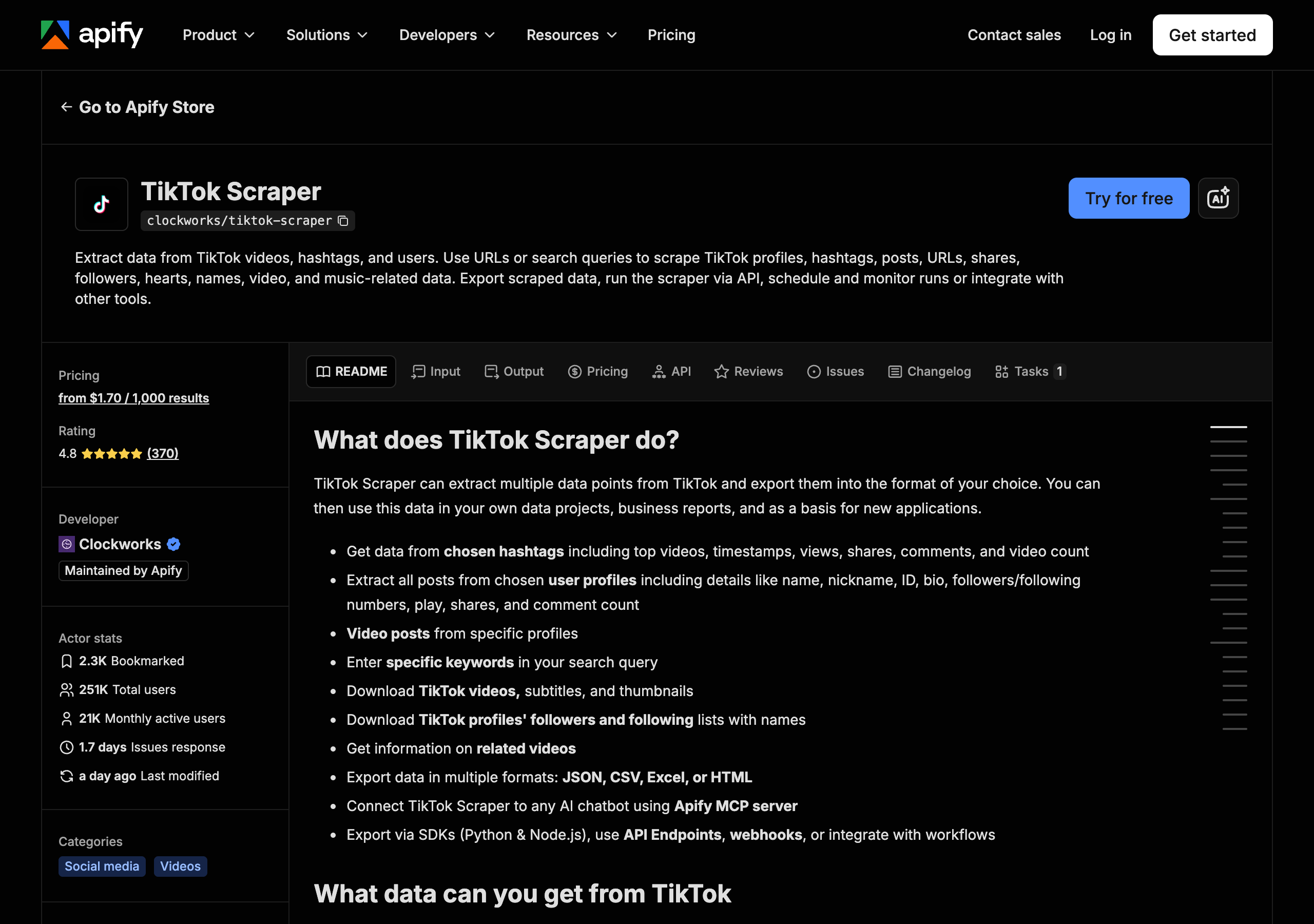
Every Actor in the Store shows a "from $X per 1,000 results" price. That "from" is the rate on Apify's most expensive plan. On the free and Starter plans, the same Actor costs more, and the difference isn't small. One popular Instagram profile scraper was $2.60 per 1,000 on the free plan and $1.60 on the top plan.
For the most common jobs, paying per request comes out well ahead. A YouTube transcript is $1.25 per 1,000 on AnyAPI. The two most-used transcript Actors on the Store charge $5 and $7 per 1,000 results, and the usage fees come on top of that.
That gap shows up across most list-shaped data: TikTok, Instagram, Reddit, X, and Google News all come out several times cheaper per item than the big Actors. It isn't universal. A TikTok profile lookup costs about the same either way, and a page of Google results is cheaper on Apify. It depends on what you're pulling.
You only pay when it works
On Apify, you pay for the computing time a scraper uses whether or not it comes back with data. A run that gets blocked, times out, or hits its spending limit still counts against your usage. Across a hundred Actors that's a steady trickle of charges for runs that returned nothing, and it's the part of the bill that's hardest to predict.
With a pay-per-request API you're charged only for calls that return data. A blocked or failed call is $0. And if the first provider behind an endpoint fails, AnyAPI tries another one for the same data before it gives up, without you changing anything.
One integration across every source
The cost that never shows up on the bill is wiring it all together. Every Actor is built by someone different, so each one has its own inputs and its own output format. Use six Actors and you've written six integrations, and you own all six the day any author changes something.
There's upkeep on top of that. Apify tests every Store Actor daily, and one that fails twice in three days gets marked "under maintenance". When that happens to the one you depend on, you're the one finding a replacement and rewriting your parser.
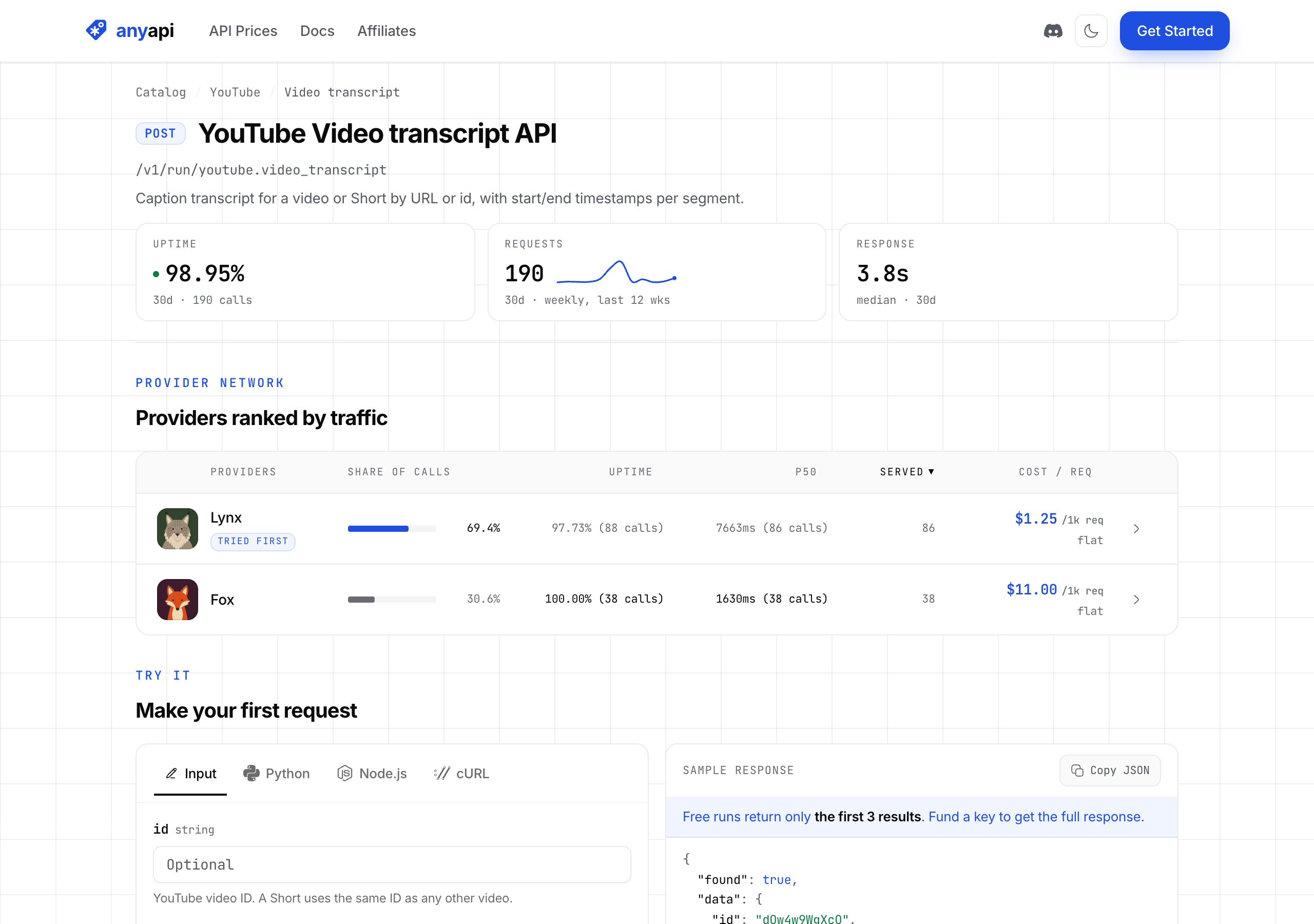
With AnyAPI it's one key, one request format, one bill in dollars, and the same response shape for every source. When a provider behind an endpoint has a bad day, another one picks up.
One call, any source
Here's the call, and what it cost: 61 timed transcript segments for $0.00125, on September 5, 2026.
curl https://api.getanyapi.com/v1/run/youtube.video_transcript \
  -H "Authorization: Bearer $ANYAPI_KEY" \
-d '{"url": "https://www.youtube.com/watch?v=dQw4w9WgXcQ"}'import os, requests
r = requests.post(
"https://api.getanyapi.com/v1/run/youtube.video_transcript",
headers={"Authorization": f"Bearer {os.environ['ANYAPI_KEY']}"},
json={"url": "https://www.youtube.com/watch?v=dQw4w9WgXcQ"},
)
print(r.json()["costUsd"], len(r.json()["data"]["segments"]))
# 0.00125 61const r = await fetch("https://api.getanyapi.com/v1/run/youtube.video_transcript", {
method: "POST",
headers: { Authorization: `Bearer ${process.env.ANYAPI_KEY}` },
body: JSON.stringify({ url: "https://www.youtube.com/watch?v=dQw4w9WgXcQ" }),
});
const { costUsd, data } = await r.json();
console.log(costUsd, data.segments.length); // 0.00125 61The same call works for anything in the catalog. To switch sources you change the endpoint name and the input. Same key, same parsing, same wallet, nothing to rent first.
Apify vs paying per request, at a glance
| What you deal with | Apify | Paying per request |
|---|---|---|
| What you're billed for | Monthly plan + usage + each scraper's fee | One price per successful call, in USD |
| Subscription | $19, $199, or $999 a month, prepaid, credit expires | None |
| The price you see | "From" price, at the top plan's rate | The price you pay, on the endpoint page |
| Adding a new source | Find and set up a new Actor | Change the endpoint name, same call |
| Response format | Different for every Actor | The same for every source |
| When a run fails | Usage is still billed | You aren't charged |
| If a source breaks | You swap Actors and rewrite your integration | Falls back to another provider |
| Run your own scraper code | Yes | No, it's a managed catalog |
| A month you scrape nothing | Your plan price | $0 |
Limitations and tradeoffs
Just want the data? Pay per request. You're tired of paying for a plan in months you barely use it, the usage bill is hard to predict, or you're maintaining a different parser for every Actor. You want one key, one bill in dollars, and a call that returns data without renting anything first.
Building or running the scrapers yourself? Stay on Apify. You need a niche Store Actor, a custom crawl, scheduled jobs, or your own code. Plenty of people run both, and AnyAPI is one of them: the Store is still the first place to look when a new source comes up.
Two limits on AnyAPI's side. It covers 363 endpoints, not 68,000, so if your source is obscure the Actor may be the only option. And list endpoints are priced per page, so for a source where you want one item at a time, Apify's per-result price can come out close.
If you're wiring this up for an AI agent, paying per call is what lets an agent buy data with no account. If it's a marketplace of per-API subscriptions you're weighing, see the best RapidAPI alternative, and for enterprise proxy infrastructure there's the best Bright Data alternative. For the whole field priced on one job, see 7 Apify alternatives on real per-request cost.
Frequently asked questions
- How much does Apify cost in 2026?
- Apify's Free plan includes $5 of monthly usage. Paid plans are Starter at $19 a month, Scale at $199, and Business at $999, and each plan's price is also its prepaid usage. Computing time and proxies are billed on top at rates that drop on the bigger plans, and each Actor charges its own fee. Unused prepaid credit expires at the end of the billing cycle. Checked September 5, 2026.
- Why does an Apify Actor cost more than its 'from' price?
- The 'from $X per 1,000 results' badge is the rate on Apify's top plan. Lower plans pay a higher rate for the same Actor. On one Instagram profile Actor the free-plan price was $2.60 per 1,000 and the top-plan price was $1.60. Apify also keeps 20% of every Actor's fee.
- Does Apify charge for failed runs?
- Yes. Computing time and proxy usage are billed whether or not the run produced data, so a run that gets blocked, times out, or hits its spending limit still costs you. A pay-per-request API charges only when a call returns data.
- What does 'under maintenance' mean on an Apify Actor?
- Apify tests each Store Actor daily. An Actor that fails at least twice in the last three days is automatically marked under maintenance. It usually means the target site changed and the Actor's author hasn't caught up yet.
- Is paying per request cheaper than Apify?
- Usually, for common sources. A YouTube transcript is $1.25 per 1,000 on AnyAPI against $5 to $7 per 1,000 results on the biggest Store Actors. It's not universal: a TikTok profile lookup costs about the same either way, and a Google search page is cheaper on Apify. It's always easier to budget, because there's one price per successful call and no plan.
Use data responsibly and follow AnyAPI's Acceptable Use Policy.