Best Twitter API alternative for reading X posts (2026)

- If your app posts, replies, sends DMs, or acts for a signed-in user, stay on X's own API. It's the one way to do that through the user's own X sign-in, and your own account's data costs $0.001 a resource there.
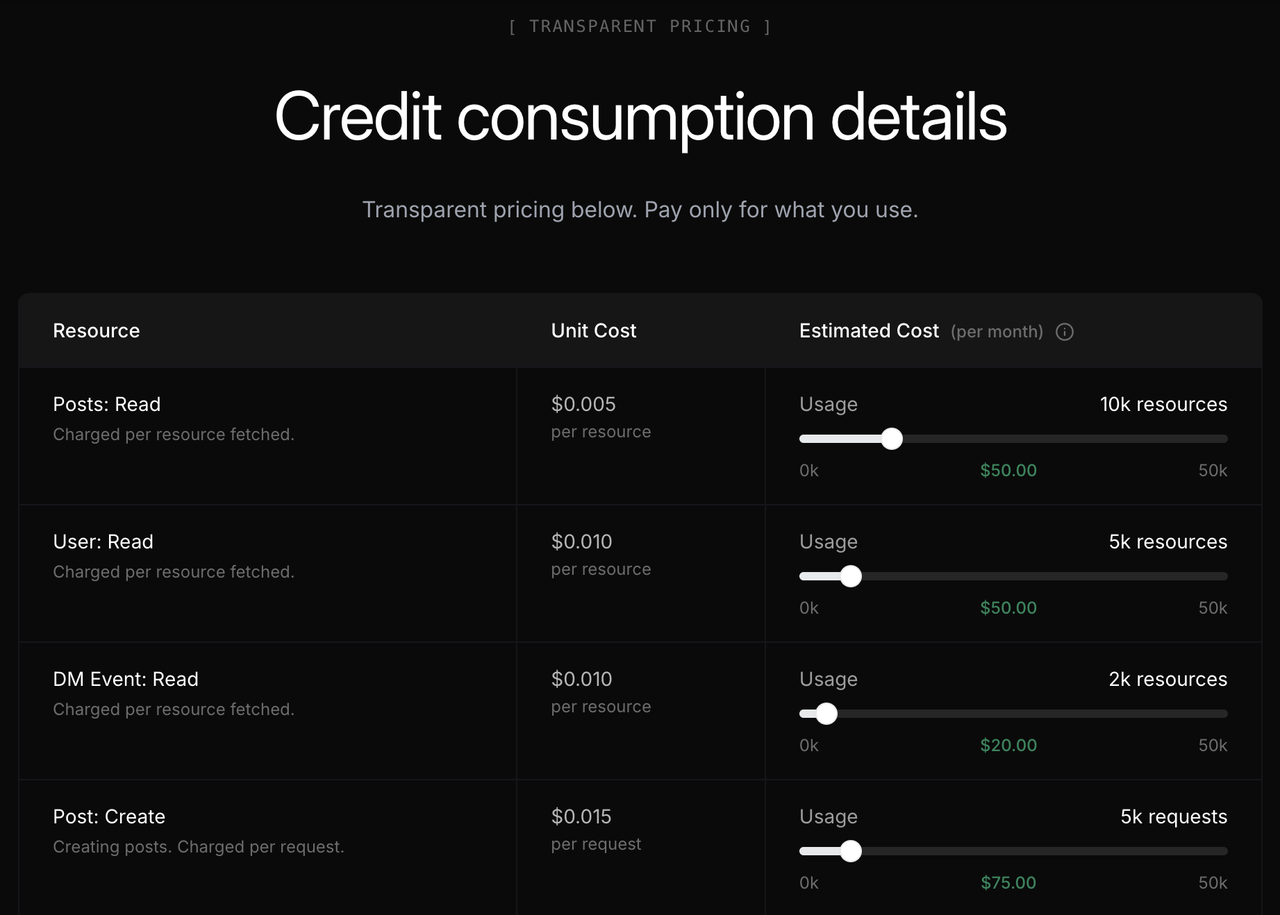
- If you only read public posts, profiles, and search results, X is the dearest option by a wide margin. It charges $0.005 for every post it returns and $0.010 for every profile, so 1,000 posts cost $5.00.
- The same 70 calls on October 2, 2026, 20 profiles, 20 timelines, 20 searches, and 10 single posts, came to $0.028 on AnyAPI. The 799 posts and 20 profiles they returned would cost $4.20 at X's list prices.
- Among hosted read APIs, the cheapest per post are AnyAPI and GetXAPI; twitterapi.io and SocialData are cheaper than AnyAPI per profile.
Built on AnyAPI
448 scraping and data APIs behind one key.
Every endpoint in this post is one call away. Pay per request in USD from a prepaid wallet, with automatic failover when a provider breaks. No subscription, no card to start.
Get ~160 free requests$0.10 of credit on signup.Your brand monitor searches X every ten minutes. Each search brings back 100 posts, and X bills each of those posts at half a cent. By the end of the month the data bill is bigger than the server bill, and none of it touched posting or a user's account.
X's API went fully pay-per-use: you buy credits in its Developer Console and every post, profile, or DM it returns draws on them. That's a fair deal when you're acting for a user. When you only read what anyone can see on x.com, hosted read APIs return the same public posts as JSON for a small fraction of the price.
Here's where X's API is the right call, what reading costs there against paying per request, a 70-call test with every charge logged, and five more X data APIs priced from their own pages.
Where is the X API strong?
If your product does something on X for its users, the official API is the right choice. Most hosted alternatives below only read what's public.
- Acting for a signed-in user. X's OAuth flow lets a user connect their account, and your app can then post, reply, like, follow, and send DMs for them. X charges $0.015 to create a post and $0.200 for a post with a link.
- Your own data is cheap. X calls these Owned Reads: your app reading its owner's posts, mentions, likes, bookmarks, followers, lists, mutes, and blocks, at $0.001 a resource. Bookmarks, DMs, and block lists aren't public, so no read API can get them.
- Real-time delivery. The filtered stream pushes matching posts to you as they're published, with up to 1,000 rules on pay-per-use. The X Activity API sends webhooks for follows, DMs, and profile changes. A read API makes you poll.
- The whole archive. Full-archive search goes back to March 2006 and returns up to 500 posts a request. Recent search covers the last seven days.
- It's X's own contract. If a compliance review or an enterprise customer asks where your X data comes from, "X's API, under X's developer terms" is the simplest answer you can give.
X's pricing has some customer-friendly parts too. The same post fetched twice in one UTC day is billed once, and from $200 of spend a cycle you get 10% to 20% back as credits for xAI's API.
X API cons:
- $5.00 per 1,000 posts read and $10.00 per 1,000 profiles
- No free tier: reads draw on credits you buy upfront
- Pay-per-use stops at 3 million post reads a month; past that is Enterprise
If your app writes to X, reads its owner's private data, or needs posts pushed in real time, use X's API and skip the rest of this page. If it reads public posts and profiles, keep going.
X API pricing: Pay per use from prepaid credits; posts $0.005 per resource read, users $0.010, Owned Reads $0.001; posting $0.015 a request; capped at 3 million post reads a month
Where does paying per request win?
Most apps that hit X's bill aren't posting anything. They're monitoring a brand, tracking competitors' accounts, enriching leads with follower counts, or feeding an agent the latest posts on a topic. All of that is public data, and it's where the price gap lives.
What does reading cost on X?
X bills reads per resource returned, not per request. A recent-search call that returns 100 posts is 100 post reads, $0.50. A profile lookup is one user read, $0.01.
At those prices, here's what common read jobs cost a month:
| Monthly job | X API | AnyAPI, paying per request |
|---|---|---|
| 1,000 profile lookups | $10.00 | $0.22 |
| 100,000 posts from search, 20 a call | $500.00 | $3.00 |
| 100,000 posts from account timelines, 20 a call | $500.00 | $2.25 |
| 3 million posts, X's monthly ceiling | $15,000.00 | $90.00 |
X's two discounts don't change that picture much. The same-day dedupe only helps if you re-read the same posts, and the xAI credit back is paid as xAI API credit rather than off your X bill.
What did 70 real calls cost?
On October 2, 2026, 70 calls went through AnyAPI's four X endpoints: a profile and a timeline page for each of 20 accounts, from NASA and the New York Times to paulg and Duolingo; 20 searches from "claude code" to "mortgage rates"; and 10 single-post lookups. Every call was logged with what it was charged.
| Endpoint | Calls | Came back | What returned | AnyAPI charged | Same data at X's prices |
|---|---|---|---|---|---|
| Profile | 20 | 20 | 20 profiles | $0.0044 | $0.20 |
| An account's posts | 20 | 20 | 400 posts, newest first | $0.009 | $2.00 |
| Search | 20 | 20 | 400 posts | $0.012 | $2.00 |
| Single post | 10 | 10 | 10 posts | $0.0022 | $0.05 |
| All 70 | 70 | 70 | 799 unique posts, 20 profiles | $0.028 | $4.20, each post counted once |
The X column counts each unique post once, the way X's same-day dedupe would, which is why it's $4.20 and not the $4.25 the rows add up to. For this test's data, X's list price is about 150 times what AnyAPI charged.
The median call took 1.6 seconds. Every search came back with a full page of 20 posts, each with the author's handle, follower count, likes, reposts, replies, views, and media links in the same object.
What does one call look like?
Here are NASA's latest posts, the first page of 20, for $0.00045 on October 2, 2026.
curl https://api.getanyapi.com/v1/run/twitter.user_tweets \
  -H "Authorization: Bearer $ANYAPI_KEY" \
-d '{"handle": "nasa"}'import os, requests
r = requests.post(
"https://api.getanyapi.com/v1/run/twitter.user_tweets",
headers={"Authorization": f"Bearer {os.environ['ANYAPI_KEY']}"},
json={"handle": "nasa"},
)
body = r.json()
tweets = body["output"]["data"]["tweets"]
print(body["costUsd"], len(tweets), tweets[0]["likes"])
# 0.00045 20 5508const r = await fetch("https://api.getanyapi.com/v1/run/twitter.user_tweets", {
method: "POST",
headers: { Authorization: `Bearer ${process.env.ANYAPI_KEY}` },
body: JSON.stringify({ handle: "nasa" }),
});
const { costUsd, output } = await r.json();
console.log(costUsd, output.data.tweets.length, output.data.tweets[0].likes); // 0.00045 20 5508The response carries a nextCursor; pass it back as cursor for the next 20. Search takes X's advanced-search syntax inline, so from:, since:, until:, and min_faves: work the way they do on x.com.
What if the cheapest source fails?
Each AnyAPI endpoint has more than one source behind it. Your call goes to the cheapest first, and if that one errors, the next source answers in the same request. A failed call costs nothing.
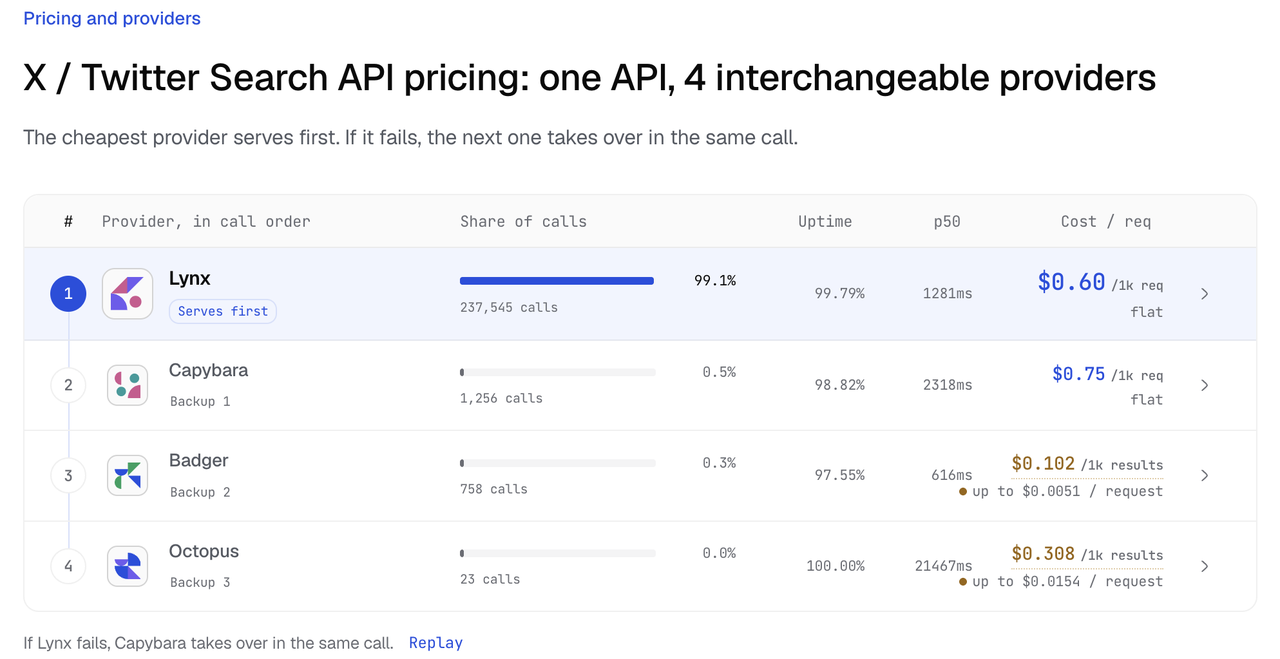
The rescue costs more. A search rescued by the dearest source is up to $0.0154, against $0.0006 normally, and a timeline page up to $0.0101. Even that ceiling is under X's price for the 20 posts a page returns, $0.10. All 70 test calls went to the first source.
What else is on the same key?
X is one platform among many on AnyAPI. The key that searches X also pulls Instagram, TikTok, Reddit, YouTube, LinkedIn, and Google results, each in its own fixed JSON shape, from one wallet in USD. If your monitor watches more than X, that's one bill instead of one per platform.
Other X API alternatives worth a look
A handful of services sell public X data as an API. They differ less in what they return than in how they charge and what you have to buy first. Prices are from each vendor's own page on October 2, 2026, rechecked on October 20.
| Service | How you pay | Per 1,000 posts | Per 1,000 profiles | Free to try |
|---|---|---|---|---|
| GetXAPI | $0.001 a call, top-ups from $10, or plans from $15 a month | $0.05 at about 20 a call | $1.00 | $0.10 of credit, no card |
| twitterapi.io | Per item returned, top up any time | $0.15 | $0.18, or $0.01 in batches of 100+ | Not shown |
| SocialData | Per item returned, prepaid balance | $0.20 | $0.20 | No card to sign up |
| Apify Tweet Scraper V2 | Per tweet, on an Apify account | $0.40, 50 a query minimum | Not sold separately | 5 runs a month of 10 items |
| ScrapeCreators | Credit packs, 1 credit a call | Depends on posts per call | $1.88 on the $47 pack | 100 credits |
| AnyAPI | Per call, prepaid wallet | $0.03 (search), $0.0225 (timelines) | $0.22 | A small starting balance |
| X API | Per resource, prepaid credits | $5.00 | $10.00 | None |
GetXAPI
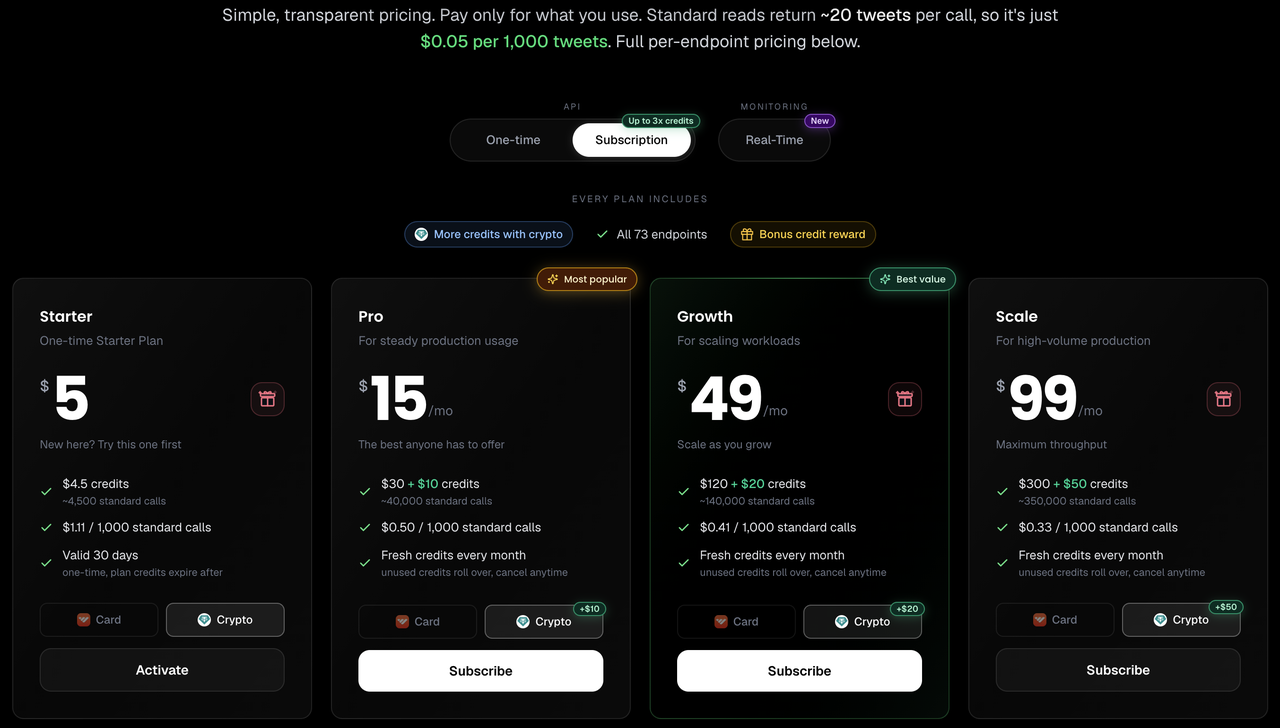
If you want the cheapest X-only API with no monthly commitment, GetXAPI is built around exactly that pitch. A standard read is $0.001 and returns about 20 posts, so $0.05 per 1,000 posts. GetXAPI's posting and DM endpoints cost $0.002 each, and it has a webhook monitor for new posts from accounts you pick, from $19 a month.
Its monthly plans buy more credit than they cost: on the $99 Scale plan a standard call works out to $0.33 per 1,000, under AnyAPI's per-call price for search or timelines, as long as you use the credits. A profile is a full call, so 1,000 profiles are $1.00 at the top-up rate.
GetXAPI pricing: $0.10 free credit with no card; $0.001 a standard call from top-ups of $10 or more that don't expire; Pro $15 a month, Growth $49, Scale $99 ($0.50 to $0.33 per 1,000 calls); card or crypto
Verdict: the pick for X-only reading at volume, on a plan you'll fill every month.
twitterapi.io
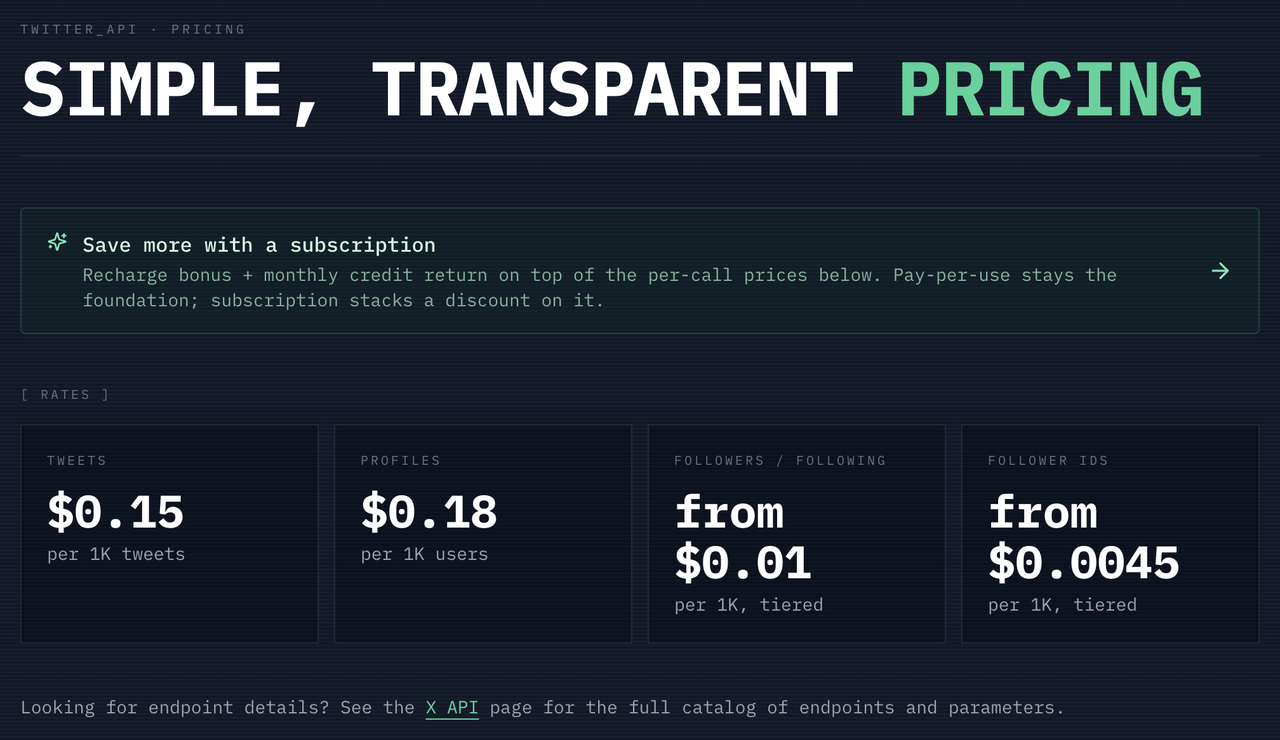
If your job is mostly profiles and follower lists, look at twitterapi.io. It charges per item returned: $0.15 per 1,000 posts, $0.18 per 1,000 profiles looked up in batches under 100 or $0.01 per 1,000 in batches of 100 or more, and follower lists from $0.01 per 1,000 when you take 200 a page.
Even the small-batch profile price is a little under AnyAPI's $0.22, and the bulk price is far under it. Posts cost more: a page of 20 is $0.003, against $0.0006 for an AnyAPI search page. Every call costs at least $0.00015, so a lookup that finds nothing still costs something.
twitterapi.io pricing: Pay as you go, no minimum spend; $0.15 per 1,000 tweets, $0.18 per 1,000 profiles or $0.01 in batches of 100+; $0.00015 minimum per call; recharged credits never expire
Verdict: the cheapest profiles and follower graphs here, if X is all you need.
SocialData
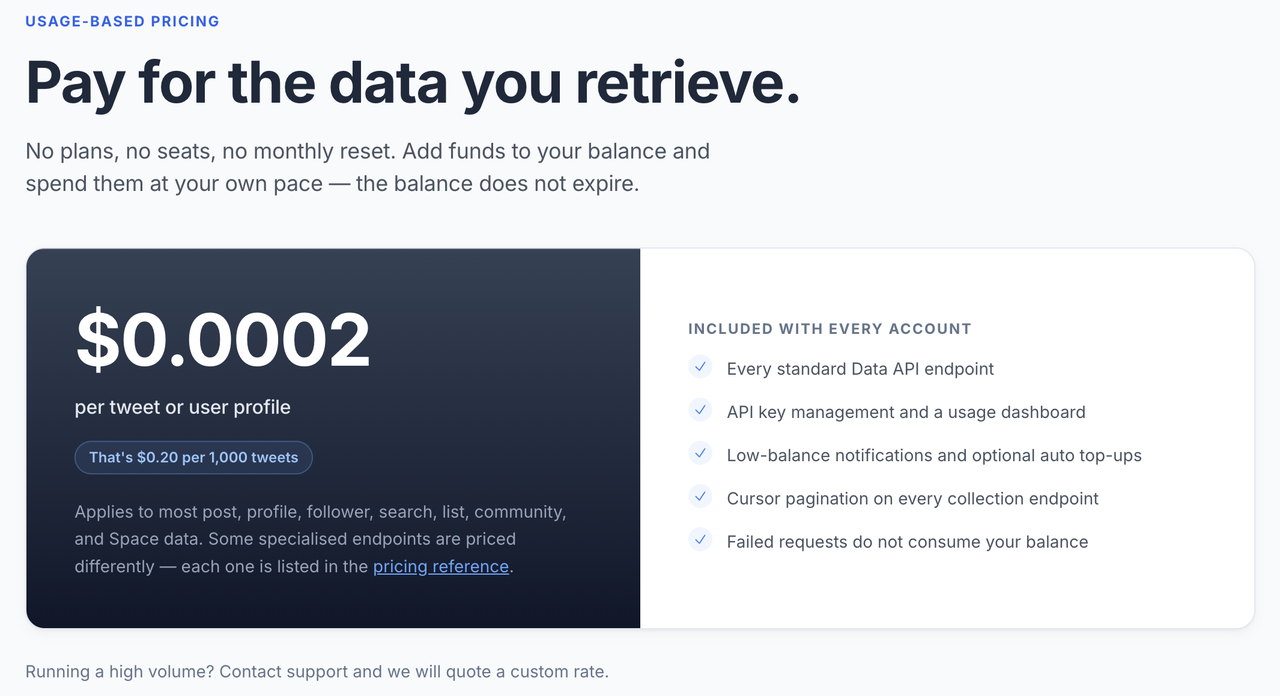
If you want one number to budget with, SocialData has it: $0.0002 per post or profile, $0.20 per 1,000, across most of its endpoints. The balance never expires, failed requests are free, and signup needs no card.
It's read-only by design and also ships an MCP server, so Claude, Cursor, or Codex can query X through it. Per post it's several times AnyAPI's price; per profile it's slightly under.
SocialData pricing: $0.20 per 1,000 posts or profiles from a prepaid balance that never expires; a few specialized endpoints cost more; no card to sign up
Verdict: the simplest pricing here, and a good fit if your agent already speaks MCP.
Apify Tweet Scraper V2
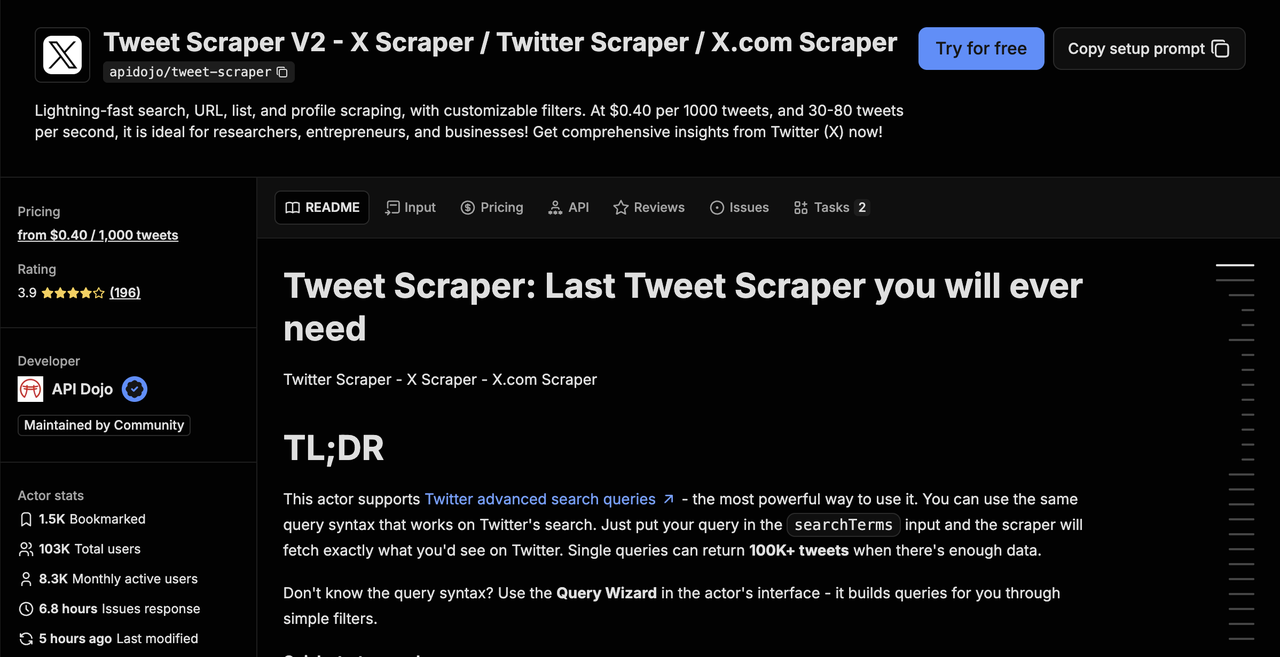
If you're pulling large historical sets, say every post matching a query over a year, Apify's Tweet Scraper V2, with more than 110,000 users, is built for it. It takes X's advanced-search syntax, runs as a batch job, and the actor's page claims single queries can return 100,000 posts or more.
It's $0.40 per 1,000 posts, and each query must return at least 50. Single-post lookups and reply threads aren't allowed, and free Apify accounts get five runs a month of 10 items each. For small, frequent lookups, a request API fits better.
Apify Tweet Scraper V2 pricing: $0.40 per 1,000 tweets on an Apify account; at least 50 tweets a query; free plan limited to 5 runs a month of 10 items
Verdict: the pick for big one-off pulls; the wrong shape for live lookups.
ScrapeCreators
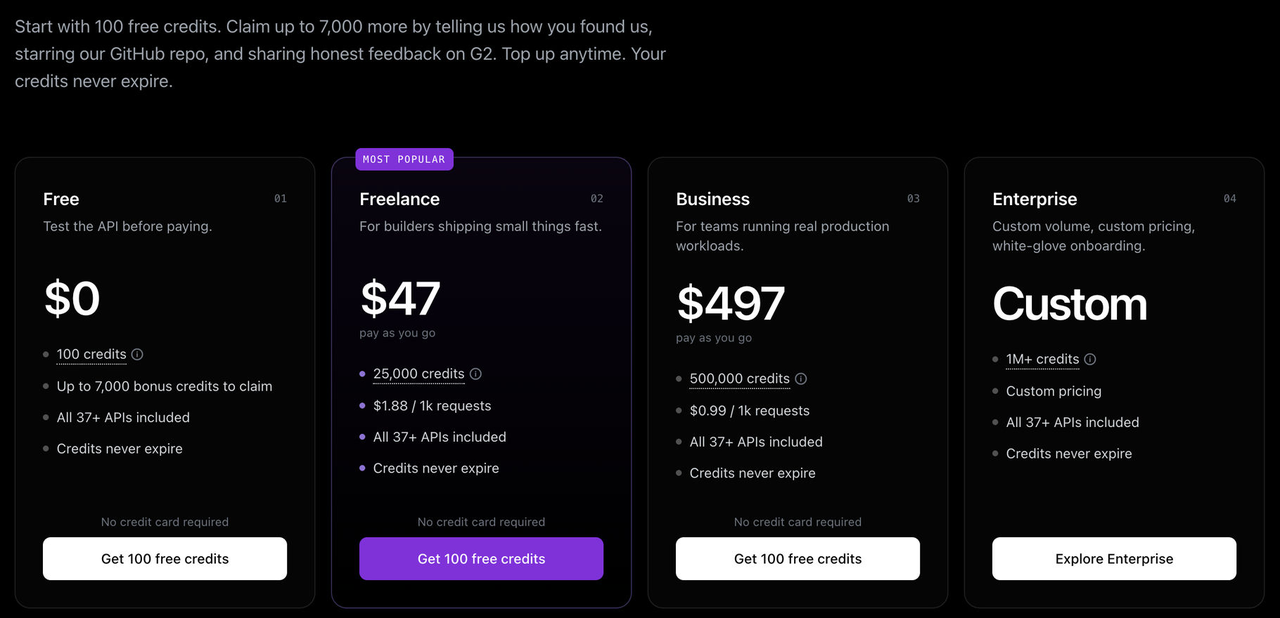
If you already pull TikTok or Instagram through ScrapeCreators, its X endpoints are on the same credits: profiles, an account's posts, single posts, video transcripts, and communities, one credit a call, with credits that never expire.
Its own docs say the account-posts endpoint returns about 100 of an account's most popular posts, not the latest ones. For monitoring what an account posted today, that matters.
ScrapeCreators pricing: 100 free credits; $47 for 25,000 credits ($1.88 per 1,000 calls); $497 for 500,000 ($0.99); credits never expire
Verdict: worth it when X is one platform among several you already buy there.
The short version:
- Posting, DMs, or a user's private data: X's API
- The cheapest public posts per call, no plan: AnyAPI, or GetXAPI on a plan you'll fill
- Profiles and follower graphs at the lowest unit price: twitterapi.io or SocialData
- One-off historical pulls of thousands of posts: Apify
- X next to other platforms on one key: AnyAPI, or ScrapeCreators if you're on its credits already
X API vs paying per request, at a glance
| What you deal with | X API | Paying per request on AnyAPI |
|---|---|---|
| What you're billed for | Every post, profile, or DM returned | Each call, a page of up to about 20 posts |
| 1,000 posts | $5.00 | $0.03 via search |
| 1,000 profiles | $10.00 | $0.22 |
| Posting, replies, DMs | Yes, from $0.015 a post | No |
| Your own bookmarks, mutes, blocks, DMs | Yes, $0.001 a resource | No |
| Posts pushed in real time | Filtered stream, 1,000 rules | No; you poll search |
| Free to start | No | A small starting balance |
| Other platforms on the same key | No | Instagram, TikTok, Reddit, YouTube, LinkedIn, Google |
Limitations and what you give up
Writing to X or reading a user's private data? Use X's API. A read API doesn't see bookmarks, DMs, or block lists, and if your use needs X's own permission on paper, only X's API gives you that.
Reading public posts and profiles? Pay per request. The 70-call test cost under three cents, and a month of brand monitoring that would run hundreds of dollars on X costs a few dollars.
AnyAPI cons:
- Read-only: no posting, DMs, or user sign-in
- No streaming; to watch for new posts you poll search on a schedule
- A call the cheapest source can't answer is billed at a dearer source's price, up to $15.40 per 1,000 searches
- Per profile, SocialData charges slightly less, and twitterapi.io far less in batches of 100 or more
AnyAPI pricing: Pay per request from a prepaid wallet; X search $0.60, an account's posts $0.45, profile $0.22, single post $0.22 per 1,000 calls; a small starting balance at signup
If X is one of several social platforms you read, the best ScrapeCreators alternative and the best TikHub alternative compare the multi-platform options on the same accounts. For what the other official social APIs charge, see social media API pricing in 2026.
Frequently asked questions
- What happened to the X API Basic and Pro plans?
- X replaced them with pay-per-use pricing. Its developer site contrasts the new model with the old one's fixed monthly fees of $200 or $5,000, tier-dependent rate limits, and monthly caps on objects. Checked October 2, 2026.
- What are the X API's rate limits?
- They're set per endpoint, in 15-minute windows. Recent search allows 450 requests per 15 minutes per app, an account's posts by username 1,500, and full-archive search one request a second up to 300 per 15 minutes. Recent search returns up to 100 posts a request and full-archive search up to 500.
- How do I stop an X API bill from running away?
- Set a spending limit in the Developer Console; once it's reached, requests are blocked until the next billing cycle. Auto-recharge, if you turn it on, tops up at most once every five minutes and pauses when the balance is zero or negative, so a burst can still hit 'out of credits' errors.
- Do hosted X data APIs need an X developer account?
- No. SocialData and GetXAPI both say you don't need an X developer account or app, and AnyAPI's X endpoints use its own API key. You sign up with the vendor, get a key, and call it. X's own API needs a Developer Console account and an app with credentials.
Use data responsibly and follow AnyAPI's Acceptable Use Policy.