The cheapest SERP API in 2026, priced at 10k, 100k, and 1M searches


Under 5,000 searches a month, Bright Data is free. From there to about 180,000 a month, AnyAPI has the lowest bill at $0.50 per 1,000 as billed, but it was the slowest API in this test by a wide margin, so if you need the answer while someone waits, pay Serper $1.00. Batch jobs should use DataForSEO's $0.60 queue, which answered in twelve seconds, not the 45 minutes its own footnote allows. Past 180,000 a month, Scrapingdog's $90 plan is the cheapest if you use all of it.
Built on AnyAPI
368 scraping and data APIs behind one key.
Every endpoint in this post is one call away. Pay per request in USD from a prepaid wallet, with automatic failover when a provider breaks. No subscription, no card to start.
Get ~150 free requests$0.10 of credit on signup.A SERP API sends a query to Google for you and hands back the results as JSON. Every vendor on this page does that same job, and the prices for it run from $0.40 to $25 per 1,000 searches, which is a 60x spread for a first page of ten links.
I priced seven of them at 10,000, 100,000, and 1,000,000 searches a month, then sent the same 20 searches through the five that would give me a key. Two things came out of that which the pricing pages don't say: the cheapest option was also the slowest, and the "queue" that everyone assumes means waiting came back in seconds.
Here's the short version. The cheapest SERP API depends on your volume and on whether a person is waiting for the result. Below 180,000 searches a month it's AnyAPI on price and Serper on speed. Above that it's Scrapingdog, on a plan.
The cheapest SERP APIs
- Bright Data for under 5,000 searches a month
- AnyAPI for the lowest bill when nobody is waiting
- Serper for cheap and fast
- DataForSEO for batch jobs
- Scrapingdog for over 180,000 searches a month
- SearchApi.io for the richest result fields
- SerpApi for multi-engine coverage
What makes a SERP API cheap?
You have a list of queries and a program that needs Google's first page for each one. You want the smallest bill for that, and you don't want to find out about the surcharges after the first invoice. Here's what I graded on.
- The bill at your volume, not the headline rate. Minimums, plan tiers, and credit packs mean the price per 1,000 changes with how many you buy. Every option is priced at 10,000, 100,000, and 1,000,000 searches a month.
- What a search actually costs in the vendor's unit. Two vendors sell credits, and a Google search costs more than one credit on both.
- Whether the cheap tier is the real-time tier. One vendor's headline price is a queue. I measured how long the queue took.
- What comes back. Organic results with position, title, link, and snippet at minimum, as JSON. Extra fields are worth something, but only if you'll read them.
I didn't grade uptime, accuracy, or engines other than Google. Speed comes from 20 identical US English searches per vendor, sent one after another from one laptop, so it's a smell test.
The cheapest SERP APIs at a glance
Monthly bill for Google web searches, using the cheapest published self-serve way to buy each volume. AnyAPI is priced at the $0.50 per 1,000 it actually billed in this test rather than the $0.40 its catalog lists; the section below explains why.
| API | Best for | 10,000 a month | 100,000 a month | 1,000,000 a month |
|---|---|---|---|---|
| Bright Data | Under 5,000 a month | $7.50 | $142.50 | $1,305.00 |
| AnyAPI | Lowest bill, nobody waiting | $5.00 | $50.00 | $500.00 |
| Serper | Cheap and fast | $10.00 | $75.00 | $750.00 |
| DataForSEO (queue) | Batch jobs | $6.00 | $60.00 | $600.00 |
| DataForSEO (live) | Batch jobs | $20.00 | $200.00 | $2,000.00 |
| Scrapingdog | Over 180,000 a month | $40.00 | $90.00 | $350.00 |
| SearchApi.io | Richest result fields | $40.00 | $250.00 | $1,500.00 |
| SerpApi | Multi-engine coverage | $150.00 | $725.00 | $3,750.00 |
Then the same 20 searches through each API that gave me a key, on September 15, 2026.
| API | Calls | Came back with results | Median time | Organic results per call | Fields on a result |
|---|---|---|---|---|---|
| Serper | 20 | 20 | 0.9 s | 8.9 | position, title, link, snippet, date, sitelinks |
| SearchApi.io | 20 | 20 | 3.9 s | 8.6 | Serper's set plus domain, favicon, source, highlighted words |
| Bright Data | 20 | 16 | 4.5 s | 8.6 | rank, title, link, description, source, extensions |
| DataForSEO (live) | 20 | 20 | 8.6 s | 8.6 | rank, title, url, description, domain, breadcrumb |
| AnyAPI | 40 | 40 | 19.9 s | 9.0 | position, title, link, snippet |
Fewer than ten results is normal now. Google's first page carries an AI overview, a "people also ask" block, and a video row, and the organic list is what's left. All five APIs returned fewer than ten organic results on most calls.
Bright Data (best for under 5,000 searches a month)
Bright Data pros:
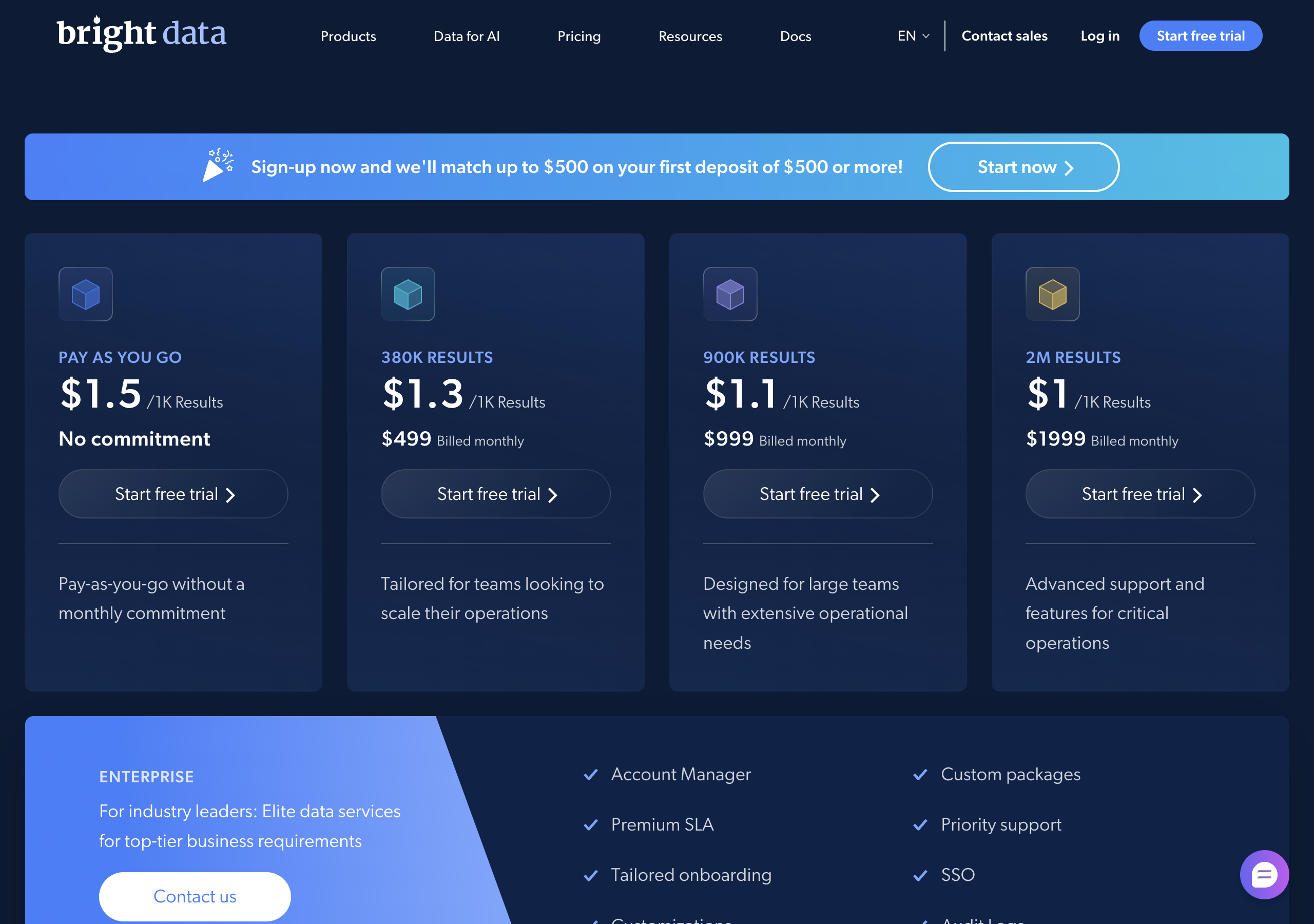
- The first 5,000 requests every month are free, with no card and no expiry
- $1.50 per 1,000 after that with no plan and no minimum
- You're billed only when a request succeeds
Bright Data cons:
- Four of my 20 searches came back as something other than the JSON I asked for
- Above 100,000 a month it's the second most expensive option here
If you run a few thousand searches a month, Bright Data is free and you can stop reading. Five thousand a month is 160 searches a day, and there's nothing to size or renew. Past that the rate is $1.50 per 1,000, which is fair but three times AnyAPI's and half again Serper's.
Check what comes back before you write the parser. I asked for JSON on every call, and four of 20 responses weren't parseable as JSON. Sixteen were clean, with rank, title, link, description, and Google's own extensions on each organic result. That could be my zone's configuration, so test yours.
Bright Data pricing: 5,000 requests a month free, then $1.50 per 1,000 pay as you go. The $499 Scale plan includes 380,000 and charges $1.30 per 1,000 above that.
AnyAPI (best for the lowest bill when nobody is waiting)
AnyAPI pros:
- The lowest bill from 5,000 to about 180,000 searches a month, at $0.50 per 1,000 as billed
- No plan, no minimum, no expiring credits; you put money in a wallet and each search takes a fraction of a cent out
- Every result is the same four fields: position, title, link, snippet
AnyAPI cons:
- The slowest API in this test: a median of 19.9 seconds and a worst call of 32.8
- The catalog lists $0.40 per 1,000, but 27 of my 40 calls were billed $0.50
- The result carries no date, sitelinks, or domain
The cheapest per-search price on this page came with the slowest response in the test, and the two facts have the same cause. AnyAPI routes each search to the cheapest of four sources that can serve it. In this run the $0.40 source timed out after 15 seconds on 27 of 40 calls, and the $0.50 source then answered in about four. You were billed for the source that answered, so the bill was $0.50, and you waited for both. Twelve calls did get the $0.40 source and came back in three to fifteen seconds.
For a cron job that fills a table overnight, none of that matters and the bill is the point: $50 for 100,000 searches. For a "search now" button, a 20 second median is unusable, and Serper at $1.00 is the right call. The request accepts a preferLatencyUnderMs hint that routes to a faster source at its price; when I set it to 3,000, the bill moved to $0.70 and $0.90 per 1,000 and nine of 20 calls still took over 17 seconds, so it didn't rescue this run.
AnyAPI pricing: $0.40 to $0.90 per 1,000 depending on which source serves, billed per request from a prepaid wallet; $0.50 was the typical charge in this test. New accounts get free credit and no card is required.
Serper (best for cheap and fast)
Serper pros:
- The fastest API in the test: 0.9 seconds at the median, 3.2 at the worst
- 2,500 free queries with no card, enough to build a real prototype
- Adds a date and sitelinks to the four basic fields
Serper cons:
- You buy credits in packs that expire in six months, so a light user pre-pays for months of searches
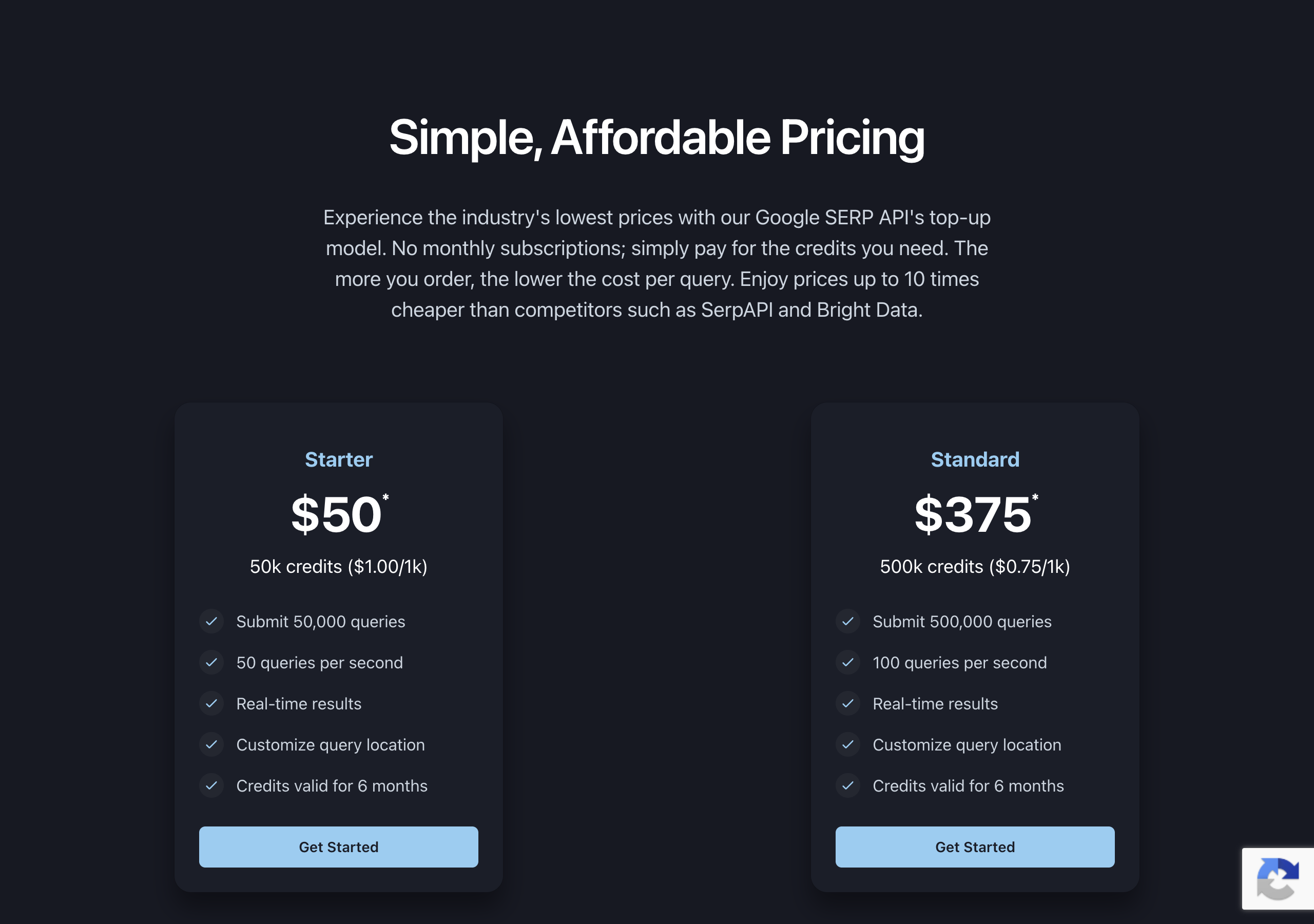
- $50 is the smallest pack
Serper is the one I'd pick for anything where a person or an agent is waiting. Every one of 20 calls came back in under four seconds, and most in under one. The response is Google's organic list with position, title, link, snippet, a date where Google shows one, and sitelinks where it shows those.
The pricing model is the catch. $50 buys 50,000 credits, one per search, and they're valid for six months. If you run 10,000 searches a month you'll use the pack in five, so your effective rate is the full $1.00 per 1,000 and your monthly bill is $10. If you run 1,000 a month, the pack expires with 44,000 credits unused and you've paid $50 for 6,000 searches. The $375 pack drops the rate to $0.75, which is the figure in the table at 100,000 and above.
Serper pricing: 2,500 free queries. $50 for 50,000 credits ($1.00 per 1,000), $375 for 500,000 ($0.75 per 1,000), credits valid for six months.
DataForSEO (best for batch jobs)
DataForSEO pros:
- The Standard Queue is $0.60 per 1,000, and all five tasks I queued were finished within twelve seconds of posting
- The richest response of the cheap options: rank, absolute rank, domain, breadcrumb, and the SERP feature type on every item
- A sandbox you can code against before paying
DataForSEO cons:
- The queue is asynchronous: you post tasks, then fetch results in a second call, so it's a different program from the others
- The live mode that behaves like the other APIs costs $2.00 per 1,000 and had an 8.6 second median here
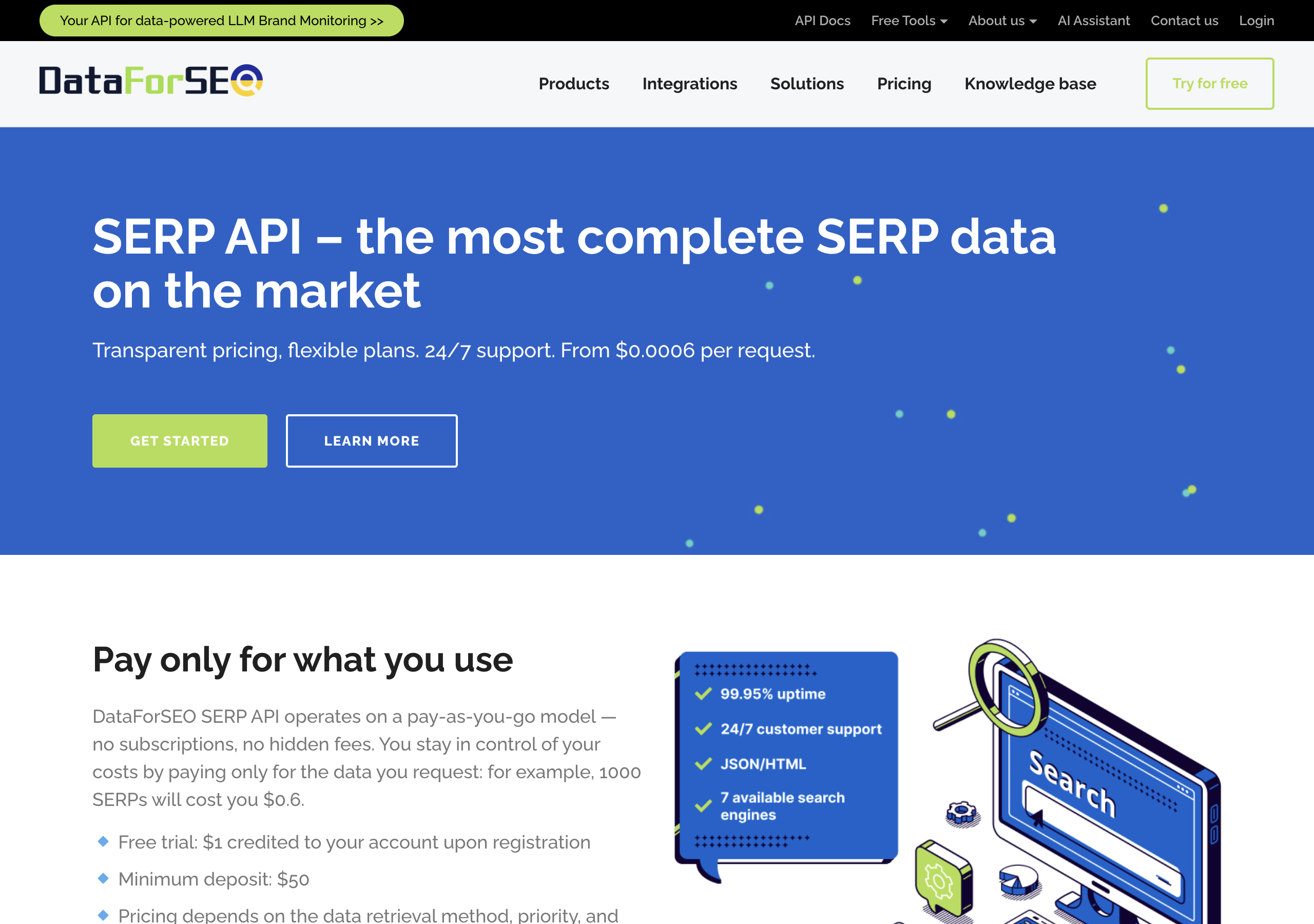
site:,inurl:, andfiletype:each multiply the price by five, and a$50minimum deposit applies
DataForSEO sells the same Google search at three prices and the cheap one is a queue. The pricing page says results arrive in "5 minutes on average" and a footnote allows up to 45. I posted five tasks to the Standard Queue and every one was complete between five and twelve seconds later. That makes the $0.60 rate the cheapest fast option on this page, provided your code can post a batch and collect it, which for a nightly job it can.
The live endpoint is the one to compare with Serper and AnyAPI, and at $2.00 per 1,000 and 8.6 seconds it loses to both. Use it only when you need DataForSEO's field set in real time.
Read the modifiers before you estimate a bill. A search with a site: operator is $3.00 per 1,000 on the queue, and asking for more than ten results bills again per extra ten.
DataForSEO pricing: Standard Queue $0.60, Priority Queue $1.20, Live $2.00 per 1,000, pay as you go with a $50 minimum deposit. Operators multiply the price by five each.
Scrapingdog (best for over 180,000 searches a month)
Scrapingdog pros:
- Above about 180,000 searches a month the Standard plan is the cheapest way to buy Google results here
- The $350 Premium plan covers 1,200,000 searches, which beats every pay-as-you-go rate on this page at that volume
- Failed requests aren't charged
Scrapingdog cons:
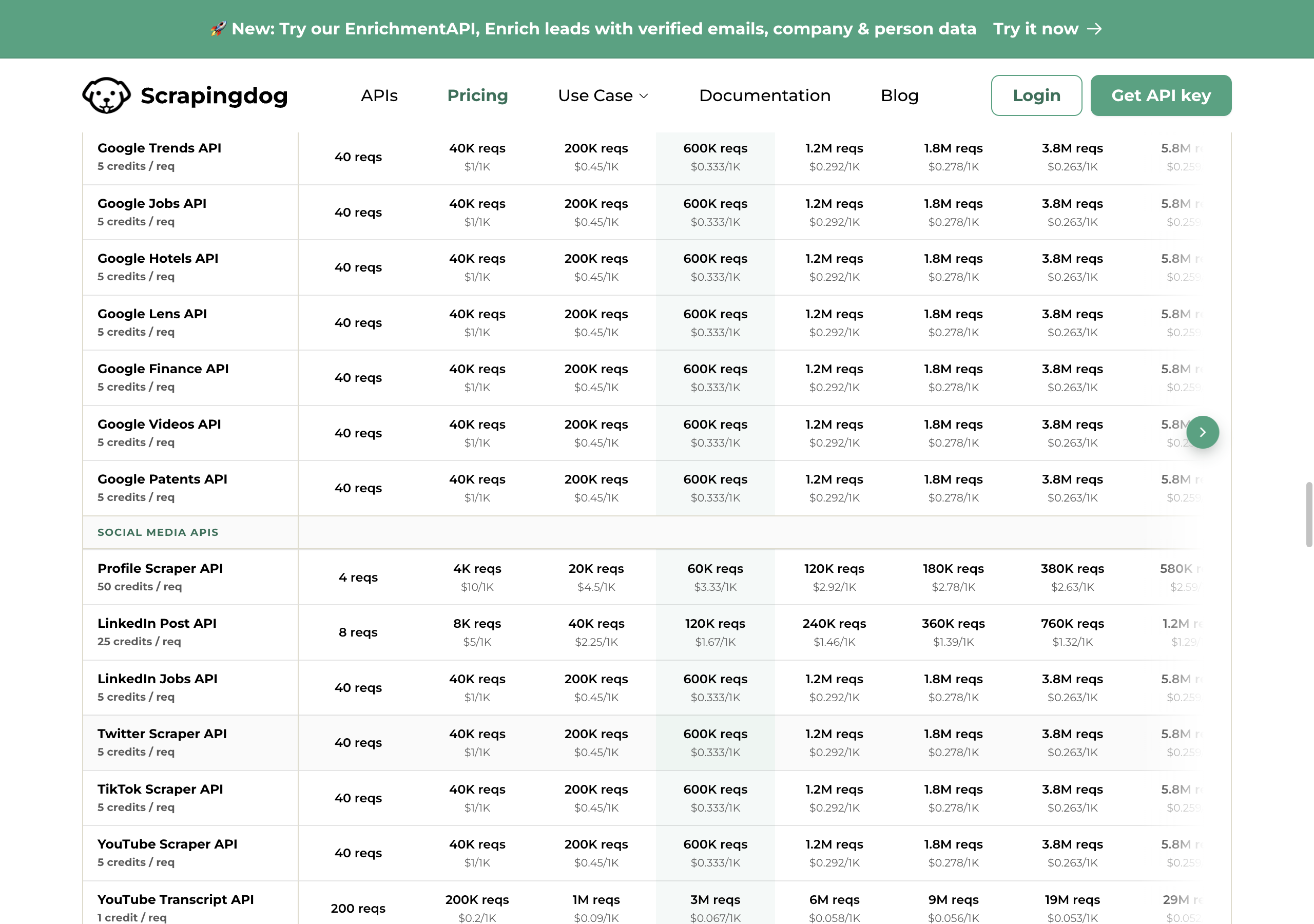
- A Google search costs 5 credits, so every plan's "credits" number is five times the search count
- Plans are monthly subscriptions and unused credits don't roll over
- The free account's 200 credits are 40 searches, and mine had run out before this test
The credit unit is the thing to know. Scrapingdog's page says 200,000 credits for $40, which reads like $0.20 per 1,000 until you find the line that a Google SERP request is 5 credits. The Lite plan is 40,000 searches, $1.00 per 1,000, the same as Serper's pack. The Standard plan is where it gets interesting: $90 for 1,000,000 credits is 200,000 searches at $0.45 per 1,000, under AnyAPI's billed $0.50. If you use the whole plan every month, that's the cheapest Google search on this page. If you use half of it, you've paid $0.90.
I couldn't measure speed this time. The free account I made three weeks ago had 200 credits, I'd spent them, and the API returned "You have reached your account limit". In an earlier run it was the fastest option, tied with Serper.
Scrapingdog pricing: Lite $40 a month for 200,000 credits, Standard $90 for 1,000,000, Premium $350 for 6,000,000. A Google search is 5 credits. 200 free credits to start.
SearchApi.io (best for the richest result fields)
SearchApi.io pros:
- Every organic result carries the domain, favicon, source name, displayed link, and the words Google bolded
- 100 free requests, no card
- Clean plan ladder with a published rate at every tier
SearchApi.io cons:
- $4.00 per 1,000 on the entry plan, eight times AnyAPI and four times Serper
- 3.9 seconds at the median, with two calls over ten
SearchApi.io returned the most useful result object of the five I measured. If your program reads the displayed URL, wants the favicon, or needs the snippet's highlighted words for a relevance score, it's all there without a second request. That's worth $4.00 per 1,000 to some readers.
For a first page of links it isn't. The $40 Developer plan buys 10,000 searches; the same 10,000 is $5 on AnyAPI or $10 on Serper. The rate falls to $2.50 at 100,000 and $1.50 at 1,000,000, which is still above every cheap option here at every volume.
SearchApi.io pricing: Developer $40 a month for 10,000 searches, BigData $250 for 100,000, Octo 1M $1,500 for 1,000,000. 100 free requests.
SerpApi (best for multi-engine coverage)
SerpApi pros:
- The most engines, the most thorough docs, and a support inbox that answers
- Cached, errored, and failed searches don't count against the plan
- Every block on the page is parsed: ads, knowledge panel, related questions, the lot
SerpApi cons:
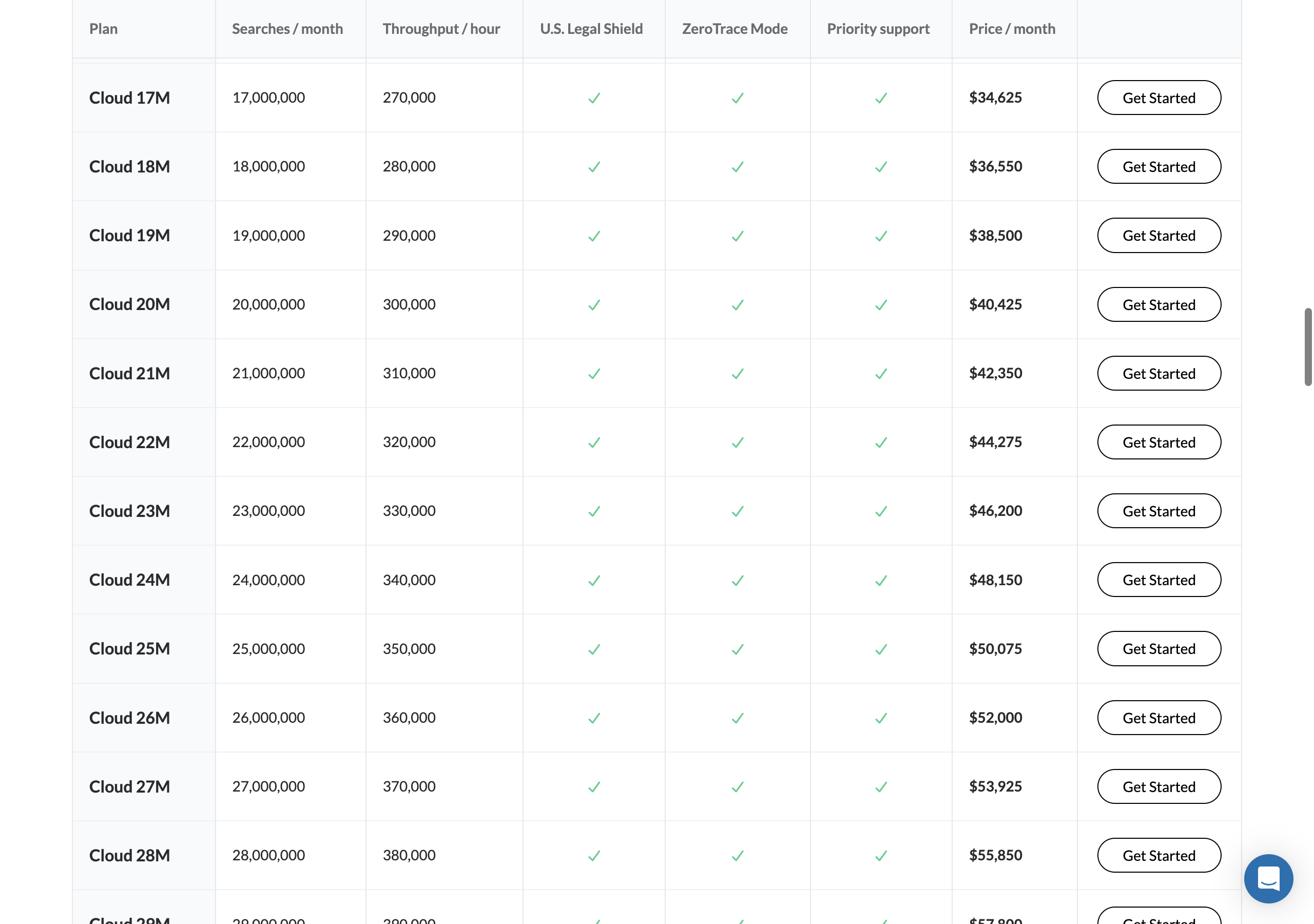
- $25 a month for 1,000 searches, which is $25 per 1,000, fifty times AnyAPI's billed rate
- 100,000 a month is the $725 plan; 1,000,000 is $3,750
- 250 free searches a month, and a key is issued only after it confirms a phone number
SerpApi is the incumbent, and on a "cheapest" list it's here as the ceiling. The Starter plan is $25 per 1,000. At 1,000,000 searches a month it's $3,750, against $350 at Scrapingdog and $500 at AnyAPI.
What you get for that is the whole Google page as structured data, across Google, Bing, YouTube, Amazon, and a long list of other engines, with documentation for every field. If you're building on several engines or you want a vendor with people behind it, that's the case for it. For Google organic results on a budget there isn't one.
SerpApi pricing: 250 free searches a month. Starter $25 for 1,000, Developer $75 for 5,000, Searcher $725 for 100,000, Cloud 1M $3,750 for 1,000,000. Only successful searches count.
Which SERP API should you use?
- Under 5,000 searches a month: Bright Data, free, and check that your responses are JSON.
- A prototype today with no card: Serper's 2,500 free queries.
- 5,000 to 180,000 a month and nobody is waiting on the result: AnyAPI.
- 5,000 to 180,000 a month and someone is: Serper.
- A nightly batch you can post and collect: DataForSEO's Standard Queue.
- Over 180,000 a month and you'll use the plan: Scrapingdog Standard, then the next plan up as you grow.
- You need the domain, favicon, and highlighted words on every result: SearchApi.io.
- Several engines and a support desk: SerpApi.
The limits of this comparison
- Twenty searches per API from one laptop, sent one after another, is a smell test for speed and response shape. It says nothing about uptime.
- AnyAPI's 19.9 second median is what happened on September 15, 2026. Its catalog reports a 1.1 second median over the trailing 30 days, so this run may be an unusually bad day for its cheapest source, or the new normal. The bill numbers assume the $0.50 source serves.
- Scrapingdog and SerpApi weren't measured: the Scrapingdog free account was out of credits and SerpApi issues a key only after it confirms a phone number.
- Every bill assumes one first-page US desktop search per query, no operators, and no retries. Deep pages,
site:queries, and locations each cost more on the vendors that charge for them. - Serper and Scrapingdog bills assume you use the pack or plan in full. A pack you don't finish costs more per search than the table shows.
- Prices checked on September 15, 2026. Enterprise deals aren't included.
- Seven vendors is a shortlist, not the market. serpprices.com tracks the list price of 26 search APIs normalized to dollars per 1,000 searches at four monthly volumes, with credit multipliers, plan floors, and credit expiry applied, and publishes the whole table as JSON under CC BY 4.0. Use it to check a vendor this page skipped.
If you're building a rank tracker rather than a general search feed, the rank tracking API comparison prices the same vendors per keyword check. If you're leaving SerpApi specifically, the SerpApi alternatives page compares the responses field by field. The Google Search API page has the live request format and the current price of each source.
Google results as clean JSON, billed per search from a prepaid wallet, no plan and nothing that expires. New accounts get free credit, no card required.
Try the Google Search API