Best SerpApi alternative for Google results as JSON (2026)

- If you need every field on every Google surface, engines beyond Google, or a vendor who'll indemnify you for scraping search results, SerpApi is the one to buy. Prices below were checked on October 1, 2026.
- If you need Google results as a ranked JSON list, paying per request costs far less: $0.40 per 1,000 searches against SerpApi's $25 per 1,000 on its cheapest plan, with no monthly plan and nothing that expires.
- SerpApi is a subscription with a fixed number of searches a month. Run out and it renews the plan early; don't use them and they reset to zero.
- Twenty queries through three APIs (September 13, 2026) all came back, and at each API's entry price the same 20 searches cost $0.008 here against $0.50 of SerpApi's Starter plan.
Built on AnyAPI
411 scraping and data APIs behind one key.
Every endpoint in this post is one call away. Pay per request in USD from a prepaid wallet, with automatic failover when a provider breaks. No subscription, no card to start.
Get ~150 free requests$0.10 of credit on signup.Maybe you've got a keyword list to rank-check every night. Maybe your agent needs the top results for a question someone just asked it.
Either way, you want a ranked list of links back as JSON. SerpApi will give you that and a lot more, and you pay for the lot more.
I ran the same 20 searches through AnyAPI, Serper, and SearchApi.io, and priced SerpApi and five more from their own pages.
SerpApi is the incumbent here. Send it a query and it returns the Google results page as JSON: organic results, ads, the knowledge panel, "people also ask", the local pack, shopping, everything. It does the same for Bing, YouTube, Google Maps, Amazon, Walmart, eBay, Yelp, Baidu, Yandex, and dozens more.
The docs are the best in the category, it doesn't count failed or cached searches against you, and on the bigger plans it takes on the legal liability of scraping search engines with $2 million of coverage.
It's also priced for companies. The cheapest plan is $25 a month for 1,000 searches, which is 2.5 cents a search, and the plan resets every month whether you searched or not.
If all you want is a rank check for your keyword list, or the top ten results for your agent's question, that's a lot of platform to rent.
Where is SerpApi strong?
If search data is a core dependency for you and you need all of it, SerpApi is the right call.
- Every field, every surface. An organic result on SerpApi comes with sitelinks, rich snippets, and the position, and the same response carries the ads, the knowledge graph, related questions, and the local pack. If you're building an SEO product, that completeness is the product.
- Engines beyond Google. SerpApi lists over 80 engines: Bing, DuckDuckGo, Baidu, Yandex, Naver, YouTube, Apple's App Store, Yelp, Zillow, Walmart, and more. One search costs one search regardless of engine.
- Failed and cached searches are free. Only successful searches count. A cached result, valid for an hour, doesn't count either.
- It'll stand behind you legally. On Production ($150 a month) and up, SerpApi's U.S. Legal Shield assumes the liability of scraping and parsing search results, with coverage up to $2 million. No one else in the category offers that.
- It keeps shipping. A weekly changelog, MCP bundle support added September 9, 2026, a 99.95% SLA in the terms, and a throughput guarantee per plan.
If you need those, stay on SerpApi. If you need the ten blue links and nothing else, the rest of this page is for you.
Where does paying per request win?
If your calls are a query in and a ranked list out, the plan is the expensive part.
What does a search cost on each SerpApi plan?
SerpApi's pricing is monthly, and it goes a long way up. Starter is $25 for 1,000 searches, Developer $75 for 5,000, Production $150 for 15,000, and Big Data $275 for 30,000.
It continues past $2,750 a month to cloud plans priced at over $100,000. Enterprise reserved capacity is $2.75 per 1,000 and starts at $3,750 a month.
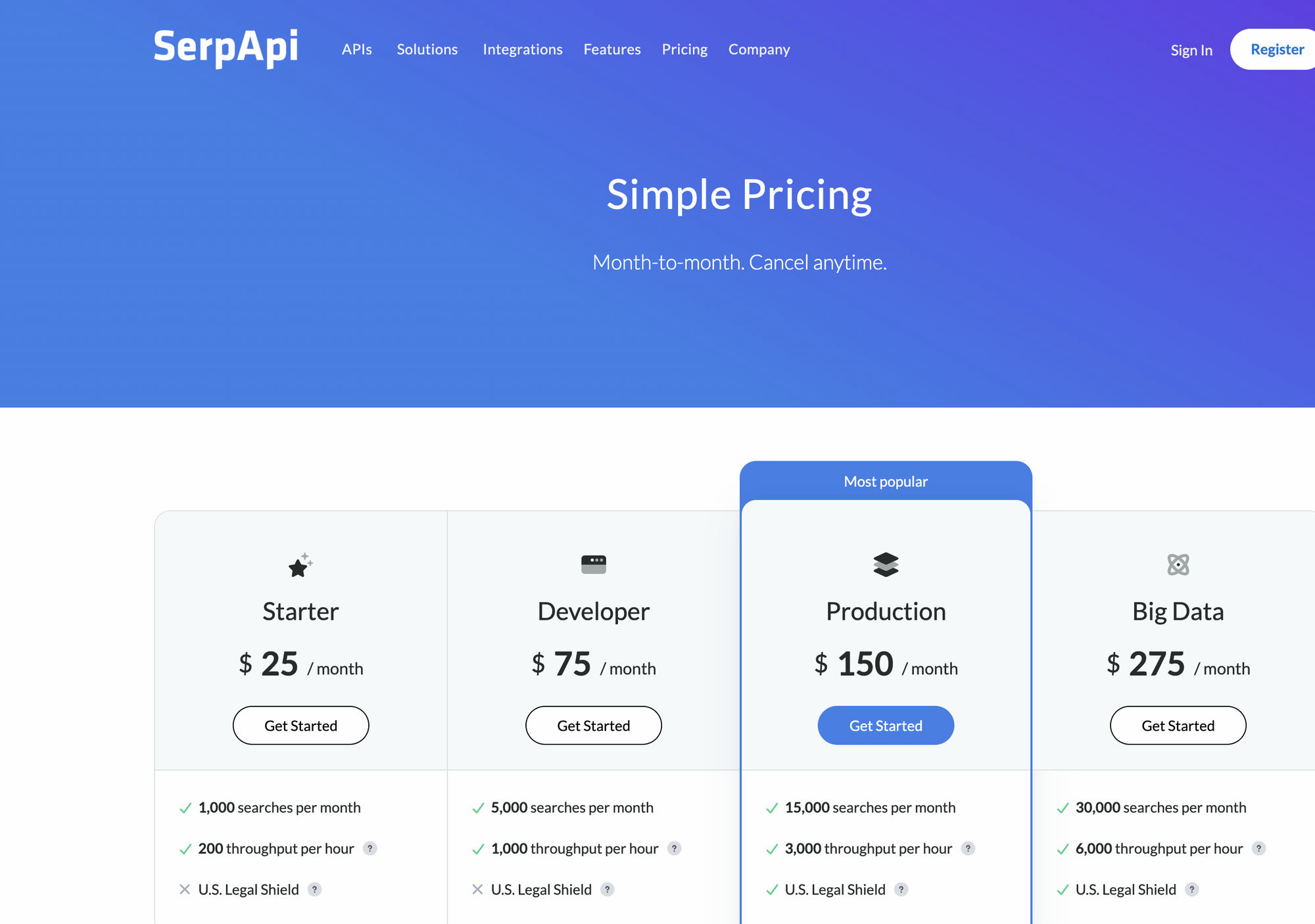
Per 1,000 searches, that's $25 on Starter, $10 on Production, $9.17 on Big Data, and $2.75 on enterprise reserved capacity.
There's no overage rate. When you run out, SerpApi's "automatic early renewal" bills the whole plan again and resets the counter, and the searches you didn't use in a slow month are gone.
SerpApi pricing: 250 free searches a month; Starter $25 a month for 1,000 (unused searches reset each cycle, and running out renews the plan early)
Before you pay anyone, check your volume. If you run fewer than 250 searches a month, SerpApi's free plan already covers you.
If you pay per request, it's $0.40 per 1,000 searches. Five thousand searches in a month, which is what SerpApi's $75 Developer plan buys, costs you $2.00.
A month with no searches is $0.
AnyAPI pricing: per search, with no plan and nothing that expires (a call costs more than the starting price when a dearer source has to answer)
How fast is it, and can you check?
SerpApi's status page showed a 1.23 second average response over the 30 days to September 13, 2026. AnyAPI's Google search endpoint page shows a 4.7 second median and 99.81% uptime over 551,760 calls in the 30 days to October 1.
The 40-call test below landed at 2.8 seconds. That's slower than SerpApi, but not slow enough to matter for your keyword list.
If an agent is waiting on the answer, SerpApi sells faster tiers at twice and four times the base price.
Which Google surfaces can you query?
SerpApi's response is different for every engine, which is right for SerpApi, because it's exposing everything Google shows.
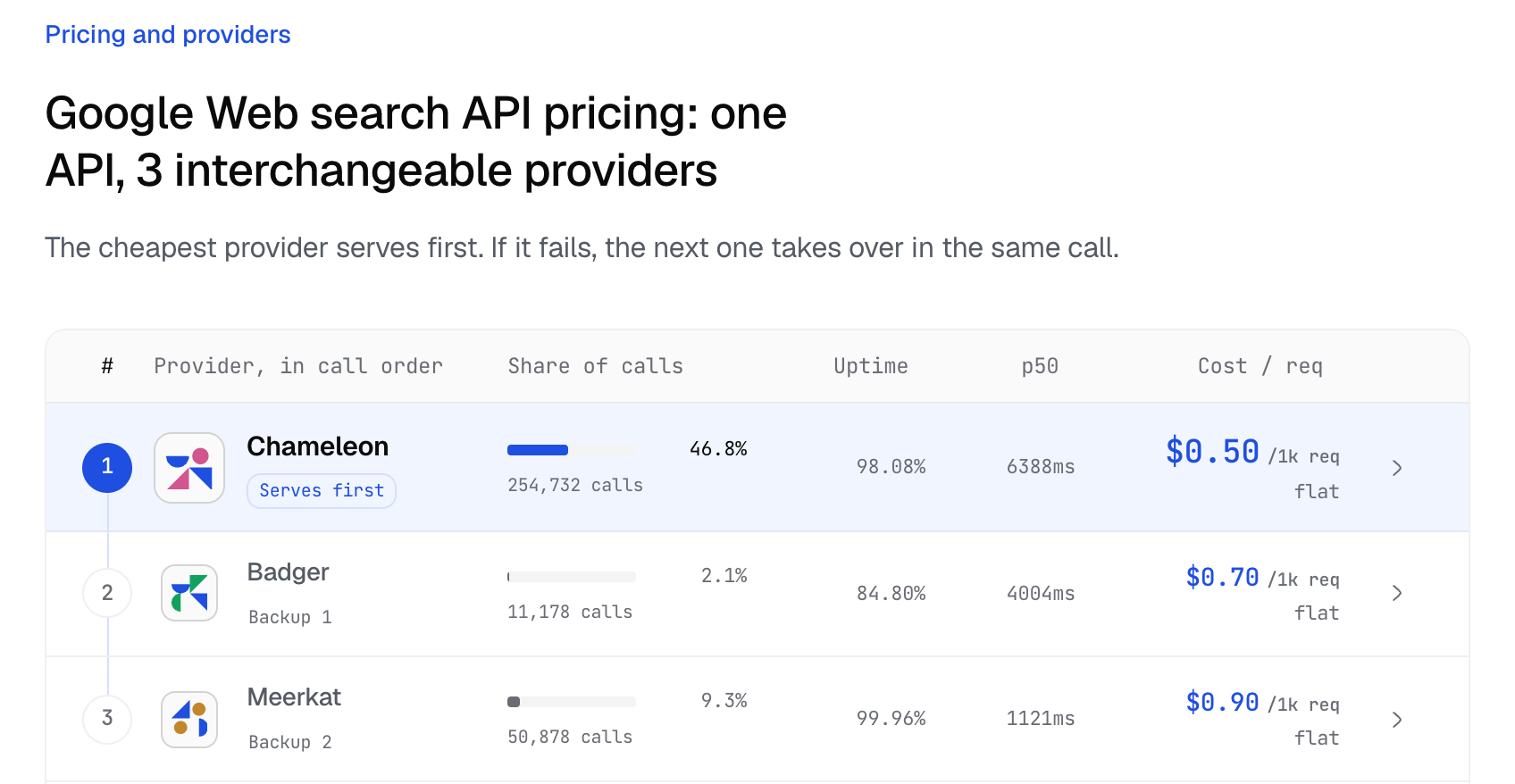
AnyAPI covers the Google surfaces most people actually query, each as its own endpoint with the same response shape, so your parsing code doesn't change: web search at $0.40 per 1,000, the full top 100 for a keyword at $1.80, news at $0.99, images at $0.18 per 1,000 images, autocomplete at $0.99, AI Mode answers at $0.70, AI Overviews at $1.50, Scholar at $0.99, and Patents at $0.99. YouTube search is $0.50, Amazon search $0.75.
What does one call look like?
Here's the search and what came back: ten results for $0.0005 in 19 seconds on September 27, 2026. The first result was a Reddit thread titled "We should look for another option besides SerpAPI, right?", which wasn't planned.
A call starts at $0.0004 and costs at most $0.0009: it's billed at the listed price of the source that answered, and a call that fails costs nothing.
curl https://api.getanyapi.com/v1/run/google.search \
  -H "Authorization: Bearer $ANYAPI_KEY" \
-d '{"query": "serpapi alternatives"}'import os, requests
r = requests.post(
"https://api.getanyapi.com/v1/run/google.search",
headers={"Authorization": f"Bearer {os.environ['ANYAPI_KEY']}"},
json={"query": "serpapi alternatives"},
)
body = r.json()
print(body["costUsd"], body["output"]["data"]["results"][0]["title"])
# 0.0005 We should look for another option besides SerpAPI, right?const r = await fetch("https://api.getanyapi.com/v1/run/google.search", {
method: "POST",
headers: { Authorization: `Bearer ${process.env.ANYAPI_KEY}` },
body: JSON.stringify({ query: "serpapi alternatives" }),
});
const { costUsd, output } = await r.json();
console.log(costUsd, output.data.results.length); // 0.0005 10Each result has a position, title, link, and snippet, and the response carries a cursor for the next page.
Change the endpoint name and the same call returns news, images, or a Google Maps listing.
How did the same 20 searches do through three APIs?
Twenty queries, from "rank tracking api" to "how to cook risotto", ran twice through AnyAPI's google.search and through Serper, and once through SearchApi.io, on September 13, 2026.
SerpApi issues a key only after phone verification, so its row is its own published status page rather than a measurement. It's a page read, not a run.
| API | Calls | Came back | Organic results per call | Fields on a result | What 20 searches cost | Price per 1,000 |
|---|---|---|---|---|---|---|
AnyAPI google.search | 40 | 40 | 8.6 | position, title, link, snippet | $0.008 | $0.40 |
| Serper | 40 | 40 | 9.0 | position, title, link, snippet, date, sitelinks | $0.02 | $1.00 on a $50 top-up |
| SearchApi.io | 20 | 20 | 8.4 | Serper's set plus domain, favicon, source, highlighted words | $0.08 | $4.00 on the $40 plan |
| SerpApi | Its status page | 99.5% over 30 days | Every organic result | Everything on the page | $0.50 | $25 on Starter |
All 100 calls came back with results. Two things in the numbers matter more than the price.
What a result carries. SerpApi's response is the whole page: ads, knowledge panel, related questions, the lot. Serper adds a date and sitelinks to the four basic fields, and SearchApi.io adds the domain, favicon, and the words Google bolded.
AnyAPI returns position, title, link, and snippet, which is what your rank check or your agent's lookup reads, with nothing to strip. If you'll use the extra fields, they're worth paying for; if you won't, you're paying for parsing you throw away.
Speed, in passing. Serper answered in 1.1 seconds at the median and SerpApi's status page says 1.23; AnyAPI was 2.8 on this run with a longer tail, and SearchApi.io 4.4.
For a nightly keyword list none of that matters. If an agent is waiting on the answer, Serper is the quick one, and SerpApi sells faster tiers at two and four times the price.
Other SerpApi alternatives worth a look
If SerpApi's price is why you're looking, you've got more than two answers. These are the ones that publish a usable number, read from their pricing pages on September 13, 2026, and priced per 1,000 Google searches.
Serper, SearchApi.io, and AnyAPI were run; the rest are page reads.
| Service | How you pay | Entry price | Per 1,000 at entry | Best published | Free tier | Beyond Google |
|---|---|---|---|---|---|---|
| Serper | Prepaid credits, valid 6 months | $50 for 50,000 | $1.00 | $0.30 at $3,750 | 2,500 queries | No |
| SearchApi.io | Monthly plan | $40 for 10,000 | $4.00 | $1.00 at $5,000 a month | 100 searches | Bing, Baidu, Yandex, Amazon, TikTok, LinkedIn, 70+ engines |
| Scrapingdog | Monthly credits, 5 per search | $40 for 40,000 searches | $1.00 | $0.33 on the $200 plan | 40 searches | Google verticals, LinkedIn, X, Amazon |
| DataForSEO | Prepaid balance, never expires | $50 minimum | $2.00 live, $0.60 queued | Same | Trial credit | Bing, Yahoo, Baidu, Naver, YouTube |
| Bright Data SERP API | Per success, no minimum | None | $1.50 | $1.31 on the $499 plan | 5,000 a month | Bing, DuckDuckGo, Yandex, Baidu, Yahoo, Naver |
| Zenserp | Monthly plan | $49.99 for 25,000 | $2.00 | $0.90 at $899.99 | 50 a month | Bing, Yandex, DuckDuckGo, YouTube |
| Oxylabs | Pay as you go or monthly | None | $1.00 | $0.30 on the $999 plan | 2,000 results | Bing |
AnyAPI google.search | Per call | None | $0.40 | $0.40 | A small starter balance | YouTube, Amazon, and the rest of a 409-endpoint catalog |
If you want SerpApi's speed for a tenth of the price, Serper is the closest thing. It's Google only, it was the fastest API in the test above, and 2,500 free queries need no card.
The catch is the model: $50 buys 50,000 credits that expire in six months, so if you're a light user, you're buying months of searches up front.
If you need Bing or Baidu and SerpApi's price is your only problem, SearchApi.io is the pick. It's the SerpApi clone: the same JSON shape, more than 70 engines, and a monthly plan.
At $4.00 per 1,000 on its $40 plan it's cheaper than SerpApi's $25 and dearer than everyone else, and it was the slowest API in the test. Google-only users should skip it.
If you'd rather have a plan than a prepaid pack, Scrapingdog matches Serper's rate, though it hides it behind a credit count. A search costs 5 credits, so the $40 plan's 200,000 credits are 40,000 searches, and the free tier's 200 credits are 40.
That's $1.00 per 1,000, the same as Serper, with subscription credits that expire monthly and a pay-as-you-go pack that doesn't.
If your job can wait, DataForSEO is priced for you. Its standard queue is $0.60 per 1,000 with a target turnaround of 45 minutes; the live mode that actually competes with the rest is $2.00.
Search operators like site: multiply the price by five, and rank tracking uses them constantly. The $50 minimum never expires.
If you search fewer than 5,000 times a month, Bright Data's SERP API is free, and nobody in this table beats free. It charges $1.50 per 1,000 after that, with no plan and no minimum, across seven engines at one price.
Above the free tier, though, its per-search price is among the highest here.
Zenserp and Oxylabs are monthly plans with a wide spread. Zenserp runs from $2.00 per 1,000 on its $49.99 plan down to $0.90 at $900 a month, and Oxylabs from $1.00 pay as you go down to $0.30 on a $999 plan.
Both are fine if you'll fill the plan. Neither publishes what happens to unused searches.
The short version: if speed matters and you're Google only, use Serper. If you're under 5,000 a month, use Bright Data's free tier. If you need the full page across every engine, SerpApi is still the one.
If you want ranked Google results as JSON with no plan, no expiry, and no queue, use AnyAPI, at $0.40 per 1,000 against DataForSEO's queued $0.60. The rank tracking API roundup runs most of these on one keyword list.
SerpApi vs paying per request, at a glance
| What you deal with | SerpApi | Paying per request |
|---|---|---|
| What you're billed for | Monthly plan with a search quota | The listed price per call, in USD; a failed call is free on all but a few endpoints |
| Subscription | $25 to $2,750+ a month, resets monthly | None |
| Price per 1,000 searches | $25 on Starter, $9.17 on Big Data, $2.75 reserved enterprise | $0.40 |
| Running out mid-month | Plan renews early at full price | Nothing to run out of |
| Fields per result | Everything on the page: ads, knowledge graph, local pack | Position, title, link, and snippet |
| Engines | 80+, including Bing, Baidu, Yandex, Yelp | Google surfaces, YouTube, and Amazon, in a 409-endpoint catalog |
| Legal coverage | $2M Legal Shield on $150+ plans | None |
| Response time | 1.23 s average, per its status page | 4.7 s median, per the endpoint page |
| A month you search nothing | Your plan price | $0 |
Limitations and what you give up
Building an SEO product or need Bing? Stay on SerpApi. Nothing else returns the whole results page across that many engines, and the Legal Shield matters if search data is your business.
Need the ranked results and a price you can budget? Pay per request. Rank checks, an agent's web lookups, a nightly keyword list, a research crawl. You get the ranked results as JSON at $0.40 per 1,000 and never think about a quota.
One limit on AnyAPI's side: there's no Bing, Baidu, or Yandex endpoint.
If it's rank tracking specifically, the rank tracking API roundup compares Serper, SerpApi, DataForSEO, and the rest on one job. For proxy-scale infrastructure there's the best Bright Data alternative, and for a raw-HTML scraping API, the best ScraperAPI alternative.
Frequently asked questions
- How much does SerpApi cost in 2026?
- SerpApi's free plan is 250 searches a month. Paid plans are monthly: Starter at $25 for 1,000 searches, Developer at $75 for 5,000, Production at $150 for 15,000, Big Data at $275 for 30,000, then Searcher at $725, Volume at $1,475, Infrastructure at $2,750, and cloud plans above that. Enterprise reserved capacity is $2.75 per 1,000 from $3,750 a month. There's no annual billing. Checked October 1, 2026.
- Does SerpApi charge for failed searches?
- No. Only successful searches count toward the monthly quota. Errored, failed, and cached searches, cached meaning a repeat of the same query within an hour, are free.
- Do unused SerpApi searches roll over?
- No. Searches reset at the start of each billing cycle. If you use them all early, SerpApi's automatic early renewal bills the plan again and refills the quota, so there's no per-search overage rate on self-serve plans.
- What is SerpApi's Legal Shield?
- On every recurring plan except Free, Starter, and Developer, SerpApi assumes the liabilities of scraping and parsing search engine results for U.S. and international customers, with up to $2 million in coverage, as long as your use of the data isn't illegal. It starts at the $150 Production plan.
- Is there a cheaper SerpApi alternative?
- For Google results as a ranked JSON list, yes. AnyAPI's google.search is $0.40 per 1,000 searches with no plan, against $25 per 1,000 on SerpApi's Starter plan and $9.17 on Big Data. SerpApi returns more fields per page and more engines, so it stays the better buy for a full SEO product.
Use data responsibly and follow AnyAPI's Acceptable Use Policy.