The best data enrichment services in 2026, tested on the same 20 contacts


Hunter's Starter plan charges $49 a month for 2,000 credits, and the same $49 buys 3,181 finds at AnyAPI's per-request price, so below that many finds a month, paying per request costs less than the plan. A free Apollo key will log you in and then refuse every enrichment call, so Apollo really starts at a paid Basic seat. And two of the seven names on every roundup can't be priced from their own websites: ZoomInfo wants your phone number before it shows a dollar, and Clearbit stopped being an API and became a button inside a paid HubSpot portal.
Built on AnyAPI
448 scraping and data APIs behind one key.
Every endpoint in this post is one call away. Pay per request in USD from a prepaid wallet, with automatic failover when a provider breaks. No subscription, no card to start.
Get ~160 free requests$0.10 of credit on signup.If you've ever tried to price a contact enrichment API, you know the drill: you open seven pricing pages, and by the third one you're not sure whether a "credit" is an email, a record, or a vibe. Every service on this list does the same thing underneath. You hand it a first name, a surname, and a company domain, and you want back a work email that won't bounce, maybe a title, and a straight answer about whether the person it found is the person you asked about.
For this list I did the unglamorous version of the work. I signed up for all seven and priced each one from its own page, in a real browser, because several of them render nothing to a plain fetch. Then I sent the same 20 contacts through every endpoint a self-serve signup would open, and timed what came back. How far you get before a sales call turns out to be the sharpest line between these seven, so every section below says plainly whether I ran it or read it: Hunter and People Data Labs publish enough to price without one, Clay's API is Enterprise-only, and ZoomInfo needs a phone call before it needs a key.
So here's the short version. Paying per request costs less than Hunter's $49 plan until your finds pass 3,181 a month. A CRM seat only makes sense if you were going to buy the CRM anyway. And the biggest names in the category are, somewhat impressively, the hardest to put a price on.
The best data enrichment services
- Hunter for a six-status email verifier
- Apollo for enrichment inside a CRM on a paid seat
- AnyAPI for pay-per-request lookups in a headless pipeline
- People Data Labs for contact values at volume without a sales call
- Clay for waterfalls a GTM team runs in a table
- ZoomInfo for enterprise contracts with a data team
- HubSpot (Clearbit) for records that already live in HubSpot
What makes a good data enrichment service?
There's a lot of category blur here. "Data enrichment" covers everything from a $15 email finder to a six-figure sales-intelligence contract, and the vendors are happy to leave it blurry. So let me say who I'm writing for: someone calling an endpoint from code, with a name and a domain in the request body, who is not going to click an Enrich button inside a sales seat.
With that person in mind, here's what I compared them on:
- A price per lookup you can compute from the page. At the smallest tier a buyer can actually sign up for, with the billing period stated. If the page only shows the annual figure, that's the figure I used, and I say so.
- Billing on a hit. A lookup that comes back empty should cost nothing. Most of these get it right. The ones that don't make it surprisingly hard to tell.
- A key without a sales call. Plus a free tier big enough to see the response shape across a real list, not just confirm that your bearer token works.
- What actually comes back. Fill rate, whether the record is the person you asked about (the one everybody skips), and how long the call took.
I didn't grade phone accuracy, CRM sync, intent data, or anything you'd only use from inside a sales seat. Every price is the smallest tier a buyer can sign up for, one lookup per contact, no phone numbers.
And I'll be upfront about the size of the test: 20 contacts, all public executives at well-known companies, sent through one vendor from one machine on one day. That's a smell test of fill rate and latency, not a benchmark, and it says nothing about accuracy on a list of mid-level titles.
Public executives at well-known companies are the easiest people to find a title for and the hardest to find a real email for. The test is still enough to tell you which pricing pages are lying to you, which is mostly what I wanted to know.
AnyAPI is the only one of the seven I could run end to end, and it is the API this site sells. Its fill rate and latency are measured; every other section is priced and read.
Apollo's free key was refused on all 20 calls, so its fill rate and latency are unmeasured. The Hunter and People Data Labs signups produced no key, so their sections are page reads.
My batch script called the finder twice per contact, so 40 finds were billed instead of 20. That's my mistake, not the vendor's, and latency and fill come from the first call of each pair.
Prices were read on 2026-09-05. Cognism, Lusha, FullContact, and Datanyze show up in the other roundups and aren't measured here.
The best data enrichment services at a glance
| Tool | Best for | Why pick it | Pricing per 1,000 lookups |
|---|---|---|---|
| Hunter | A six-status email verifier | The free plan includes the API, and a find that returns nothing is free | $24.50 on Starter monthly ($49 for 2,000 credits); $17.00 billed yearly; Free is 50 credits a month |
| Apollo | Enrichment inside a CRM on a paid seat | 1 credit per email, 0 when nothing comes back; a Free-plan key is refused | $19.60 on Basic billed annually ($49 a seat a month, 2,500 credits a month); Free is 75 credits a month with no enrichment API |
| AnyAPI | Pay-per-request lookups in a headless pipeline | Find, verify, and two person endpoints from one wallet | $15.40 find, $6.60 verify, $7.20 reverse lookup, $66.00 name-plus-domain record; no plan |
| People Data Labs | Contact values at volume without a sales call | Bills only a match, a 404 is free, likelihood score on every record | $280 on Self-Serve monthly ($98 for 350 records); Free is 100 records a month as true/false flags |
| Clay | Waterfalls a GTM team runs in a table | Multi-provider waterfall charged only on the step that answers | $148 to $370 on Launch monthly ($185 for 2,500 credits, 2 to 5 credits an email) |
| ZoomInfo | Enterprise contracts with a data team | Enrich 25 records a call; a record already under management is not re-billed | No published price; a phone number gets you one |
| HubSpot (Clearbit) | Records that already live in HubSpot | Enrichment inside the CRM without consuming credits | Not sold as lookups; included with a paid HubSpot portal |
Best data enrichment service for a six-status email verifier
Hunter
Hunter pros:
- The free plan includes the API, and a find that comes back empty doesn't spend a credit
- Every endpoint is on one docs page, and the verifier returns six statuses: valid, invalid, accept_all, webmail, disposable, unknown
- 15 requests a second, which is plenty for a nightly job
Hunter cons:
- Signup asks for a work email, and secondary sources disagree on whether a Gmail address gets through
- I never got a key, so this is a page read and I can't show you what a real response looks like
If your goal is to spend a lot of money on enrichment, there are plenty of ways to do that further down this list. But if all you want is a work email you can trust, for a list that fits in a spreadsheet, Hunter is the one I'd point you at. Starter is $49 a month for 2,000 credits, which works out to $24.50 per 1,000, and it drops to $17.00 per 1,000 if you pay yearly. Monthly costs about 44 percent more than yearly, so if you know the job will still be running in a year, don't pay monthly. The free plan gives you 50 credits a month and (unusually) includes the API, so you can wire it up and look at the response before you spend anything.
The verifier is the part I like most, at least on paper. Six statuses instead of a yes or a no, and accept_all gets its own answer. That matters more than it sounds. On a catch-all domain, "valid" tells you nothing, and a verifier that admits that is worth more than one that pretends otherwise. The docs are tidy and short enough to read over a coffee.
Where Hunter stops making sense is the flat fee. Starter charges $49 whether you use 200 credits or all 2,000, and the same $49 buys 3,181 finds at AnyAPI's per-request price. Billed yearly, Starter's $34 a month buys 2,207. Below those numbers the plan costs more than the same finds on a wallet, and Starter stops at 2,000 credits, so if both numbers are over 2,000, paying per request is cheaper at every volume Starter covers. Do the math on your own list.
Hunter pricing: Free (50 credits a month, API included), Starter $49 a month for 2,000 credits ($24.50 per 1,000), or $17.00 per 1,000 billed yearly.
Best data enrichment service for enrichment inside a CRM on a paid seat
Apollo
Apollo pros:
- One credit per email and zero when nothing comes back, which works out to about two cents an email on Basic
- The health endpoint answered my free key in about a quarter of a second, so auth itself is painless
- A seat comes with the database and the CRM, so if you were buying Apollo anyway the enrichment rides along
Apollo cons:
- The people match endpoint refused all 20 of my calls on a free key with a 403 and the message "not included in your Free plan and is not accessible, even with a master key"
- The pricing page renders nothing to a fetch, and in a browser shows only annual figures under a "Save 24%" label
- Apollo's own pages describe free API access four different ways
Ok, this one needs a story. Apollo issued me a key on a Free plan. GET /api/v1/auth/health came back 200 healthy, and I thought, great, this is going to be easy. Then POST /api/v1/people/match came back 403 for every one of the 20 contacts, each refusal in under half a second, and a people-search call got the same answer. Zero credits and zero dollars spent, which I suppose is the one thing about the experience I can't complain about.
What bugs me is that I couldn't have known in advance. The developer FAQ says every plan has at least basic API access. The rate-limit table lists Free-plan enrichment limits of 50 a minute and 600 a day. The pricing FAQ says API access comes with Custom plans. The plan cards put "API Access" on Free and "API Enrichment" on Basic. Only the plan cards agree with the endpoint. (The endpoint reference also says a free account needs a work-email registration, but the refusal names the plan, not the email, so I'm taking the refusal's word for it.)
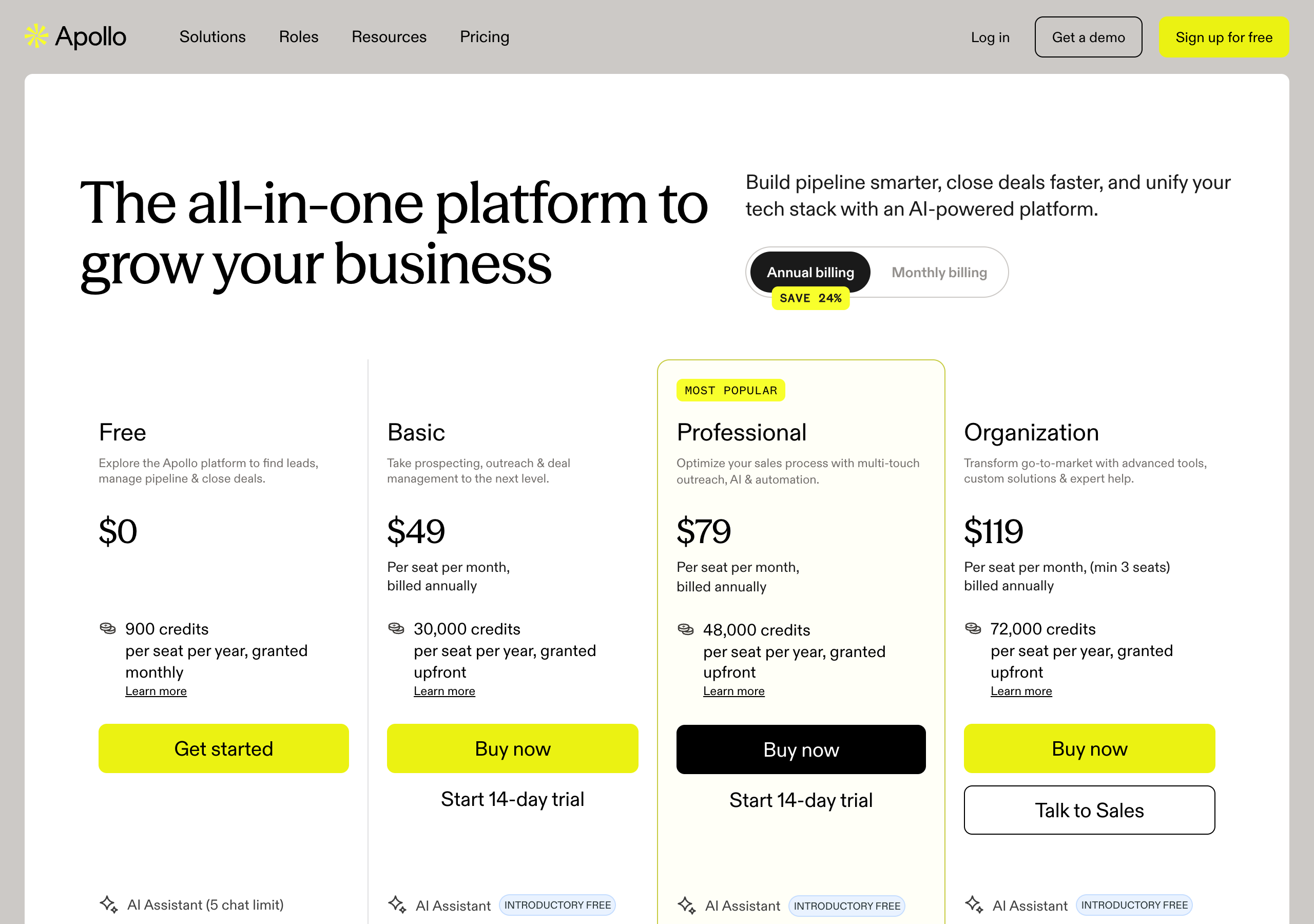
So Apollo starts at Basic: $49 a seat a month billed annually, with 2,500 credits a month, which is $19.60 per 1,000 and about two cents an email. Free is 75 credits a month with no enrichment API, and even that number is 900 a year divided by 12, because the page only talks in annual terms. If your team already lives in Apollo, the price per email is fair and a miss is free, and you should just turn it on. If you came here for an endpoint, you're buying a sales seat nobody is going to sit in.
Apollo pricing: Free (75 credits a month, no enrichment API), Basic $49 a seat a month billed annually with 2,500 credits a month ($19.60 per 1,000).
Best data enrichment service for pay-per-request lookups in a headless pipeline
AnyAPI
AnyAPI pros:
- The finder returned an address for 20 of 20 contacts, about two seconds median
- One bearer key, the same envelope on every call, and the cost in dollars printed beside the data
- Find, verify, reverse lookup, and a name-plus-domain record from one prepaid wallet, no plan and nothing that expires
AnyAPI cons:
- The slowest find took eight seconds, and the name-plus-domain record takes about five seconds on a hit
- The email-keyed record returned a different employee at the same company 5 times out of 13
- The name-plus-domain record only came back for 11 of the 20
This is the one endpoint set that actually let me run the test, so it gets the most scrutiny, for better and worse. The request is one POST. On September 27, 2026, sending https://api.getanyapi.com/v1/run/email.find a bearer key and the body {"person":{"domain":"zapier.com","firstName":"Wade","surname":"Foster"}} got back {"output":{"found":true,"data":{"items":[{"email":"w...@zapier.com","status":"found"}]}},"costUsd":0.0154}. That costUsd field is the whole pitch: every call tells you what it just cost, and a found: false costs nothing.
Three of my 20 finds billed about three cents instead of a cent and a half because the automatic fallback answered them, and the response said so.
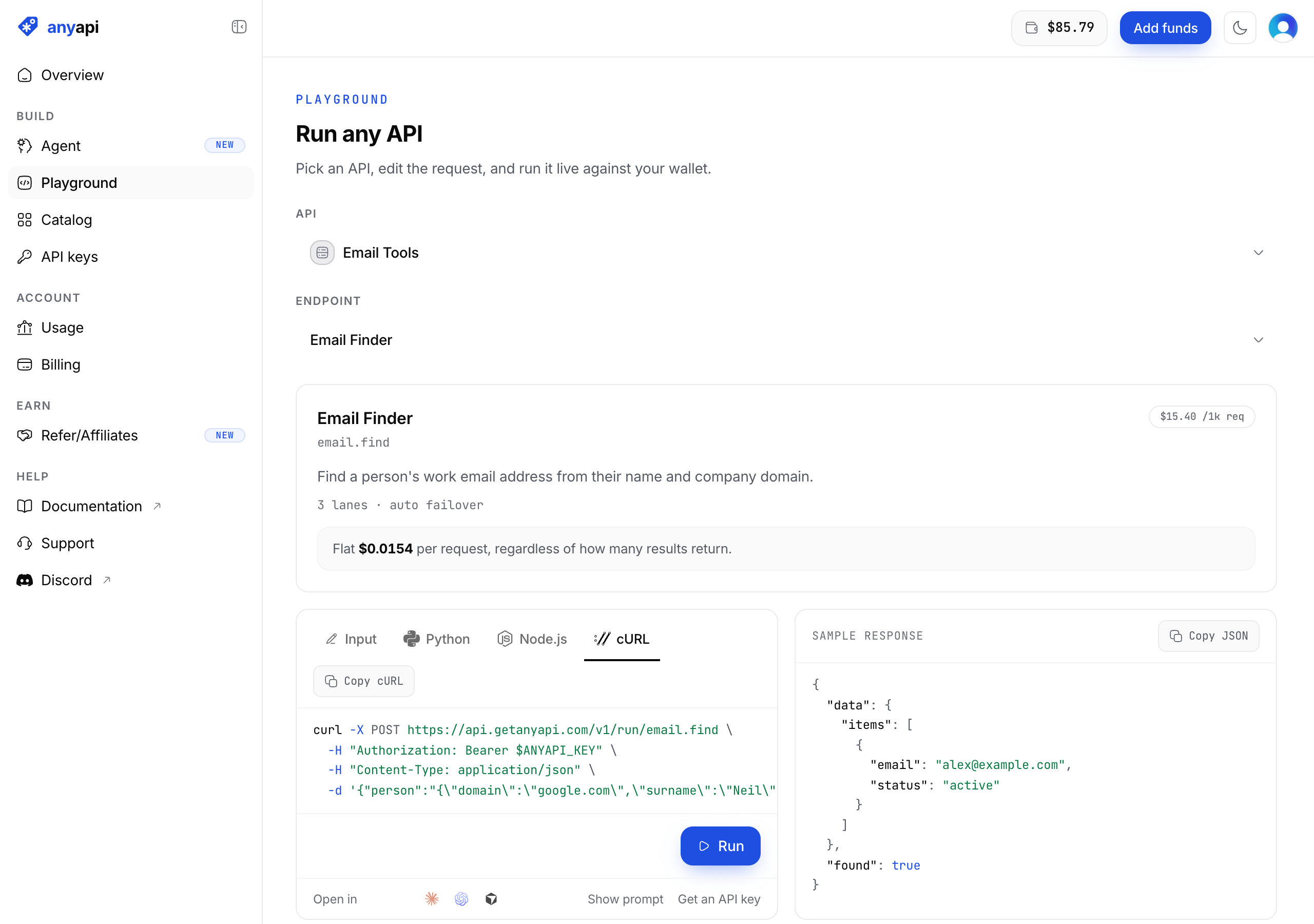
The find was the strong part. All 20 came back, about two seconds median and eight at the worst, and it caught Notion's actual mail domain (makenotion.com, not notion.so), which is exactly the kind of thing that breaks a naive lookup. Verifying those 20 called 19 good and 1 bad (Apple). Before you get excited about 19 of 20, though: 11 of the 20 domains are catch-all, so only 8 addresses were "good" on a domain that actually rejects unknown mailboxes. That isn't the verifier's fault. That is just what verification means on a catch-all domain, and any service that quotes you a higher number on this list is rounding.
The two person endpoints are where you should slow down. person_enrichment.quickenrich, keyed on the found email, came back in under a second and returned a record 13 times. Six were the named executive. Two were the right person under a former employer. Five were a different employee at the same company (a software engineer at Google, an enterprise sales title at Stripe, a content creator at Canva, a support engineer at Supabase, a senior engineer at Notion). It's cheap at $7.20 per 1,000 and it's fast, and you should not trust the title without checking the name. The name-plus-domain record is the mirror image: 11 records, every one the named executive, 6 with a verified work email, at $66.00 per 1,000 and about five seconds a hit. It missed Salesforce, Stripe, Shopify, Plaid, Vercel, Supabase, Front, Intercom, and SparkToro, and each miss was free and took about a second.
Pick it if you're calling from a cron job or a queue and want one wallet and no seat. The cheap path (find, verify, reverse lookup) is $15.40 plus $6.60 plus $7.20 per 1,000, and running a contact through all four endpoints adds $66.00 for the record. Skip it if a Hunter plan comes out cheaper at your volume, or if you need the enrichment to show up inside a CRM instead of in a JSON body.
AnyAPI pricing: $15.40 per 1,000 finds, $6.60 per 1,000 verifies, $7.20 per 1,000 reverse lookups, $66.00 per 1,000 name-plus-domain records, pay as you go from a prepaid wallet with no plan. My 20 contacts through four endpoints came to 100 billed calls and $2.254.
Best data enrichment service for contact values at volume without a sales call
People Data Labs
People Data Labs pros:
- Bills only a match; a 404 is free
- A likelihood score on every record, and the docs actually say what the numbers mean
- Paid rate limit of 1,000 requests a minute
People Data Labs cons:
- Signup produced no key, so this is a page read
- The free Testing tier returns emails, phones, and addresses as true or false flags, not values
- The pricing page is client-rendered; I had to read the figures out of the page's embedded payload
People Data Labs is the one to look at when you want the full record, phone and address actually filled in, and you'd rather buy it from a website than from a sales rep. Self-Serve is $98 a month for 350 records, which is about 28 cents a record and $280 per 1,000. That's a lot next to an email finder and a lot less than a ZoomInfo contract. You only pay when a record matches, and a miss is a plain 404.
The likelihood score is the thing I'd build on. The docs say a likelihood of 2 is roughly a 10 to 30 percent chance of a correct match, that email-only queries rarely score above 6, and that anything you care about should set the floor at 6 or more. That is more candor than most of this category offers, and it's the knob that decides whether "match rate" means anything on your list.
I couldn't run it. Signup never handed me a key, and even if it had, the free tier answers "is there an email" with true or false, which shows you the shape of the record and nothing else. If you only need emails, skip it, because the finders above do that for a fraction of the price. If your pipeline needs the contact values and a confidence number you can filter on, this is the one to try.
People Data Labs pricing: Free Testing tier of 100 records a month as true/false flags, Self-Serve $98 a month for 350 records ($280 per 1,000).
Best data enrichment service for waterfalls a GTM team runs in a table
Clay
Clay pros:
- A multi-provider waterfall that only charges the step that answers
- Data Credits roll over up to twice the monthly amount on Launch and Growth
- The rest of the GTM team can see and edit the table
Clay cons:
- The pricing page disagrees with itself: the plan cards say $167 and $446, the FAQ on the same page says $185 and $495
- The Public API and CLI are open beta on Mac and Linux, and tables are read-only and Enterprise-only
- Practitioners report the API throttled to 400 records an hour on the plan they bought
Clay is a spreadsheet that calls everyone else on this list. An email costs 2 credits when Prospeo, Dropcontact, Datagma, or Hunter answers and 5 when People Data Labs does, and the waterfall stops at the first provider that finds something. On Launch that's $185 a month for 2,500 credits, so an email lands somewhere between $148 and $370 per 1,000 depending on who answered. Monthly is about 11 percent more than annual. On the biggest annual tier a credit is under a cent, which is the number the case studies quote and the number most buyers will never see.
The catch for a pipeline is that Clay is built for a person at a table, not a job in a queue. The Public API is open beta, tables are read-only through it, and that access is Enterprise-only. The 400-records-an-hour throttle is a practitioner report rather than a documented limit, but it's the kind of thing you want to hear about before you point a nightly batch at it and go to bed.
Pick it if the people running enrichment are a GTM team who want to see the waterfall and fiddle with it. Skip it if you want an endpoint, because you'd be paying for a UI and a beta API at the same time.
Clay pricing: Launch $185 a month for 2,500 credits (the same page's plan cards show $167 annual), 2 to 5 credits an email, $148 to $370 per 1,000 emails.
Best data enrichment service for enterprise contracts with a data team
ZoomInfo
ZoomInfo pros:
- Contact Enrich takes up to 25 records a request, matched on a person id, name, email, phone, hashed email, or URL
- A record already under management is not billed again
- The longest output field list here, down to management level and regional compliance flags
ZoomInfo cons:
- The pricing page returned 403 to every plain fetch, and rendered in a browser shows packages, testimonials, and an FAQ without a single dollar figure
- OAuth2 with no self-serve key, so you can't try it
My biggest knock on ZoomInfo is that there's nothing to knock. There's a Get Pricing form, it asks for your phone number, and that's the price. If you have a data team and a procurement process, the API itself reads well: batches of 25, six ways to match a record, and a rule that a contact you already manage doesn't cost you twice. The field list is longer than anyone else's, which is either the reason you buy it or completely irrelevant, depending on what you're building.
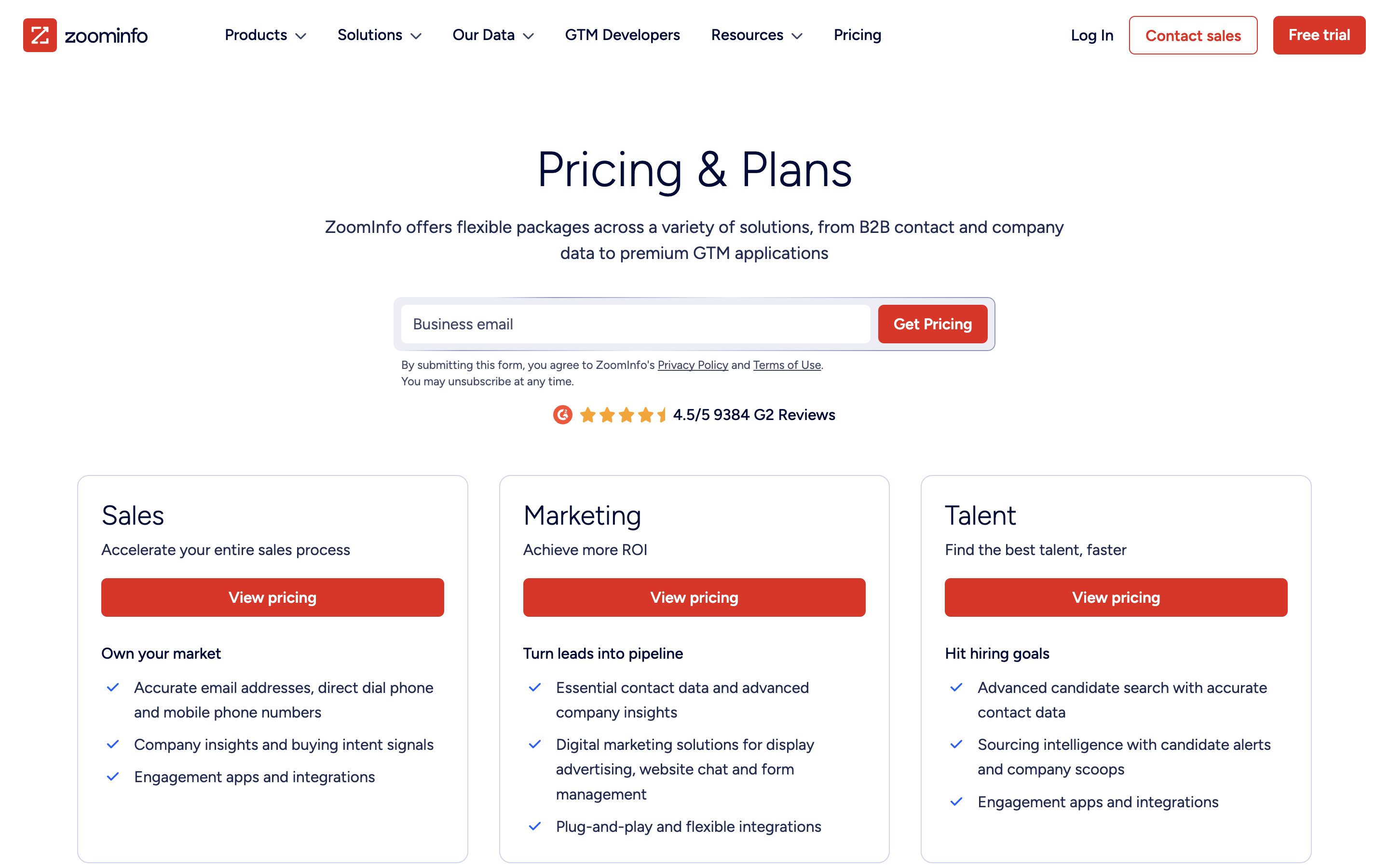
If you were hoping to compute a per-lookup price from this section, so was I. Everyone else on this page can be priced from a browser tab. ZoomInfo can be priced from a phone call.
ZoomInfo pricing: No published price. What does it cost? They'd love to tell you, over the phone.
Best data enrichment service for records that already live in HubSpot
HubSpot (Clearbit)
HubSpot (Clearbit) pros:
- Enrichment runs on contact and company records inside HubSpot, manually, automatically, or in bulk
- HubSpot's guide says it does not consume HubSpot Credits
HubSpot (Clearbit) cons:
- There is no endpoint to call from outside HubSpot
- clearbit.com now reads "Clearbit has joined HubSpot!" and the free logo API shut down on December 8, 2025
Ok, this one's kind of a cheat, because it's on the list to tell you it shouldn't be. Six of the seven roundups a search for this keyword returns still list Clearbit as a service with a database size. It hasn't been one for a while. It's a button inside a paid HubSpot portal, and the last public thing it exposed, the logo API, went away in December 2025. If your records already live in HubSpot, that's genuinely good news: enrichment runs on them without a credit line, and you don't wire anything up. If your records live anywhere else, there's nothing here to call, and you can cross it off.
HubSpot (Clearbit) pricing: Not sold as lookups; included with a paid HubSpot portal.
Which data enrichment service should you use?
- You'd use most of Starter's 2,000 credits every month and want Hunter's six-status verifier: Hunter Starter, billed yearly if you can.
- From a script, with no seat to fill: AnyAPI, until your finds pass 3,181 a month, which is how many finds Starter's $49 buys per request.
- You already pay for an Apollo seat: Apollo Basic, and don't bother with the Free key.
- You need the full record with phone and address and a confidence score to filter on: People Data Labs.
- A GTM team wants to see and edit the waterfall: Clay.
- You have a data team, a contract, and a phone: ZoomInfo.
- Your contacts already live in HubSpot: HubSpot's built-in enrichment.
The rank tracking API roundup is the same exercise for Google results, the LinkedIn MCP server guide covers pulling a profile into an agent, and the Person Enrichment catalog page lists every endpoint with its current price.
A work email from a name and domain for $15.40 per 1,000, verified for $6.60, from one prepaid wallet with no plan. New accounts get about 100 free requests.
Try the Email Tools API
Use data responsibly and follow AnyAPI's Acceptable Use Policy.