The Google reviews API in 2026: why Google gives you five, and how to get the rest


- Google's Places API gives you five reviews per place, picked by relevance. Asking for them makes each call $25 per 1,000 once you're past 1,000 free requests a month.
- Google's full review feed is only for businesses you manage. The Business Profile API is free and returns every review, but only for verified locations on your account, after Google approves your project.
- For any other place, buy reviews from a third-party API. At 1,000 reviews, AnyAPI charges $0.0215, ScrapeBadger $0.15, Apify $0.30 to $0.60, and SerpApi about $0.43.
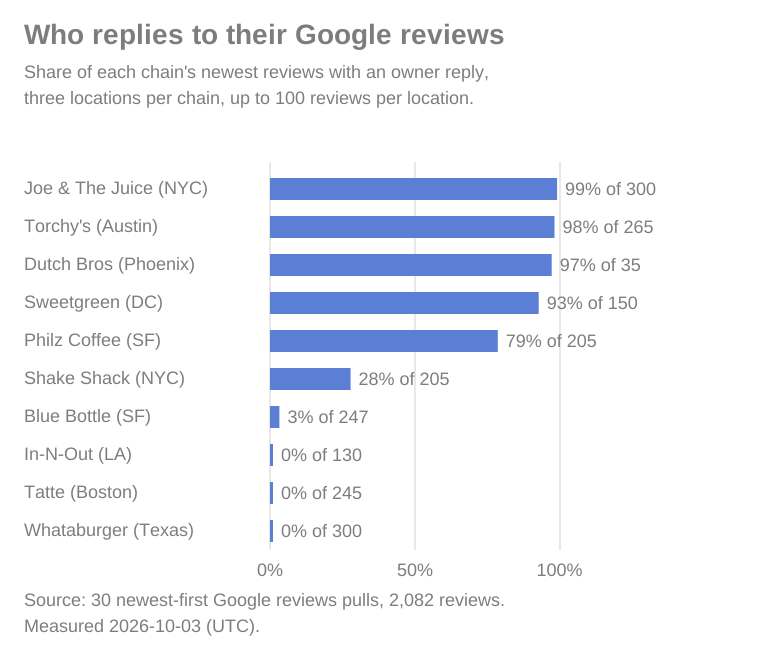
- To watch many locations, pull the newest reviews and compare review IDs. Across 10 chains, some answered nearly every review and others answered none.
Built on AnyAPI
472 scraping and data APIs behind one key.
Every endpoint in this post is one call away. Pay per request in USD from a prepaid wallet, with automatic failover when a provider breaks. No subscription, no card to start.
Get ~160 free requests$0.10 of credit on signup.Maybe you run reputation for a 40-store franchise and the owner wants a Slack alert for every one-star review. Maybe you're comparing your cafes against the chain down the street, or feeding a few thousand reviews into a model to find out what people complain about.
Either way, you go looking for Google's reviews API and find two that each miss the job. I read Google's docs and price lists, pulled reviews for 30 locations of 10 chains through AnyAPI's Google Maps endpoints on October 3, 2026, and priced the rest from their own pages.
Here's what each option is for.
The best Google reviews APIs
- Google Places API for showing a few reviews in your app
- Google Business Profile API for locations you own or manage
- AnyAPI for monitoring many locations, with no plan
- ScrapeBadger for paging through a place's full history
- SerpApi for one plan across every Google surface
- Apify Google Maps Reviews Scraper for bulk exports billed per review
What makes a good Google reviews API?
I'm assuming you're a developer who needs reviews for places you don't control: a chain's locations, a competitor's, or a list of businesses for research. Here's what I compared.
- Whose reviews you can get. Some APIs only cover your own listings.
- How many reviews per place. Five is a sample; a monitor or a sentiment study needs the recent history.
- Sort order. Newest first for monitoring, lowest rating first for complaint hunting.
- Price per 1,000 reviews. The same job everywhere: 1,000 reviews of one busy place.
- AnyAPI: I found each of 10 chains in its home city, then pulled the newest reviews for three locations of each. I also tried the other sort orders and the last-week filter, and ran the monitoring script below twice. That's 57 calls, one at a time, on 2026-10-03.
- Most locations returned the full 100 reviews or every review the place had; the rest returned fewer.
- I didn't check review text and counts against Google Maps itself, and the speeds come from a small run, so treat them as rough.
- Google's two APIs weren't called. Their sections are from Google's docs and price list, read on 2026-10-03.
- ScrapeBadger, SerpApi, and Apify weren't run. Their sections are from their own pages on 2026-10-03, with prices rechecked on 2026-11-05. Outscraper's site wouldn't load for us that day, so it isn't priced here.
- Prices per 1,000 reviews assume each call returns its maximum: 5 for Google, 20 for ScrapeBadger, 60 for SerpApi, 100 for AnyAPI.
The best Google reviews APIs at a glance
| Tool | Best for | Why pick it | 1,000 reviews of one place |
|---|---|---|---|
| Google Places API | Showing a few reviews in your app | Google's own data and terms | Not possible: 5 per place, $25 per 1,000 calls |
| Google Business Profile API | Locations you own or manage | Every review, plus replying from code | Free, your own verified locations only |
| AnyAPI | Monitoring many locations, with no plan | Up to 100 reviews a call, four sort orders | $0.0215 |
| ScrapeBadger | Paging through a place's full history | 20 reviews a page with a next-page token | $0.15 pay as you go |
| SerpApi | One plan across every Google surface | Reviews on the same key as Search and Maps | About $0.43 on the $25 Starter plan |
| Apify Google Maps Reviews Scraper | Bulk exports billed per review | Many places in one run, out to a dataset | $0.60 on Apify's Free plan, $0.30 on Business |
Best Google reviews API for showing a few reviews in your app
Google Places API
Google Places API pros:
- Google's own data, under Google's terms, with an official key
- 1,000 free requests a month at the tier that includes reviews
- The same call can return rating, review count, hours, and photos
Google Places API cons:
- A maximum of 5 reviews per place, with no page token
- Places API (New) sorts them by relevance only
- Asking for reviews puts the call in Google's priciest Place Details tier
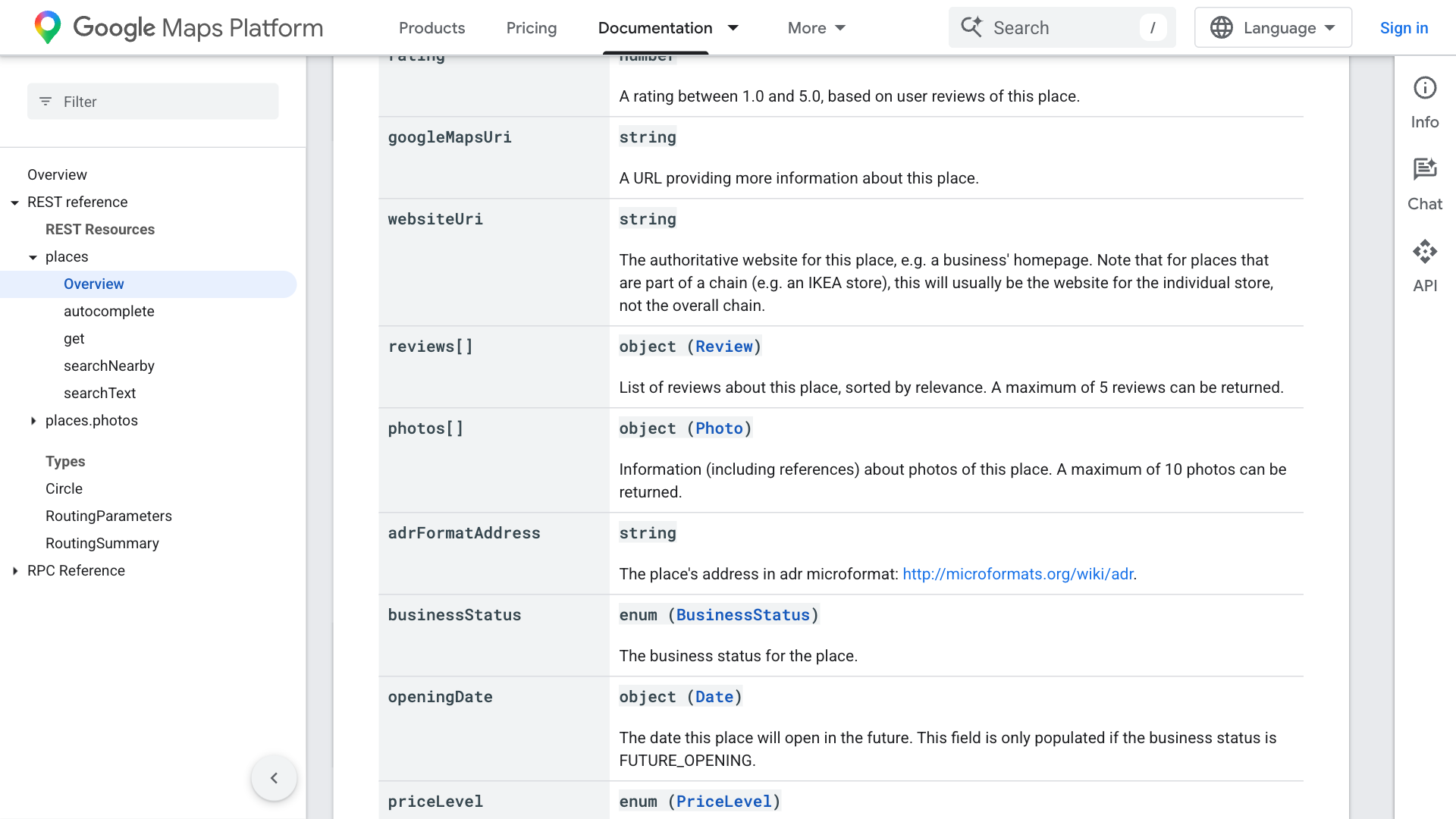
The Places API is what Google means by "reviews API" in its own docs. You ask for a place's details with reviews in the field mask, and you get up to five reviews back. The Place resource reference is plain about it: "List of reviews about this place, sorted by relevance. A maximum of 5 reviews can be returned."
There's no sort option in the new API. The legacy Place Details endpoint has a reviews_sort parameter that takes most_relevant or newest, but it still returns "up to five reviews". Newest-first five is better for a monitor than relevance-first five, and it's still five.
Reviews are billed at the top tier. Google prices a Place Details call by the fields you ask for, and reviews is one of the fields Google bills at its Place Details Enterprise + Atmosphere rate, so the whole call costs that much. That's $25.00 per 1,000 calls up to 100,000 a month, $20.00 to 500,000, and less above that, with the first 1,000 calls each month free.
If you're showing a business's rating and a few quotes on a page, this is the right tool and you can stop here. For monitoring or analysis it can't help, because the review you care about is rarely one of the five Google picks. The Google Maps API pricing guide covers what the rest of the Places API costs.
Google Places API pricing: Place Details with reviews is $25.00 per 1,000 calls (0 to 100,000 a month), $20.00 (to 500,000), $15.00 (to 1 million), $7.50 (to 5 million), and $2.28 above that; 1,000 calls a month free. Source: Google Maps Platform pricing, updated 2026-09-28, read October 3, 2026.
Best Google reviews API for locations you own or manage
Google Business Profile API
Google Business Profile API pros:
- Every review of your location, 50 a page, with a next-page token
- Sort by rating or by last update, and reply to reviews from code
- No charge: Google says it's "available to registered users at no charge"
Google Business Profile API cons:
- Only for verified locations your Google account owns or manages
- Your project needs Google's approval before the API answers at all
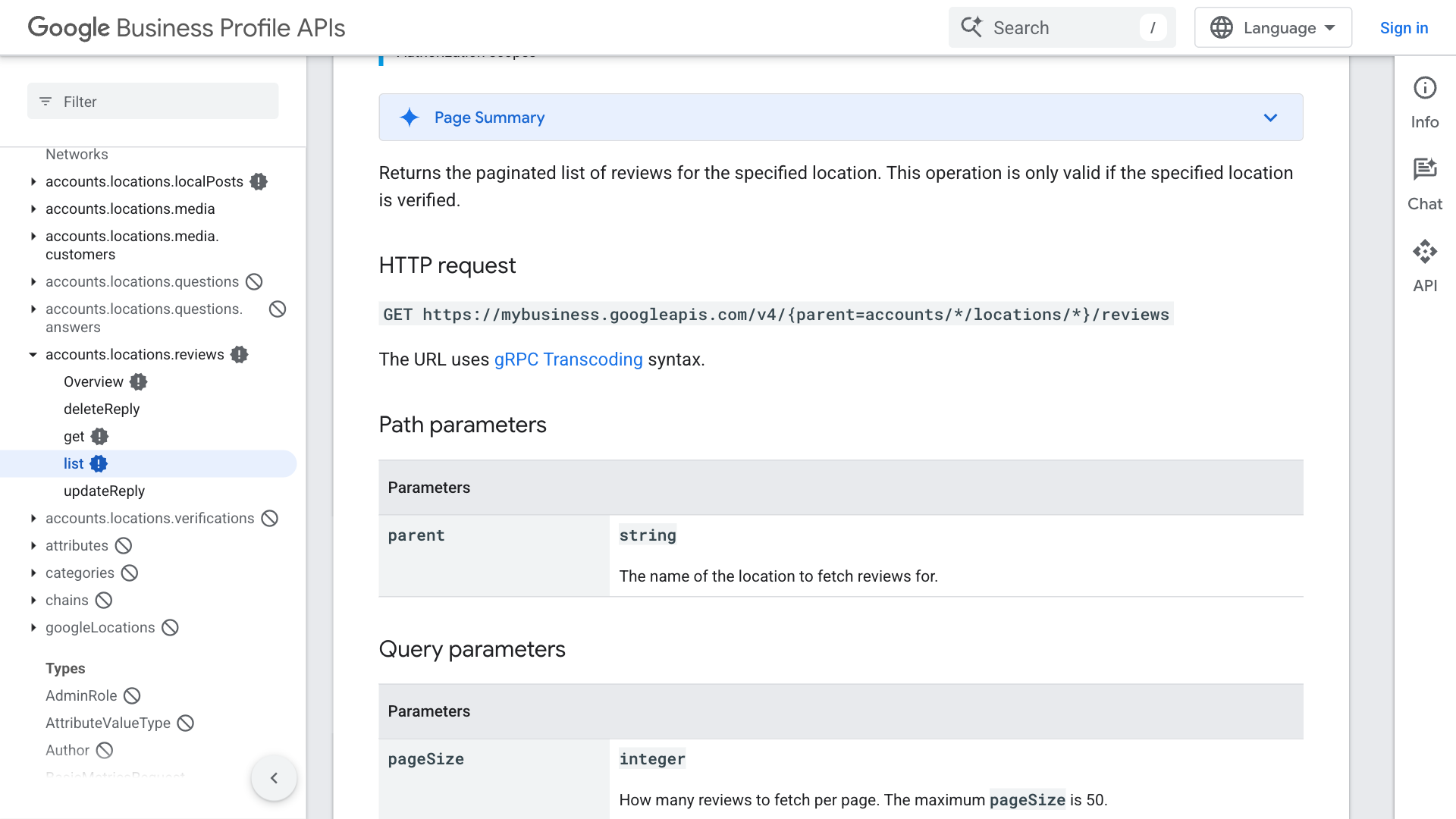
If the reviews are yours, use this. accounts.locations.reviews.list returns a location's reviews 50 at a time, sorted by rating, rating desc, or updateTime desc, along with the average rating and total count. batchGetReviews takes several locations in one request, which is how a franchise pulls every store at once. You can also reply to a review or delete your reply.
The first line of the docs limits it: "This operation is only valid if the specified location is verified." You sign in with OAuth as an owner or manager of the profile. A competitor's store, or a chain you're researching, isn't something this API will touch.
Getting access also takes an application. Google's prerequisites page asks every applicant to manage a Business Profile that's been verified and active for 60 days or more, with a website. You apply with your Cloud project number, and until you're approved the project's quota sits at 0 requests a minute. Approved projects get 300.
Google Business Profile API pricing: no charge. Access needs Google's approval and a verified profile you manage. Sources: pricing and prerequisites, both updated 2026-08-28, read October 3, 2026.
Best Google reviews API for monitoring many locations, with no plan
AnyAPI
AnyAPI pros:
- Any public place, by Google's own place ID, so a competitor's stores work the same as yours
- Up to 100 reviews a call, sorted newest, most relevant, highest, or lowest rating
- Owner replies, reply dates, reviewer IDs, and Local Guide status on each review
AnyAPI cons:
- One call returns at most 100 reviews, with no next page
- A reviews call usually took about 10 seconds, and up to 34
AnyAPI is the pick if you're watching dozens or hundreds of locations you don't manage, and you'd rather pay for what you pull than for a plan. You find the locations with maps.search, then send each place ID to maps.reviews.
curl -sS -X POST 'https://api.getanyapi.com/v1/run/maps.reviews' \
  -H "Authorization: Bearer $ANYAPI_KEY" \
  -H 'Content-Type: application/json' \
  -d '{"placeId":"ChIJ2ewnbrG3t4kRsUOhGHHlO40","sort":"newest"}'
Here's the first of 100 reviews it returned for Sweetgreen on Pennsylvania Avenue SE in Washington on 2026-10-03, trimmed:
{
  "output": {
    "found": true,
    "data": {
      "items": [
        {
          "reviewId": "Ci9DQUlRQUNvZENodHljRjlvT2twZlJHVnlkMDV4T0VkRVlqZDFTemczTTJkRmMxRRAB",
          "rating": 5,
          "text": "I came a few minutes before they closed. The staff was very friendly. The food was super yummy and healthy!!",
          "publishedAgo": "3 days ago",
          "createdUtc": 1790738484,
          "isLocalGuide": true,
          "reviewerReviewsCount": 72,
          "ownerResponse": "Andrew, made our day reading this! We're glad you felt welcomed right up to closing and enjoyed the food's fresh crunch and wholesome feel. Hope you'll swing by again soon!",
          "ownerResponseAt": "2026-09-30T06:28:49Z"
        }
      ]
    }
  },
  "items": 100
}
Every one of the 57 calls came back with a 200, each charged the lowest published price that day. The whole test cost $0.18 at October 3 prices.
| Endpoint | Calls on 2026-10-03 | What came back | Typical time |
|---|---|---|---|
maps.search | 12, one per chain and city | Up to 20 places each, with place ID, address, rating, and review count | 2.7 s |
maps.reviews | 45 | 2,082 reviews from 30 locations on the newest-first pulls; sorting by lowest rating returned only 1-star reviews, by highest only 4 and 5 | 9.9 s |
Here's a monitor you can run on a schedule. It finds a chain's locations, pulls each one's newest reviews, and prints the ones it hasn't seen before. It keeps the review IDs it has seen in a file, so a daily cron job only shows you what's new.
import json, os, requests

API = "https://api.getanyapi.com/v1/run/"
HEADERS = {"Authorization": f"Bearer {os.environ['ANYAPI_KEY']}"}
CHAIN, CITY = "Torchy's Tacos", "Austin, TX, USA"

def run(sku, body):
    r = requests.post(API + sku, headers=HEADERS, json=body, timeout=120)
    r.raise_for_status()
    return r.json()

# 1. Find the chain's locations, keeping only places that carry its name.
places = run("maps.search", {"query": CHAIN, "location": CITY})["output"]["data"]["items"]
locations = [p for p in places if CHAIN.lower() in p["name"].lower()][:3]

# 2. Pull each location's newest reviews and report the ones not seen last run.
seen = json.load(open("seen.json")) if os.path.exists("seen.json") else {}
for place in locations:
    reviews = run("maps.reviews", {"placeId": place["placeId"], "sort": "newest"})["output"]["data"]["items"]
    old = set(seen.get(place["placeId"], []))
    new = [r for r in reviews if r["reviewId"] not in old]
    print(f"{place['address']}: {len(new)} new of {len(reviews)}")
    for r in new[:3]:
        print(f"  {r['rating']} stars, {r['publishedAgo']}: {r['text'][:80]!r}")
    seen[place["placeId"]] = sorted(old | {r["reviewId"] for r in reviews})
json.dump(seen, open("seen.json", "w"))
The first run on October 3 printed every review as new. Run straight after, it found nothing new:
Torchy's Tacos, 1801 E 51st St Bldg D, Austin, TX 78723: 0 new of 25
Torchy's Tacos, 1822 S Congress Ave, Austin, TX 78704: 0 new of 100
Torchy's Tacos, 110 San Antonio St Unit 120, Austin, TX 78701: 0 new of 45
The name filter matters, because Google Maps search matches loosely. "Joe & The Juice" in New York returned 7 of its stores among 20 results, next to Joe's Pizza and Joe Coffee. "Whataburger" in Houston returned one Houston store and 19 elsewhere in Texas, so search with the neighborhood when a chain is dense.
Track reviews by their ID. Google's newest-first order goes by when a review was last edited. Some reviews were marked "Edited", and a few written years ago sat among last week's. A monitor that keeps the newest date it saw would treat those as old news; one that keeps IDs catches them.
The reply data is what makes a chain-wide view useful. Torchy's and Joe & The Juice answered almost every recent review, Shake Shack about a quarter, and In-N-Out, Tatte, and Whataburger none. Also expect blanks: about a third of the reviews had a star rating and no text.
AnyAPI pricing: maps.reviews is billed by the reviews it returns, up to $0.00215 for a full call of 100, or $0.0215 per 1,000 reviews at full calls. maps.search is $0.00175 for up to 20 places. Checking 30 locations once a day is about 900 reviews calls a month, at most $1.94. A call the cheapest source can't answer goes to a backup, which costs up to $0.0441 a call (about 20 times a full call at the usual price) and up to $116.00 per 1,000 searches (about 66 times). maps.search's rating, category, and website filters also route to a dearer source, so filter the results yourself. Prepaid, no plan; new accounts get free credit, no card required.
Best Google reviews API for paging through a place's full history
ScrapeBadger
ScrapeBadger pros:
- 20 reviews a page with a next-page token, so you can walk a place's whole history
- The same four sort orders, plus an offset to resume where you stopped
- 1,000 free credits, no card, and failed requests aren't charged
ScrapeBadger cons:
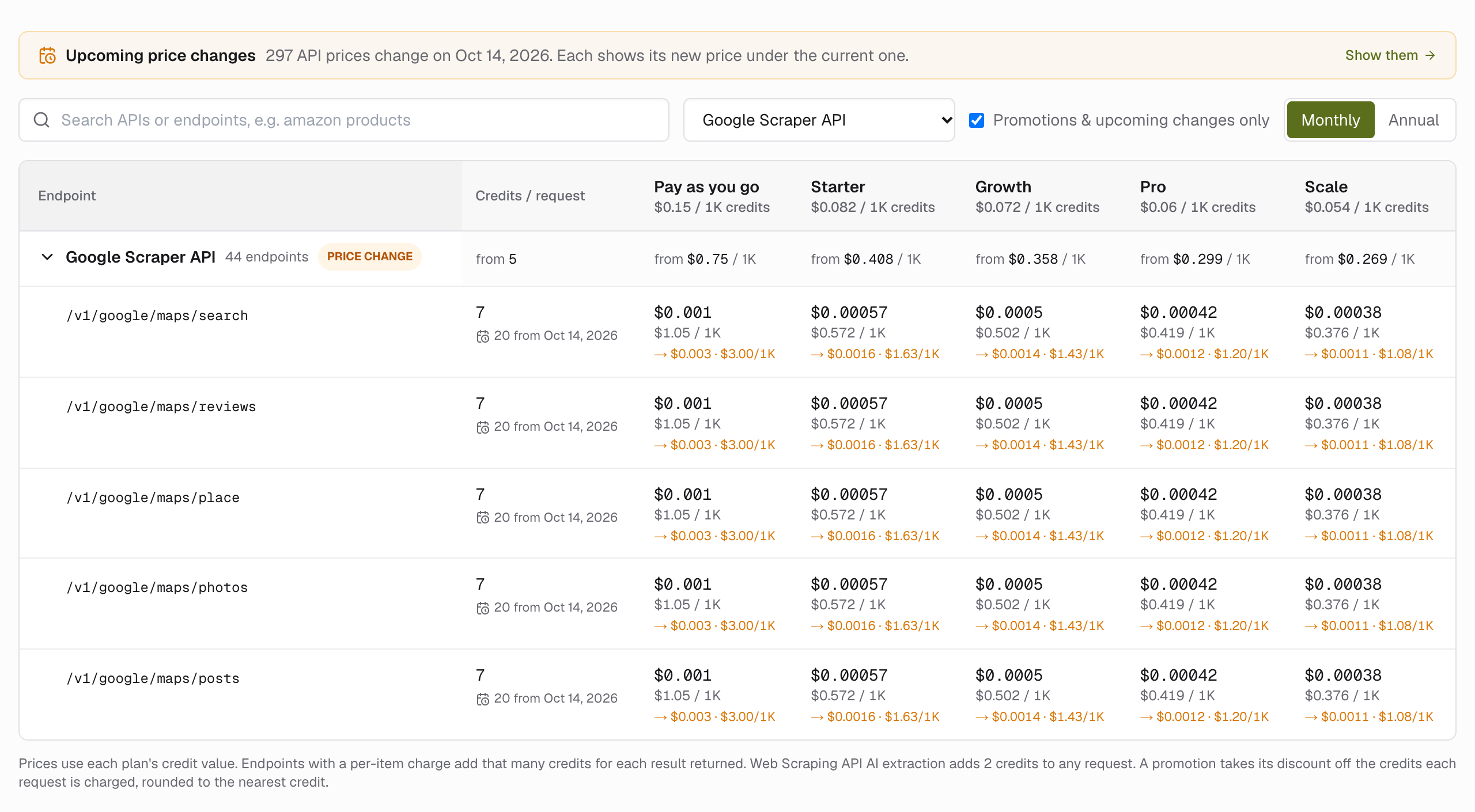
- A reviews request went from 7 credits to 20 in mid-October 2026
- Monthly plans for the best rate; pay-as-you-go credits cost more
ScrapeBadger sells five Google Maps endpoints, reviews among them. Its reviews endpoint takes a place's data ID, returns 1 to 20 reviews a page, and includes a next_page_token for the next 20. If you need every review a place has ever had, paging is the way to get it.
It's also cheap per review. Pay-as-you-go credits are $0.15 per 1,000, and a reviews page of 20 is 20 credits, about $0.003, so 1,000 reviews is about $0.15. That's three times what it was in early October: ScrapeBadger raised a Google Maps request from 7 credits to 20 in mid-October 2026.
ScrapeBadger also wrote one of the better guides to monitoring reviews across many locations. Its advice is sensible: check flagship and struggling stores daily and quiet ones weekly.
ScrapeBadger pricing: 1,000 free credits. Pay as you go is $0.15 per 1,000 credits (from $10), and monthly plans start at $49. A Google Maps reviews request is 20 credits. Source: ScrapeBadger pricing, read November 5, 2026.
Best Google reviews API for one plan across every Google surface
SerpApi
SerpApi pros:
- One key and one plan for reviews, Maps search, Google Search, and dozens of other engines
- Next-page tokens, keyword and topic filters, and a sort parameter
- 250 free searches a month
SerpApi cons:
- Filtering by keyword or topic returns at most 5 reviews, with no next page
- Monthly plans, so you pay for searches you don't use
SerpApi's Google Maps Reviews API is one engine among many on the same account. Each page of reviews costs one search. The docs say the num parameter returns 1 to 60 reviews a page, so 1,000 reviews is about 17 searches.
If you already pay SerpApi for Google Search results, adding reviews is one more engine name. If reviews are all you need, it's roughly $0.43 per 1,000 on the Starter plan, but only if you use the plan's searches every month.
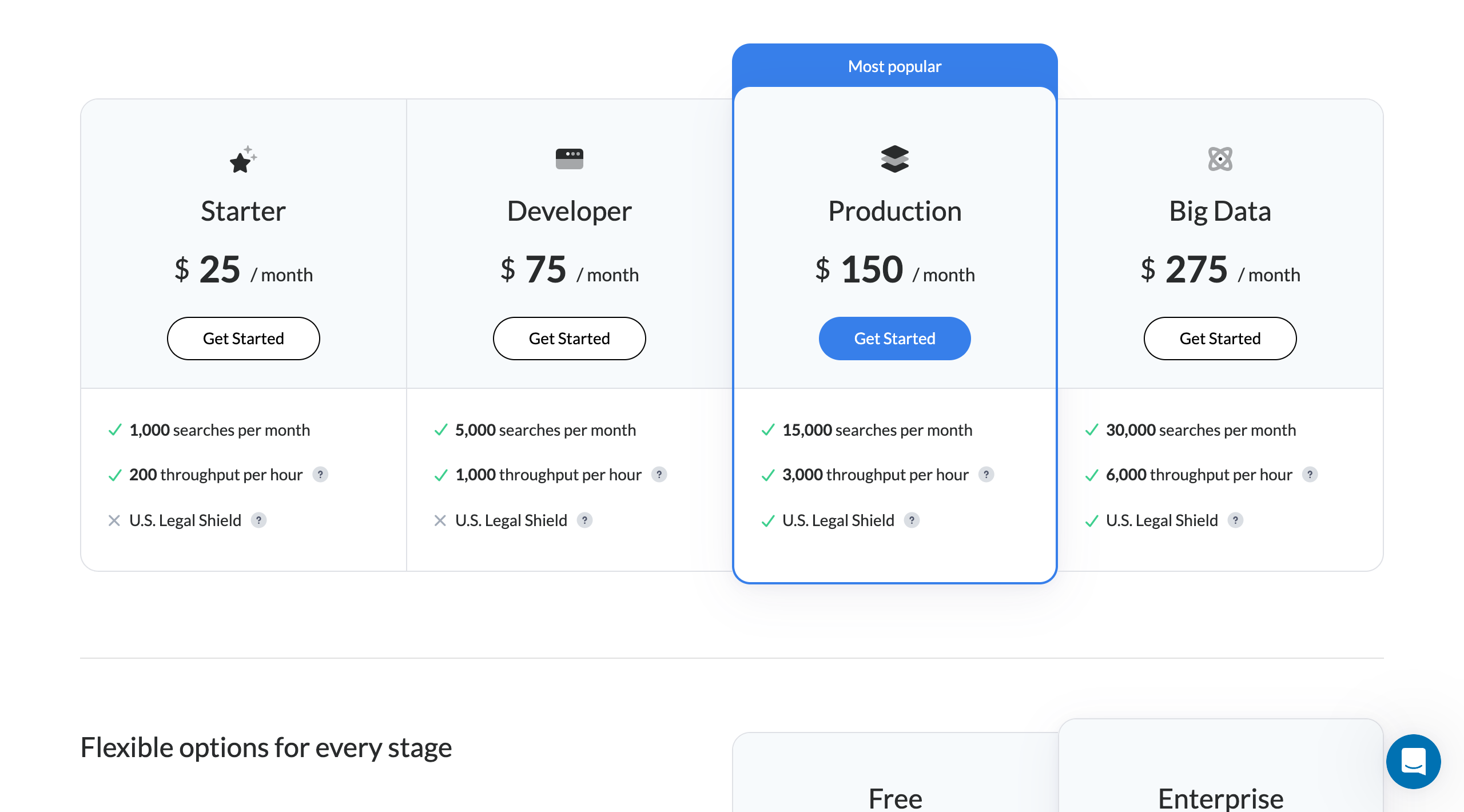
SerpApi pricing: free plan of 250 searches a month. Starter is $25 a month for 1,000 searches, Developer $75 for 5,000, Production $150 for 15,000, and Big Data $275 for 30,000. Source: SerpApi pricing, read November 5, 2026.
Best Google reviews API for bulk exports billed per review
Apify Google Maps Reviews Scraper
Apify Google Maps Reviews Scraper pros:
- Billed per review, so a run over many places costs what it returns
- Runs on a schedule and writes to a dataset you export as JSON or CSV
- Maintained by Apify, with about 68,000 total users
Apify Google Maps Reviews Scraper cons:
- Platform usage is charged on top of the per-review price
- A run is a batch job, so your code waits for it to finish
The Google Maps Reviews Scraper by Compass is Apify's own reviews actor, maintained by Apify. You give it place URLs, and it writes every review it finds to a dataset with the text, date, owner reply, and reviewer details.
It suits a big one-off export, like every review of 500 dentists for a study, where you start a run and collect the file later. For a script that checks a few stores every morning and waits on the answer, a request-and-response API is simpler.
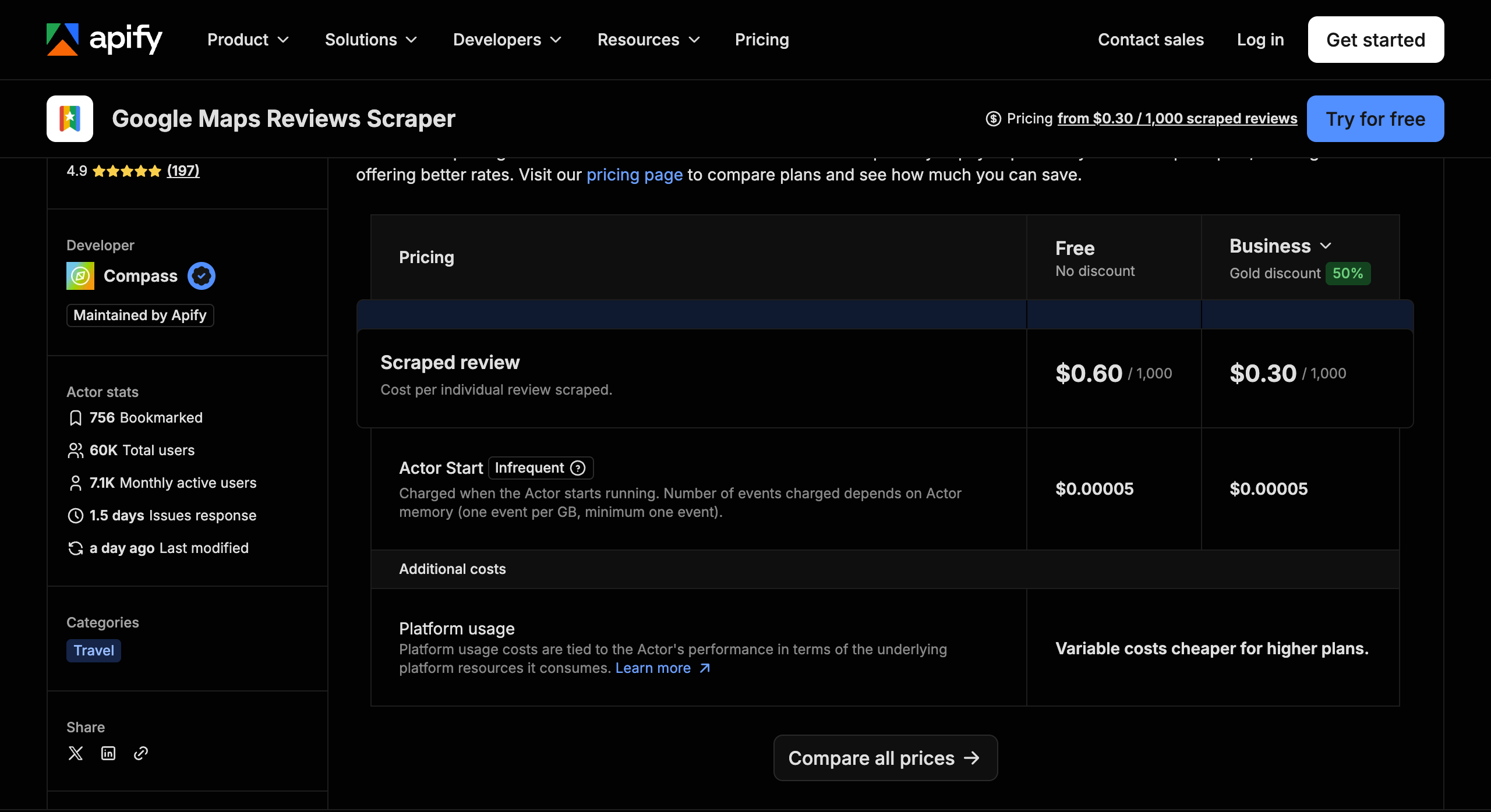
Apify Google Maps Reviews Scraper pricing: $0.60 per 1,000 reviews on Apify's Free plan and $0.30 on Business, plus $0.00005 per run start and platform usage. Source: Apify Store, read November 5, 2026.
Which Google reviews API should you use?
- You want a business's rating and a few quotes on your own page: the Google Places API.
- The locations are yours and you can get Google's approval: the Business Profile API.
- You're watching many locations you don't manage and want to pay as you go: AnyAPI.
- You need every review a place has ever had, page by page: ScrapeBadger.
- You already use SerpApi for Google Search: add its reviews engine.
- You want a one-off export of reviews from hundreds of places: Apify's Google Maps Reviews Scraper.
Whichever you pick, store each review's ID so edited reviews don't slip past. The Google Maps API page lists all of AnyAPI's Google Maps endpoints, and the Google Maps API pricing guide compares what a list of places costs on each route.
Frequently asked questions
- Does Google have a reviews API?
- Two, and neither does the common job. The Places API returns up to 5 reviews for any place, sorted by relevance. The Business Profile API returns every review, 50 a page, but only for locations you own or manage, and only after Google approves your project. For every review of a place you don't manage, you need a third-party API.
- Can I get more than 5 reviews from the Places API?
- No. Google's Place resource docs say a maximum of 5 reviews can be returned, sorted by relevance, and there's no page token for reviews. The legacy Place Details endpoint also returns up to five, though it lets you sort them newest first.
- Can I pull reviews for a competitor's locations?
- Not through Google. The Business Profile API only works for verified locations your account manages. Reviews on Google Maps are public, so the third-party APIs on this page take any place ID, yours or a competitor's.
- How do I spot new reviews without reading them all again?
- Pull each location's newest reviews on a schedule and keep the review IDs you've already seen. Anything with an ID you haven't seen is new. Key on the ID rather than the date, because Google's newest-first order puts recently edited reviews near the top with their original date.
Up to 100 Google reviews a call for $0.00215, sorted the way you need, no plan and nothing that expires. New accounts get free credit, no card required.
Try the Google Maps Reviews API
Use data responsibly and follow AnyAPI's Acceptable Use Policy.