The best time to post on LinkedIn, from 5,683 posts


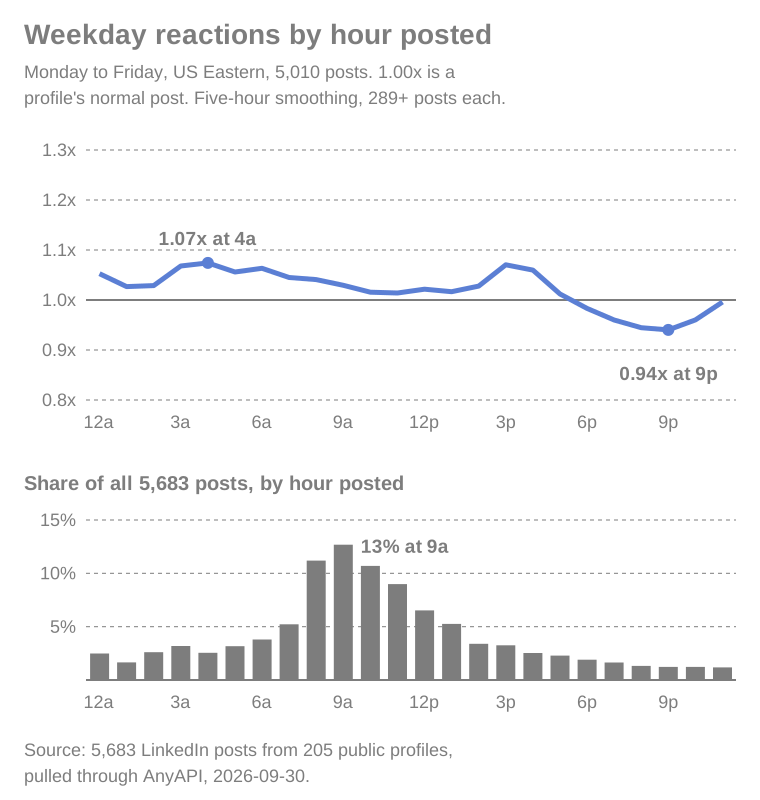
- No hour of the day is the best time to post on LinkedIn. In 5,683 posts from 205 profiles, pulled on September 30, 2026, every smoothed weekday hour stayed between 0.94x and 1.07x of a profile's usual reactions. The widest gap between two four-hour blocks is 1.08x, with an interval from 0.90 to 1.30.
- Weekend posts did better than weekday posts. They ran 1.11x the weekday posts' reactions, interval 1.03 to 1.19, and the gap held for profiles that post on both, for US-based profiles alone, and with the most viral posts taken out. All five of the big guides tell you to avoid the weekend.
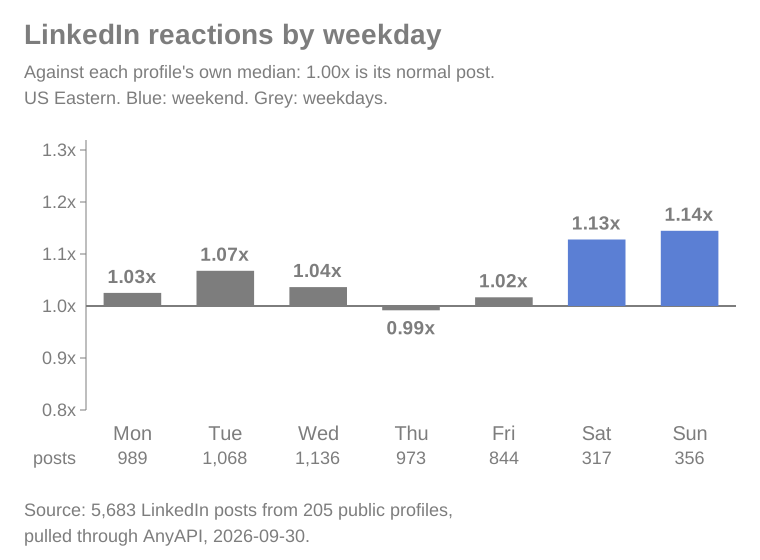
- No weekday stands out. Tuesday was highest at 1.07x and Thursday lowest at 0.99x, and no single weekday cleared against the rest of the week.
- Most people post in the same few morning hours. 46% of all posts went out between 8am and 1pm ET on a weekday, and only 12% went out on a Saturday or Sunday.
Built on AnyAPI
412 scraping and data APIs behind one key.
Every endpoint in this post is one call away. Pay per request in USD from a prepaid wallet, with automatic failover when a provider breaks. No subscription, no card to start.
Get ~150 free requests$0.10 of credit on signup.Buffer, Sprout Social, Hootsuite, SocialPilot, and Later all tell you the same thing about LinkedIn: it's a work network, so post on a weekday and stay away from the weekend. They disagree on the hour, naming anything from 4am to 10pm. This sample backs neither part.
On September 30, 2026, I pulled 5,683 posts from 205 people who post on LinkedIn, across 40 professional niches, and scored each post as its reactions divided by its own author's median reactions. That way a profile with 300,000 followers and one with 3,000 count the same, and a post only scores high if it beat what that person usually gets. Scored that way, the hour of the day barely moves anything, and the weekend posts come out ahead.
At a glance
| Question | What the data says |
|---|---|
| Best time to post | No hour cleared. 4am to 8am ET on weekdays was highest at 1.07x, on 718 posts |
| Worst time to post | 8pm to midnight ET on weekdays at 0.99x, on 215 posts, which doesn't clear either |
| Best day | Sunday at 1.14x and Saturday at 1.13x. The weekend as a whole ran 1.11x weekdays (interval 1.03 to 1.19) |
| Worst day | Thursday at 0.99x, and it doesn't clear against the rest of the week |
| Is the weekend bad for LinkedIn? | Not here. 131 of the 205 profiles posted on a weekend at least once, and those posts beat the weekday ones |
| Does Tuesday to Thursday beat Monday and Friday? | No. 1.01x, interval 0.96 to 1.07 |
| When do people actually post? | 46% of posts between 8am and 1pm ET on a weekday; the busiest hour is 9am, with 13% |
What is the best time of day to post on LinkedIn?
No hour of the weekday gave LinkedIn posts an edge that cleared the noise. Across Monday to Friday, every smoothed hour stayed within about 7% of a profile's normal post: the curve peaks at 1.07x at 4am ET and bottoms out at 0.94x at 9pm, and each point on it holds at least 289 posts.
The four-hour blocks show the same flat line:
| Weekday block (ET) | Reactions vs the profile's median | Posts |
|---|---|---|
| Midnight to 4am | 1.02x | 481 |
| 4am to 8am | 1.07x | 718 |
| 8am to noon | 1.03x | 2,255 |
| Noon to 4pm | 1.03x | 936 |
| 4pm to 8pm | 1.00x | 405 |
| 8pm to midnight | 0.99x | 215 |
The best block against the worst is 1.08x, interval 0.90 to 1.30. Against the rest of the weekday, the 4am to 8am block is 1.05x, interval 0.99 to 1.11. Posts from 6pm onward ran 0.94x the working day (9am to 5pm), interval 0.84 to 1.07, and the lunch hours from 11am to 2pm ran 0.97x the rest of the working day. None of those clears.
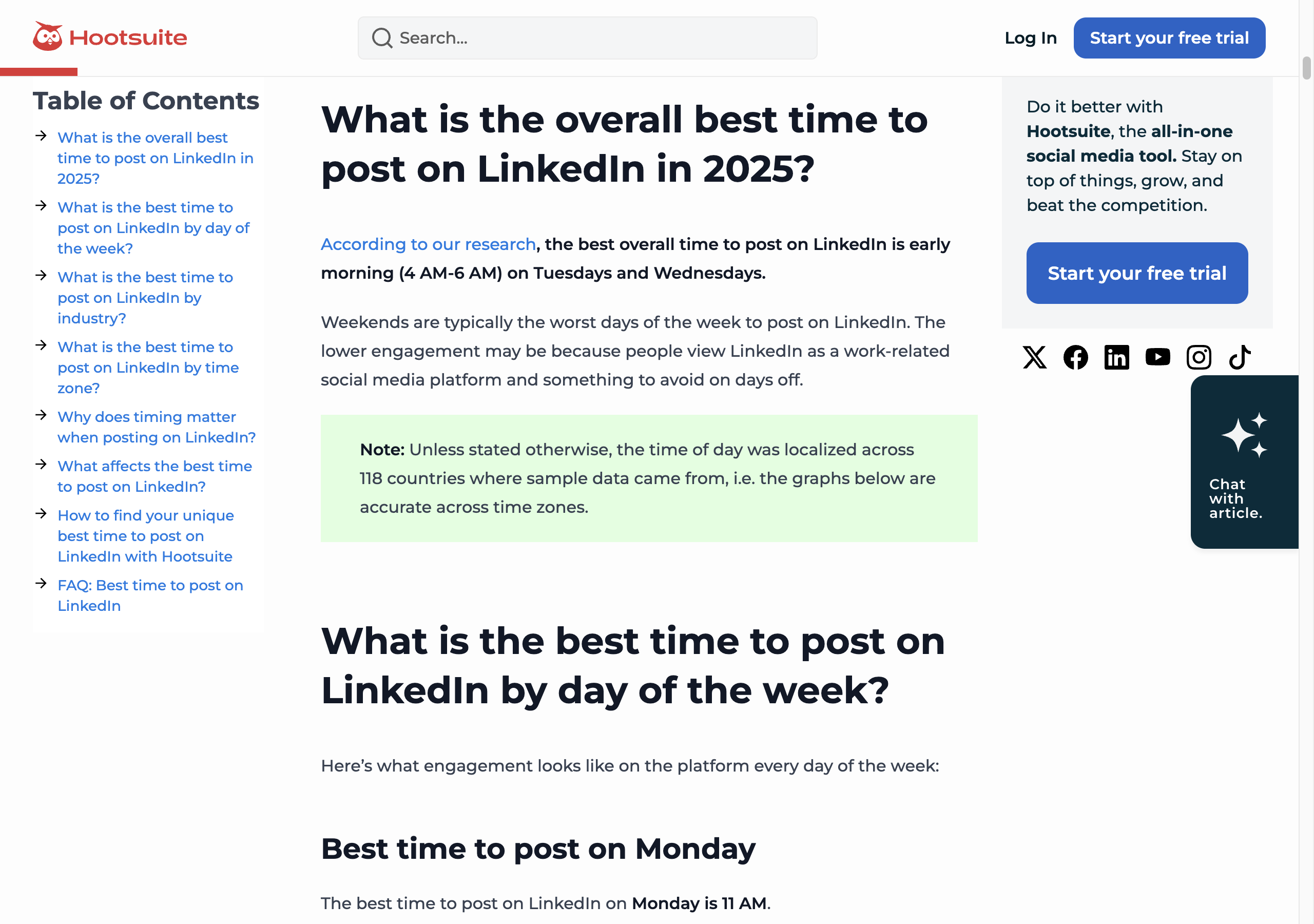
Hootsuite's best overall time, 4am to 6am on Tuesdays and Wednesdays in each poster's local time, is the closest of the five guides to the highest block here, and that block still doesn't clear.
What would make this wrong: a real edge of a few percent. The 4am to 8am block's interval runs from 1% below the rest of the weekday to 11% above it, so an edge that size could hide inside it. It's also not an edge worth rearranging your week for.
The raw hours bounce more, from 0.80x at 7pm to 1.16x at 2am, but on cells of 50 to 659 posts, which is why the chart smooths each hour over two neighbours on either side.
Is it bad to post on LinkedIn on the weekend?
Weekend LinkedIn posts ran 1.11x the same sample's weekday posts, with a 95% interval from 1.03 to 1.19. That's 673 posts from 131 profiles against 5,010, resampled by profile. Sunday posts scored 1.14x a profile's usual reactions and Saturday posts 1.13x.
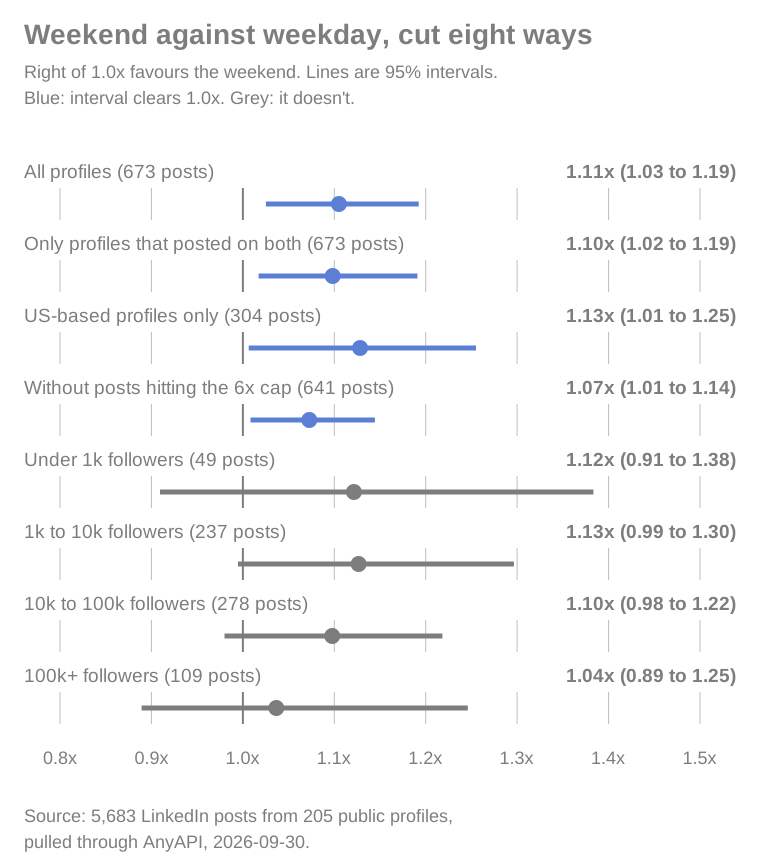
I tried to break it four ways, and it held each time it had the posts to:
| Cut | Weekend vs weekday | 95% interval | Weekend posts |
|---|---|---|---|
| All profiles | 1.11x | 1.03 to 1.19 | 673 |
| Only the 131 profiles that posted on both | 1.10x | 1.02 to 1.19 | 673 |
| US-based profiles only | 1.13x | 1.01 to 1.25 | 304 |
| Without posts above 6x the author's median | 1.07x | 1.01 to 1.14 | 641 |
| Under 1k followers | 1.12x | 0.91 to 1.38 | 49 |
| 1k to 10k followers | 1.13x | 0.99 to 1.30 | 237 |
| 10k to 100k followers | 1.10x | 0.98 to 1.22 | 278 |
| 100k+ followers | 1.04x | 0.89 to 1.25 | 109 |
The US-only cut rules out a time-zone mix-up. 119 of the 205 profiles list a US location, and for profiles abroad a Monday morning can fall on a Sunday in Eastern time. Every follower tier points the same way, but none clears on its own, and the smallest has 11 profiles.
Sprout Social gives the weekend verdict in its summary, from nearly 2 billion engagements across 307,000 profiles:
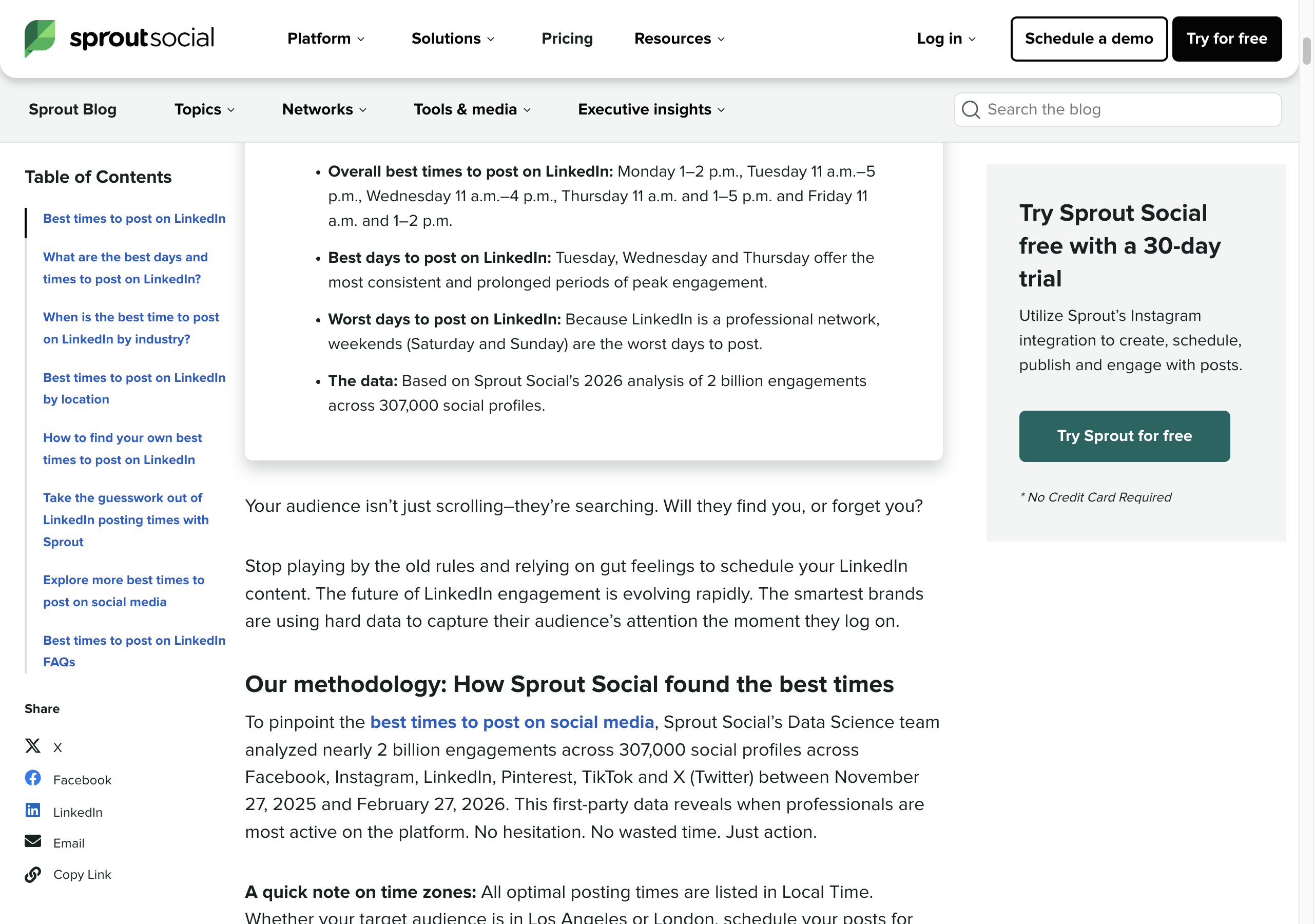
One explanation fits both this and the big guides: fewer people post on Saturday and Sunday, so the posts that do go out compete with less in the feed. What would make this wrong: people saving their strongest posts for the weekend. This sample can't rule that out, because it can't see what a post would have done on a different day.
What it does rule out is a rule against weekend posting. If you've been holding finished posts until Monday, nothing here backs that habit.
Which weekday is best for posting on LinkedIn?
No weekday stood out: Tuesday was the best weekday for LinkedIn posts at 1.07x, and Thursday the worst at 0.99x. Against the rest of the week, Tuesday is 1.03x, interval 0.98 to 1.08, and Thursday is 0.94x, interval 0.88 to 1.00. Neither clears.
| Day (ET) | Reactions vs the profile's median | Posts | Share of all posts |
|---|---|---|---|
| Monday | 1.03x | 989 | 17% |
| Tuesday | 1.07x | 1,068 | 19% |
| Wednesday | 1.04x | 1,136 | 20% |
| Thursday | 0.99x | 973 | 17% |
| Friday | 1.02x | 844 | 15% |
| Saturday | 1.13x | 317 | 6% |
| Sunday | 1.14x | 356 | 6% |
Tuesday against Thursday directly is 1.08x, interval 1.00 to 1.16, which just touches 1.00. That's the widest gap of the ten weekday pairs, chosen after seeing the data, so I don't count it. Tuesday to Thursday together against Monday and Friday is 1.01x, interval 0.96 to 1.07, so the midweek window most guides recommend didn't show up.
People post the way the guides tell them to. 46% of all posts went out between 8am and 1pm ET on a weekday, and 9am alone held 13%.
What do Buffer, Sprout Social, and Hootsuite say about the best time?
The five most-cited LinkedIn timing guides, read on September 30, 2026, all name weekday slots and warn against the weekend, and none of them gives a margin of error for the times it names.
| Guide | Data behind it | Best time it names | Best day | Weekend | Margin of error |
|---|---|---|---|---|---|
| Buffer | More than 4.8 million posts sent through Buffer | 3pm to 8pm on weekdays; Wednesday 4pm strongest | Wednesday | Engagement "drops off significantly" | None given |
| Sprout Social | Nearly 2 billion engagements, 307,000 profiles, six networks | Tuesday 11am to 5pm | Tuesday to Thursday | "The worst days to post" | None given |
| Hootsuite | Over 1 million posts | 8am to 9am Tuesday and Wednesday in its summary; 4am to 6am further down | Tuesday and Wednesday | "Typically the worst days" | None given |
| SocialPilot | More than 683,000 posts | 10am to noon and 1pm to 4pm, Tuesday to Thursday | Tuesday to Thursday | "The worst days to post" | None given |
| Later | Its own social team's posting | 8am and 1pm Eastern | Weekdays | Post "rather than on the weekends" | None given |
| This study | 5,683 posts from 205 profiles, each scored against its author | No hour cleared | Sunday 1.14x and Saturday 1.13x | 1.11x weekday posts | 95% intervals, resampled by profile |
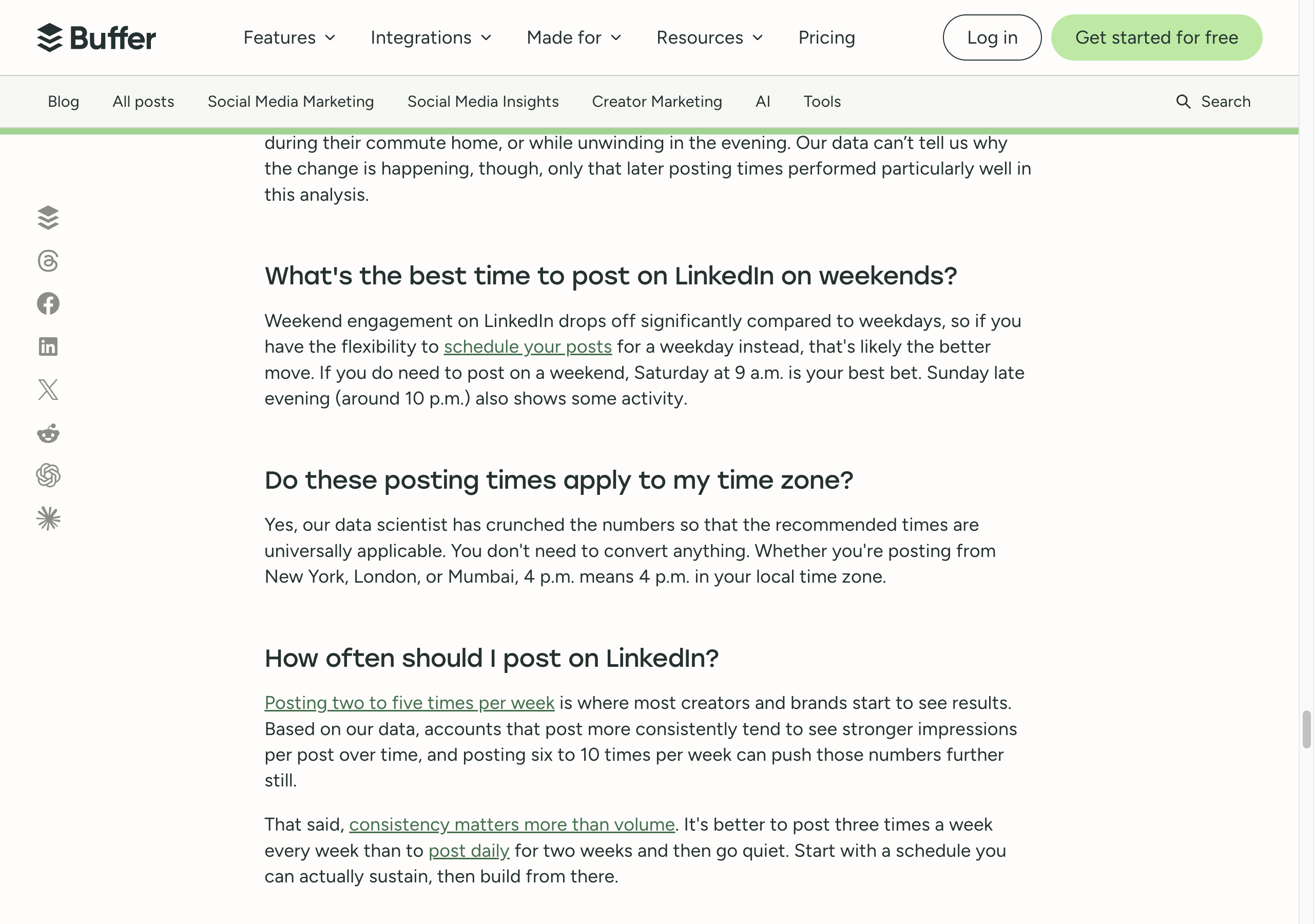
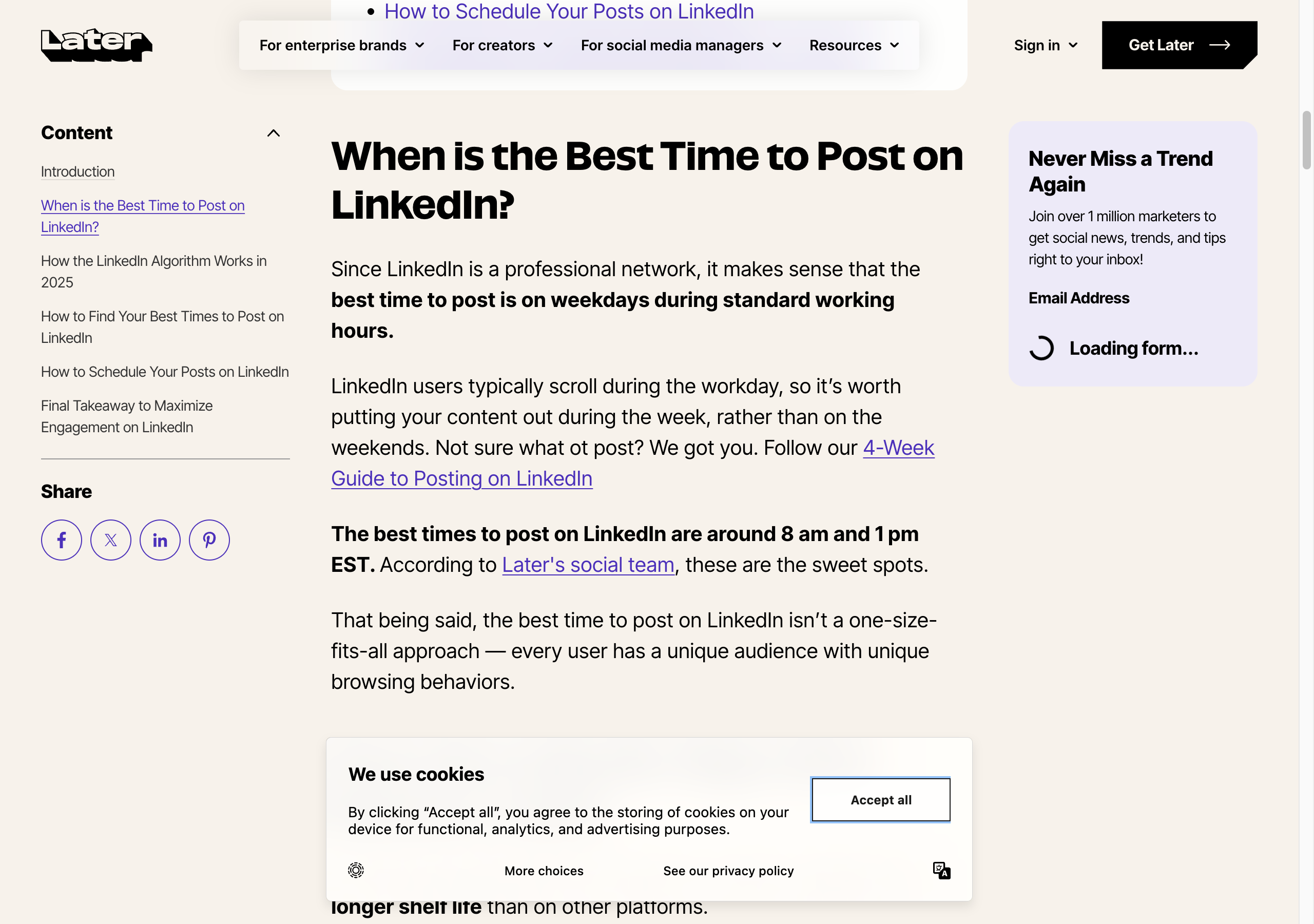
On the hour, this sample can't side with any of them, because no hour stood out. On the day, it disagrees with all five. Tuesday was the best weekday, which fits the midweek days most of them favour, but by a margin that doesn't clear, and the weekend they all warn against came out on top.
The methods land in different places because they measure different things. A study that adds up engagement across millions of posts will find the weekend quiet, because fewer people are scrolling and fewer are posting. This one asks a narrower question: did a post do better or worse than its own author usually does? A quiet feed can be a good place for one post even when it's a bad place for total engagement.
How I measured it
This study scored 5,683 LinkedIn posts from 205 personal profiles, published between September 30, 2025 and September 16, 2026. They came through four LinkedIn endpoints on AnyAPI on 2026-09-30, in 644 calls, and cost $1.66.
- Find people who post. 40 niche searches through
linkedin.search_posts, filtered to the last month, two pages each, from B2B marketing and recruiting to nursing and construction. That turned up 538 personal profiles, with company pages left out, and I took 240 of them round-robin across the niches. - Pull their posts. One
linkedin.profile_posts_thincall per profile, withlimitset to 100, returns that profile's most recent posts with a timestamp and a reaction count on each. Each call returned at most 50, and 196 of the 240 returned exactly 50. - Drop reposts. 2,767 items were reshares of someone else's post, carrying the original author's time and reactions, so they don't count.
- Apply the cutoffs. Posts had to be published between 2025-09-30 and 2026-09-16, so every reaction count had at least 14 days to settle, and a profile needed five scorable posts. That dropped 1,694 posts as too recent, 790 as older than the window, 288 with zero reactions, 34 profiles under five posts, and 1 profile whose posts all reported the same count. That leaves 205 profiles and 5,683 posts.
- Score each post against its own author. Divide each post's reactions by that profile's median, and cap the result at 6x so one viral post counts once. 179 posts hit the cap.
- Bucket and average. Convert every timestamp to US Eastern, group by weekday, four-hour block, and hour, and take the geometric mean of the scores in each group. Hours are smoothed over a five-hour window. Every interval comes from resampling whole profiles 1,000 times.
- Add follower counts and locations.
linkedin.profile_thinandlinkedin.profilegave each profile's followers and location, for the tier and US-only cuts.
Here's one profile's call from the crawl, trimmed to the fields the study reads:
curl -sS -X POST https://api.getanyapi.com/v1/run/linkedin.profile_posts_thin \
  -H "Authorization: Bearer $ANYAPI_API_KEY" \
  -H 'Content-Type: application/json' \
-d '{"url":"https://www.linkedin.com/in/tycholuijten/","limit":100}'{"output":{"found":true,"data":{"items":[{"id":"7510951945600335872","createdUtc":1790750490,"engagement":{"reactions":131,"comments":31,"reposts":0}},"..."]}},"costUsd":0.005}The same post, run again in the dashboard playground that evening, had picked up two more reactions:
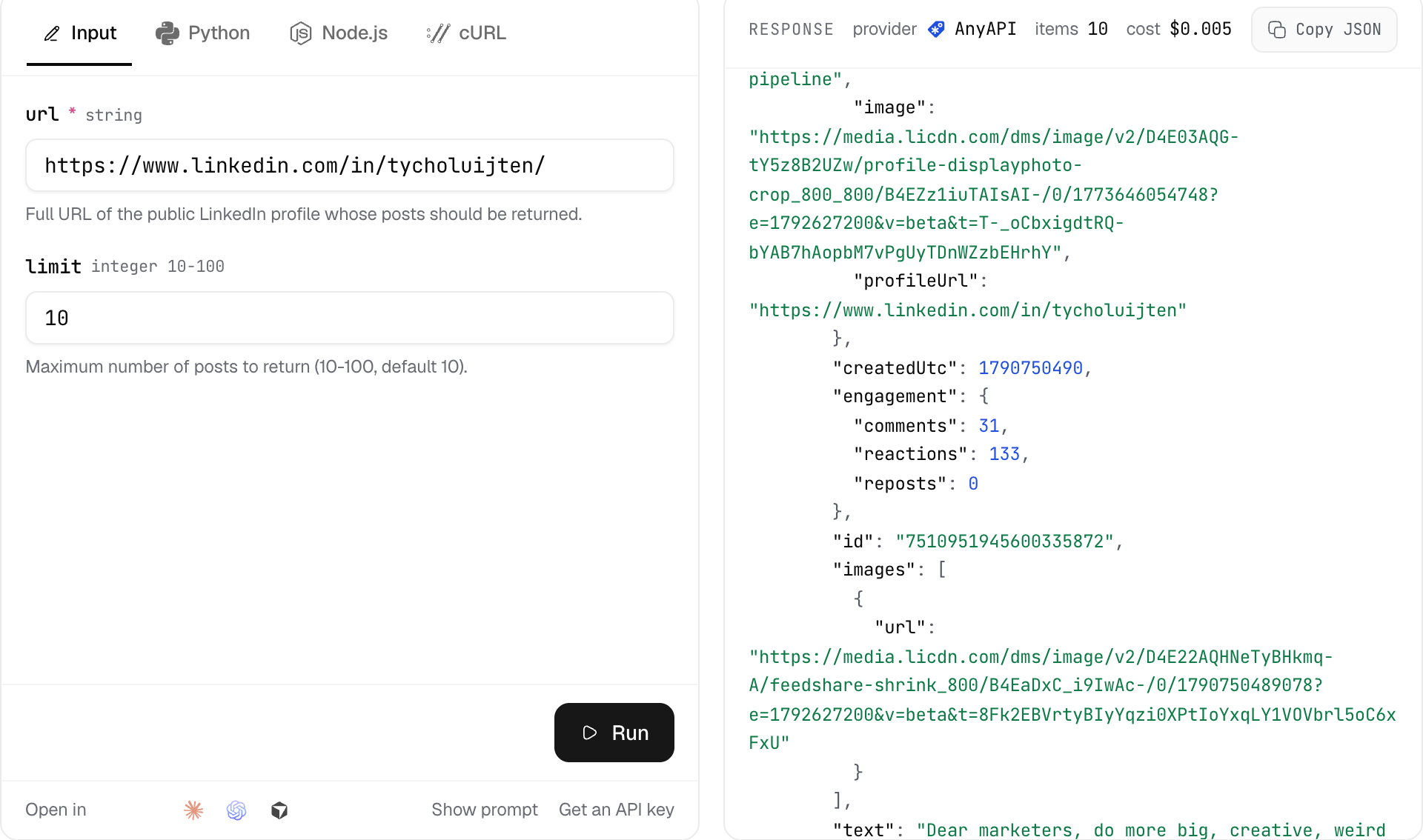
The sample: 16 profiles under 1k followers, 99 between 1k and 10k, 73 between 10k and 100k, and 17 over 100k. The typical profile's typical post had 31 reactions, and the median profile contributed 30 scored posts.
What are the limits of this data?
This LinkedIn study measures reactions only, in US Eastern time, on a convenience sample of 205 personal profiles.
- Reactions only. Each post comes with reactions, comments, and reposts, and no impressions, so nothing here speaks to reach, profile views, or leads.
- US Eastern for everyone. 119 of the 205 profiles list a US location, and the rest were left in Eastern time. The US-only cut gives the same weekend result, but the hour results for the other 86 profiles are shifted by their own time difference.
- Weekend posts are fewer and chosen. 673 posts from 131 profiles. If people save their best material for Sunday, Sunday looks good for reasons that have nothing to do with the day.
- Recent posts weigh more. Each call returns up to 50 posts, so for someone who posts every weekday the sample covers about ten weeks, not the whole year.
- A convenience sample. The profiles came from 40 niche searches over the last month's posts, so they lean toward people who post often about work. A different set of niches could shift an effect this size.
- Personal profiles only. Company pages were left out, and they may behave differently.
- Current follower counts. A profile that grew during the year is labeled by today's size.
The weekend edge is about 11%, with an interval from 3% to 19%. Every hour of the weekday sits inside the noise.
What should you change in your LinkedIn posting schedule?
In 5,683 LinkedIn posts, the weekend was the only change with an edge that cleared, so that's the one worth testing.
- Post on weekdays at whatever hour suits your schedule. No block of the day beat another by a margin that cleared.
- Stop holding finished posts until Monday. Weekend posts ran about 11% above weekday posts here, and the result held on every check with enough posts behind it.
- Test the weekend on your own profile. Post your next few on a Saturday or Sunday and compare them with your median before you make it a habit.
- Don't chase a best weekday. Tuesday to Thursday did no better than Monday and Friday.
- Check your own numbers. Pull your posts with
linkedin.profile_posts_thinatlimit100, drop reposts and anything from the last 14 days, divide each post's reactions by your median, and compare weekend against weekday. One call costs $0.005.
Frequently asked questions
- What is the best time to post on LinkedIn?
- No hour of the day clearly beats another. In 5,683 LinkedIn posts from 205 profiles, pulled on September 30, 2026, the highest weekday block was 4am to 8am ET at 1.07x a profile's usual reactions and the lowest was 8pm to midnight ET at 0.99x, and neither cleared the margin of error.
- What is the best day to post on LinkedIn?
- Sunday and Saturday did best in this study, at 1.14x and 1.13x a profile's usual reactions. Weekend posts as a whole ran 1.11x weekday posts, with a 95% interval from 1.03 to 1.19. No weekday cleared against the rest of the week.
- Is it bad to post on LinkedIn on the weekend?
- Not by this data. Buffer, Sprout Social, Hootsuite, SocialPilot, and Later all call the weekend worse, but scored against each author's own usual reactions, 673 weekend posts from 131 profiles ran 1.11x the same sample's weekday posts.
- Does posting Tuesday to Thursday beat Monday and Friday on LinkedIn?
- No. In this study, LinkedIn posts from Tuesday to Thursday ran 1.01x posts from Monday and Friday, with a 95% interval from 0.96 to 1.07.
- What time zone are these LinkedIn posting times in?
- US Eastern. 119 of the 205 profiles list a US location, and those US profiles alone showed the same weekend result, 1.13x weekday posts with an interval from 1.01 to 1.25.
The Instagram study, the TikTok study, and the Facebook study use the same method on other platforms, and the Facebook one also found Saturday on top. The LinkedIn endpoints are what you'd use to rerun this on your own profile.
Use data responsibly and follow AnyAPI's Acceptable Use Policy.