The best Tavily alternatives for AI agent web search


- For an agent that reads links and snippets, the cheapest Tavily alternative is Google results. On September 30, 2026, Tavily's basic search was $8 per 1,000 on pay as you go (Tavily's credits page). AnyAPI's Google search is $0.40 per 1,000, about 16 times less, and Google's snippets held the answer to all 20 test questions.
- If your agent reads the pages, Tavily is fairly priced. With
include_raw_contenton, one basic search returned full page text for 138 of 191 results at the same one credit. Fetching ten pages yourself costs about as much and takes eleven calls. - Tavily was the fastest search in the test. Its median search took 3.6 seconds against 7.9 seconds for Google results through AnyAPI, and it never took longer than 8.6 seconds.
- For your own index, use Brave; for search by meaning, use Exa. Brave is $5 per 1,000 from an index it crawls itself. Exa starts at $4 per 1,000, with the text of the first ten results included.
Built on AnyAPI
409 scraping and data APIs behind one key.
Every endpoint in this post is one call away. Pay per request in USD from a prepaid wallet, with automatic failover when a provider breaks. No subscription, no card to start.
Get ~150 free requests$0.10 of credit on signup.Your agent calls Tavily a few times per task. Each call turns a question into about ten URLs, a few lines of text from each, and, if you ask, the whole page as markdown. The bill is one credit a search, and in February the company agreed to be bought by Nebius, an AI cloud provider.
So you're wondering two things: whether $8 per 1,000 is a fair price for what your agent actually reads, and what you'd move to. I sent the same 20 questions through Tavily's free plan and through AnyAPI's Google search, web scrape, and Perplexity endpoints, and priced Exa, Brave, and Firecrawl from their own pages.
Whether you should leave comes down to one thing: does your agent read the pages, or just the snippets?
The best Tavily alternatives
- AnyAPI for links and snippets at the lowest price
- Brave Search API for results from an independent index
- Exa for search by meaning, with page text included
- Firecrawl for search and scraping from one balance
What makes a good Tavily alternative?
A good Tavily alternative returns text your agent can answer from, for less per 1,000 searches, without making it wait much longer.
I'm assuming you're building an agent or a RAG pipeline (one that looks things up before it answers) and search is a tool it calls on its own. The model reads what comes back, so the text matters more than the ranking. With that in mind, here's what I compared on:
- Price per 1,000 searches: the cheapest self-serve rate for one search that returns about ten results.
- Page text: whether you can get the whole page back, and what that adds to the bill.
- Did the answer come back: for each question, whether the answer appeared anywhere in the text the API returned.
- Speed: seconds per call, because an agent waits on every search it makes.
- Free tier: what you get before you pay.
- Twenty short factual questions, one call each per API, on September 30, 2026 between 22:14 and 22:22 UTC, with five calls in flight at a time: 20 Tavily searches on its free plan, and 20 Google searches, 20 Perplexity answers, and 60 page scrapes through AnyAPI. Seconds are wall-clock time from request to full response, one day from one machine.
- The questions have one checkable answer each (a port number, a year, a name). A hit means the answer string appeared in the returned text. It doesn't grade ranking, freshness, or research questions that need several sources, where page text matters more.
- Exa, Brave, and Firecrawl weren't called. Exa's signup stopped at a verification check in the test browser; the other two are page reads. Their prices were checked on September 30, 2026.
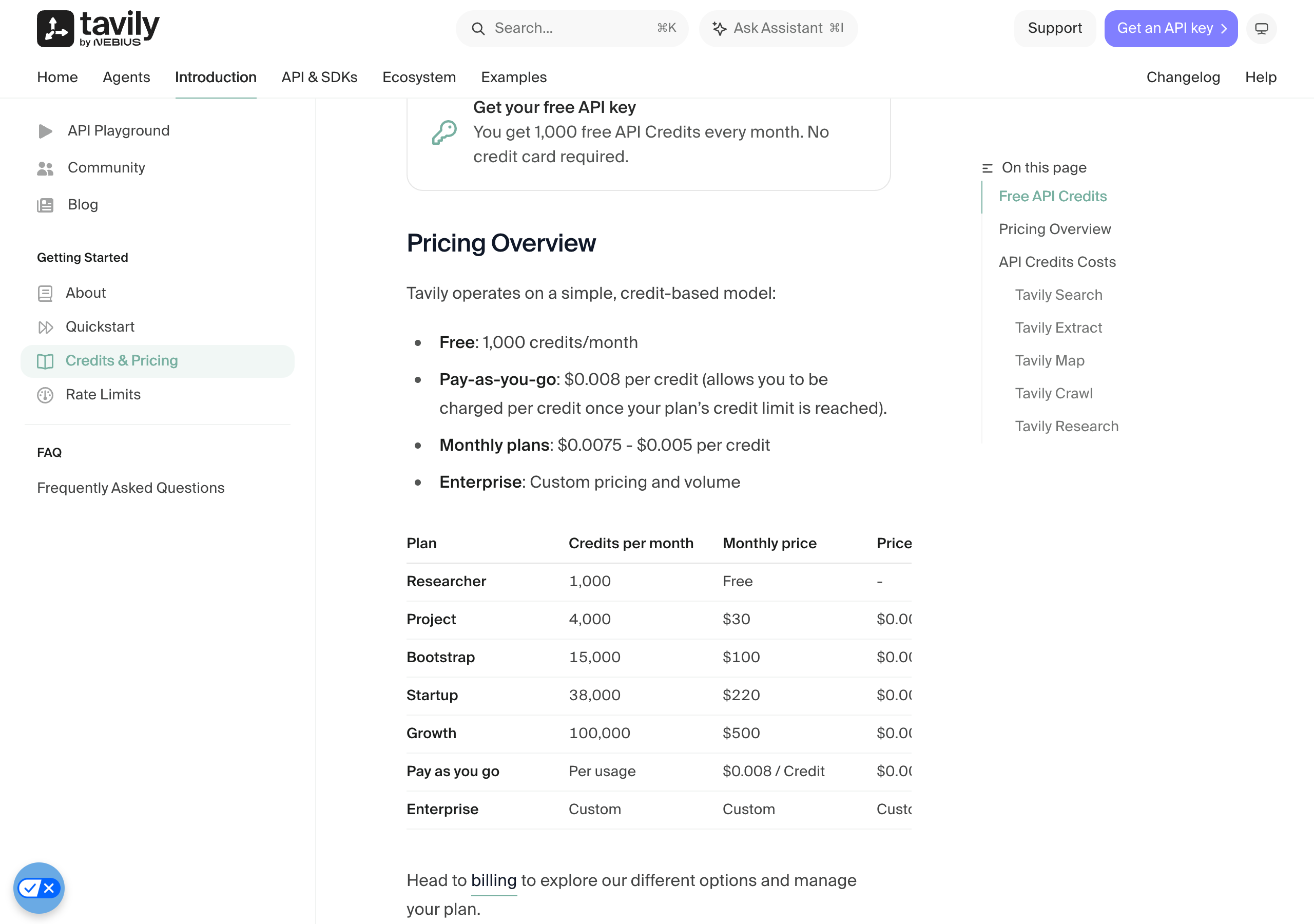
- Tavily is priced at pay as you go, $0.008 a credit. Its monthly plans run from $0.0075 a credit down to $0.005 on the $500 Growth plan.
- Brave, Exa, and Firecrawl bills assume ten results per search.
The best Tavily alternatives at a glance
On September 30, 2026, 1,000 searches of about ten results cost $8.00 on Tavily's pay as you go rate, $7.60 on Firecrawl's Hobby plan, $7.00 on Exa's default search, and $5.00 on Brave. AnyAPI's Google search is $0.40 per 1,000. With the text of all ten pages, Tavily stays at $8.00, Exa at $7.00, and Firecrawl comes to $45.60.
| Tool | Best for | Why pick it | Pricing |
|---|---|---|---|
| Tavily (for reference) | Full page text in the same call | Fastest here, page text at no extra credit | $8.00 per 1,000 basic searches pay as you go, page text included; $5.00 on Growth; 1,000 free credits a month |
| AnyAPI | Links and snippets at the lowest price | Google results, then scrape only the pages you need | $0.40 per 1,000 searches, $0.70 per 1,000 pages; free credit at signup |
| Brave Search API | Results from an independent index | Brave crawls a 40+ billion page index itself | $5.00 per 1,000 requests, no whole-page option listed; $5 of free credit a month |
| Exa | Search by meaning, page text included | Four search speeds, text of ten results included, summaries extra | $7.00 per 1,000 default searches ($4.00 to $15.00 by type), text of ten pages included; $10 of free credit a month |
| Firecrawl | Search and scraping from one balance | One key for search, scrape, and crawl | $7.60 per 1,000 searches on the $19 Hobby plan (2 credits per 10 results), $45.60 with ten pages scraped; 1,000 free credits a month |
Speed is where Tavily earns part of its price. In the same 20-question run, Tavily answered at a median of 3.6 seconds, less than half the 7.9 seconds Google results took through AnyAPI.
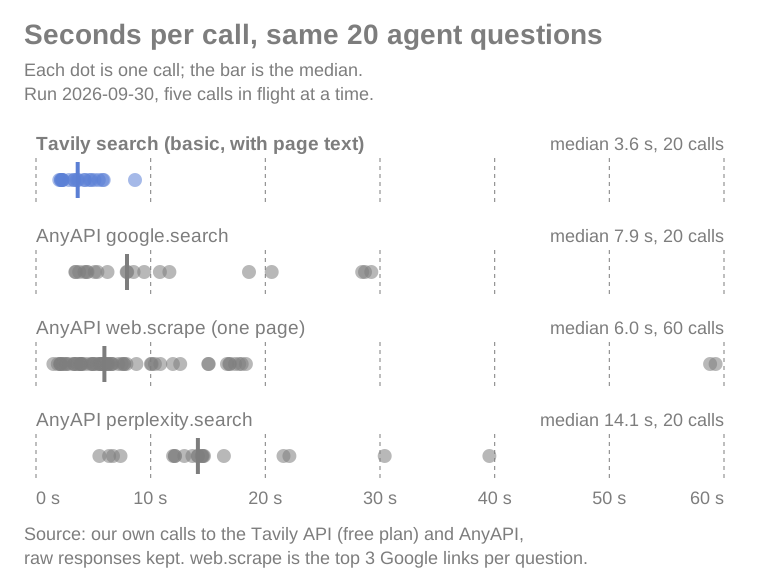
| Call, 20 questions on 2026-09-30 | Calls | Answer in the returned text | Median seconds | Slowest seconds |
|---|---|---|---|---|
| Tavily search, basic with page text | 20 | 20 of 20 in snippets; full text on 138 of 191 results | 3.6 | 8.6 |
AnyAPI google.search | 20 | 20 of 20 in snippets | 7.9 | 29.2 |
AnyAPI web.scrape, top 3 Google links each | 60 | 56 of 60 pages returned text | 6.0 | 59.3 |
AnyAPI perplexity.search | 20 | 19 of 20 | 14.1 | 39.5 |
Best Tavily alternative for links and snippets at the lowest price
AnyAPI
AnyAPI pros:
- Google's snippets held the answer to all 20 questions, the same score as Tavily's snippets
- You pay for page text only on the pages your agent opens
- One key covers Google results, page scraping, and answer engines like Perplexity
AnyAPI cons:
- Twice as slow as Tavily at the median, and 19 to 29 seconds on the five calls where the first source didn't answer
- Reading a page is a second call, so an agent that reads everything makes eleven calls where Tavily makes one
web.scraperefused Reddit and Facebook links and points you to their own endpoints instead
Most agent searches are lookups: a port number, a rate limit, who runs a company. For those, the answer is usually in the snippet, and a snippet is what Google already gives you. In this test the titles and snippets from AnyAPI's google.search carried the answer to every one of the 20 questions, including the one about who bought Tavily. Tavily's snippets did no better, at about 16 times the price.
Here's the call:
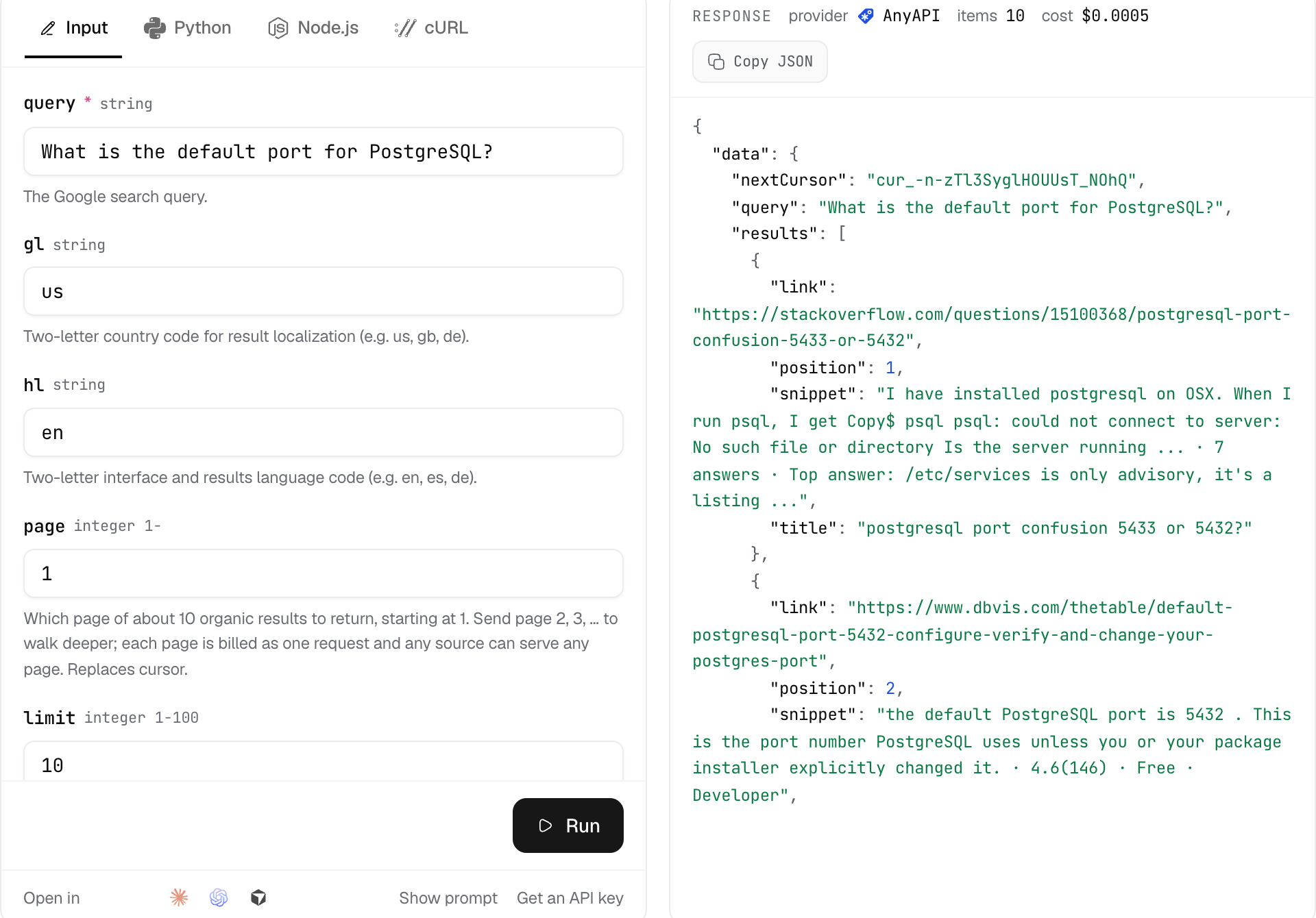
curl -sS -X POST https://api.getanyapi.com/v1/run/google.search \
  -H "Authorization: Bearer $ANYAPI_KEY" \
  -H "Content-Type: application/json" \
  -d '{"query":"What is the default port for PostgreSQL?"}'
And the first of the ten results that came back, with what the call was billed:
{
  "costUsd": 0.0004,
  "output": {
    "data": {
      "query": "What is the default port for PostgreSQL?",
      "results": [
        {
          "position": 1,
          "title": "PostgreSQL :: Fedora Docs Staging",
          "link": "https://docs.stg.fedoraproject.org/en-US/quick-docs/postgresql/",
          "snippet": "Firewall. PostgreSQL operates on port 5432 (or whatever else you set in your postgresql.conf ). In firewalld, to make the change persist after reboot: $ sudo ... Read more"
        }
      ]
    }
  }
}
When the snippet isn't enough, send the link you want to web.scrape and you get the page as markdown:
curl -sS -X POST https://api.getanyapi.com/v1/run/web.scrape \
  -H "Authorization: Bearer $ANYAPI_KEY" \
  -H "Content-Type: application/json" \
  -d '{"url":"https://docs.stg.fedoraproject.org/en-US/quick-docs/postgresql/","formats":["markdown"]}'
I scraped the top three Google links for each question, 60 pages. 56 came back with text, at a median of 6 seconds a page. Two were Reddit and Facebook links, which web.scrape turns away without charging, one timed out, and one hit a rate limit.
Search plus three pages comes to about a third of Tavily's bill. Read all ten results and it's about the same. That's the whole case: the saving is in the pages your agent skips.
Leave out onlyMainContent unless you need it. In this test, asking for main content only was billed at $1.00 to $1.25 per 1,000 pages, while the default request was billed at $0.70 per 1,000 on four of five pages.
If you'd rather get a written answer with sources than a list of links, perplexity.search returns one, with a median of seven citations. It answered 19 of 20. On the question about Tavily's buyer it didn't search at all: "I don't have the necessary current information loaded here to answer definitively." It also took 14 seconds at the median, which is slow for a tool call inside a loop.
AnyAPI pricing: $0.40 per 1,000 searches ($0.0004 each), $0.70 per 1,000 pages, $2.00 per 1,000 answers; prepaid wallet, no plan, free credit at signup
Best Tavily alternative for results from an independent index
Brave Search API
Brave Search API pros:
- Results from Brave's own index of more than 40 billion pages, which it crawls itself
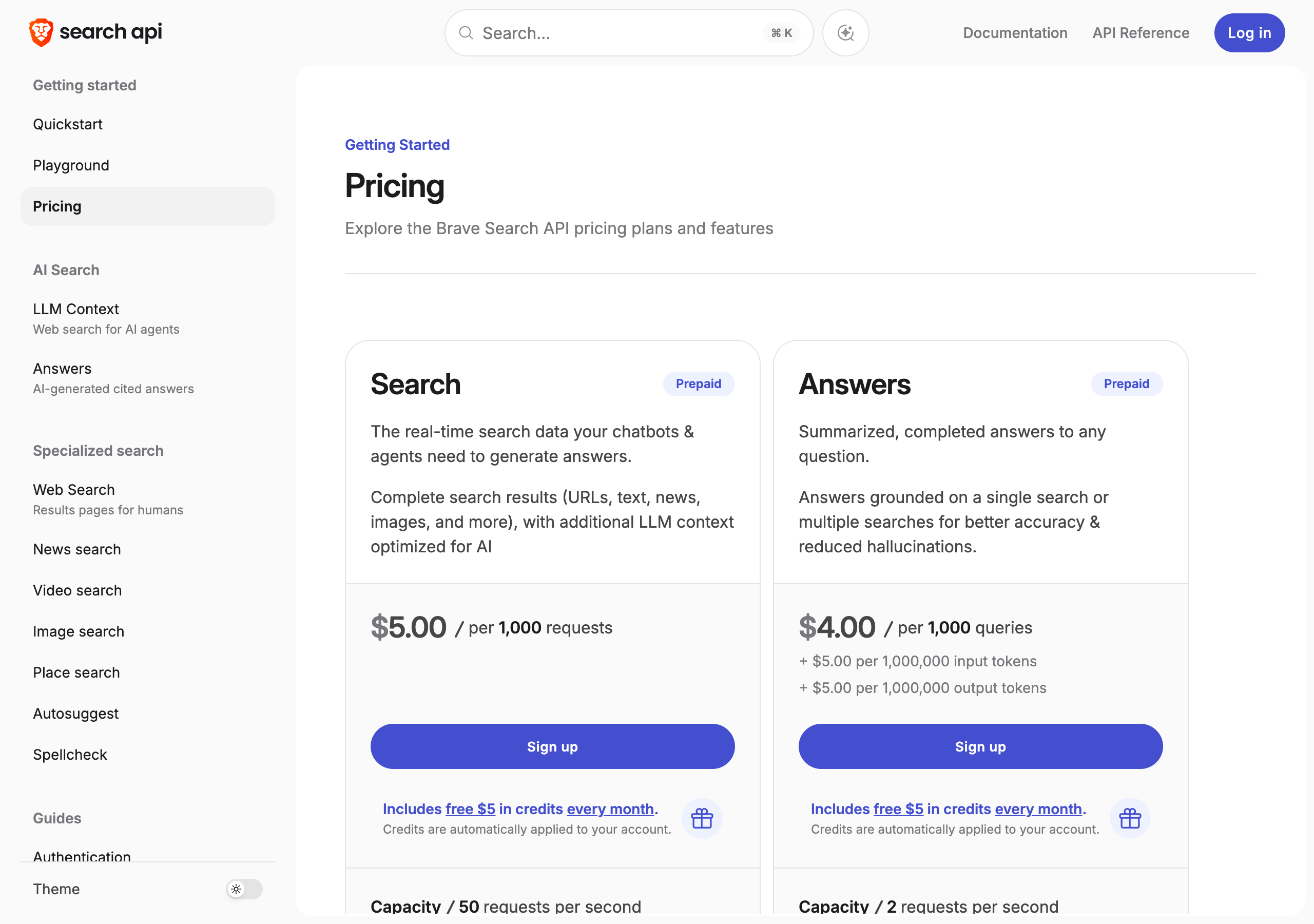
- $5 per 1,000 requests with $5 of free credit every month, which covers 1,000 searches
- 50 requests per second on the search plan
Brave Search API cons:
- Snippets, with no whole-page option on the pricing page
- Not tested here, so I can't tell you its speed or how often the answer came back
Brave is the option if you care where the results come from. Its search engine runs on an index it crawls itself, and the search plan includes what Brave calls "additional LLM context optimized for AI". I didn't test what that returns, so if your agent needs whole pages, plan on a scraper beside it.
At $5 per 1,000 it sits between Google results and Tavily. If your agent reads snippets and you'd rather not depend on Google's ranking, it's the pick. It also sells cited answers at $4 per 1,000 plus $5 per million input and output tokens, but that plan is capped at 2 requests per second.
Brave Search API pricing: $5.00 per 1,000 search requests, prepaid, $5 of free credit a month; Answers $4.00 per 1,000 plus $5.00 per million tokens each way
Best Tavily alternative for search by meaning, with page text included
Exa
Exa pros:
- Its own search engine built on embedding models it trains, so it can match what a page is about, not only its words
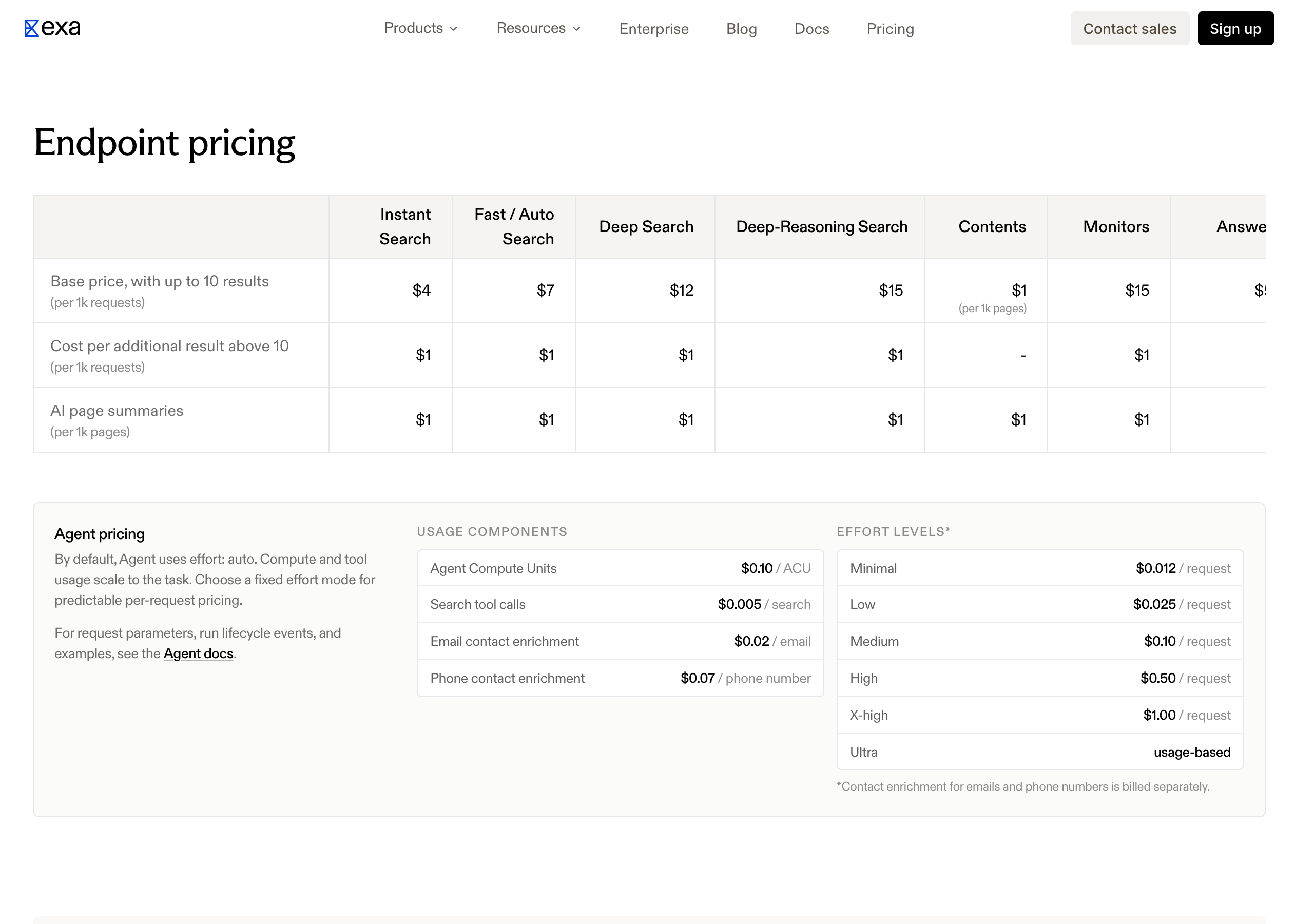
- Four search types, from $4 per 1,000 (instant) to $15 (deep reasoning)
- $10 of free credit a month plus a $10 signup bonus, no payment method needed
Exa cons:
- AI page summaries are $1 per 1,000 pages on top, and so is each result past ten
- Not tested here; I couldn't get past its signup check from the test browser
Exa's embedding search is for queries where you describe the thing rather than name it. If your agent's searches look like that, test Exa on your own questions, because none of the other options here works the same way.
For plain lookups it's priced close to Tavily. Its default auto search is $7 per 1,000 for up to ten results, and since March 2026 that includes the text of all ten, so $7 per 1,000 searches with page text, a dollar under what Tavily charges for the same thing.
Exa pricing: $4.00 (instant), $7.00 (fast and auto), $12.00 (deep), $15.00 (deep reasoning) per 1,000 searches with up to 10 results, $1.00 per 1,000 each extra result; text of the first 10 results included; contents for other URLs $1.00 per 1,000 pages per content type; $10 free credit a month
Best Tavily alternative for search and scraping from one balance
Firecrawl
Firecrawl pros:
- Search, scrape, and crawl draw on one credit balance, with one key
- Can scrape every search result in the same call
- 1,000 free credits a month, no card, and its docs say search works without a key to start
Firecrawl cons:
- The dearest route to page text: 12 credits for a search plus ten pages
- Its docs say results come from "our upstream search provider", so it isn't an index of its own
- Hobby, Standard, and Growth credits don't roll over
Firecrawl is a scraping API first. If your agent already scrapes pages through it, adding search there keeps one bill and one key. That's the reason to pick it.
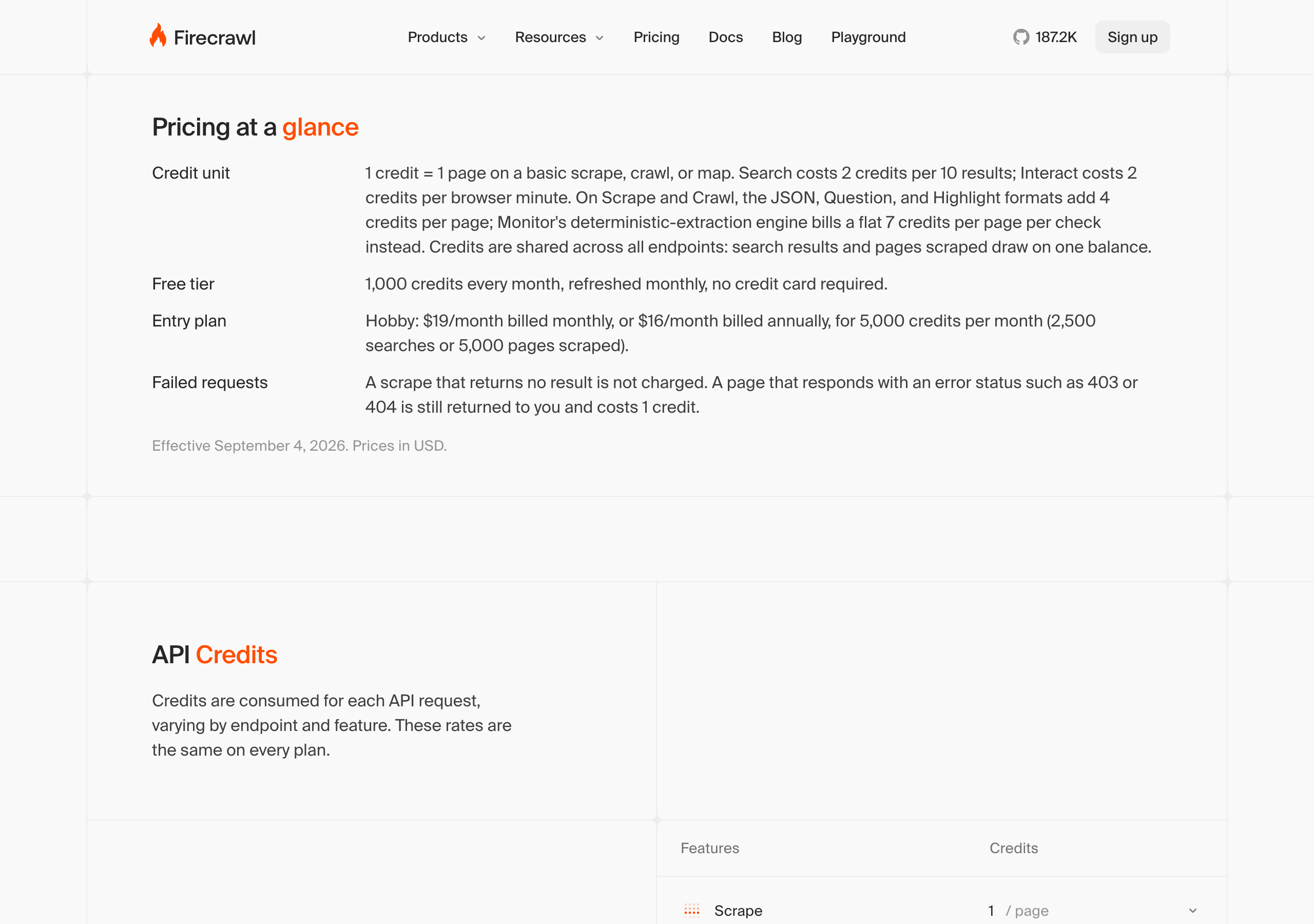
Search costs 2 credits per 10 results, and each page scraped from the results is 1 more. On the $19 Hobby plan (5,000 credits) a bare search is about $7.60 per 1,000, close to Tavily. A search that also scrapes ten pages is 12 credits, about $45.60 per 1,000 searches, several times what Tavily charges for page text. If you're comparing Firecrawl with other scrapers rather than with Tavily, the Firecrawl alternatives page does that.
Firecrawl pricing: 2 credits per 10 search results, 1 credit per scraped page; free 1,000 credits a month; Hobby $19 a month for 5,000 credits, pay as you go in $5 steps on paid plans
Which Tavily alternative should you use?
The right Tavily alternative depends on whether your agent reads whole pages or only the snippets.
- Your agent reads snippets and rarely opens a page: AnyAPI's Google search, and scrape the one page you need.
- Your agent reads most of the pages it finds, or waits on every search: stay on Tavily with
include_raw_content. - You want results that don't come from Google: Brave Search API.
- Your queries describe things rather than name them: Exa.
- You already scrape with Firecrawl and want one bill: Firecrawl's search.
- Under 1,000 searches a month: Tavily's free plan or Brave's free credit, both of which cover it.
If Google results are the part you need, the cheapest SERP API comparison prices seven vendors at three monthly volumes. The Google Search API page and the web scrape page have the live request format and the current price of each source.
Frequently asked questions
- How much does Tavily cost?
- Tavily's basic search costs 1 credit and advanced search costs 2. On September 30, 2026, Tavily's credits page priced pay as you go at $0.008 a credit, so $8 per 1,000 basic searches, and monthly plans at $0.0075 down to $0.005 a credit on the $500 Growth plan. The free plan includes 1,000 credits a month.
- What is the cheapest Tavily alternative?
- AnyAPI's google.search is the cheapest option compared here, at $0.40 per 1,000 searches against Tavily's $8 per 1,000 on pay as you go. In a test of 20 agent questions on September 30, 2026, Google's snippets held the answer to all 20, the same as Tavily's. Tavily is still the better buy if your agent reads the full text of most pages it finds, because Tavily includes page text at no extra credit.
- Is there a free Tavily alternative?
- Brave Search API includes $5 of free credit a month, which covers 1,000 searches at $5 per 1,000. Exa gives $10 of free credit a month, and Firecrawl gives 1,000 free credits a month, which is 500 searches at 2 credits each. Tavily's own free plan covers 1,000 basic searches a month.
- Who owns Tavily?
- Nebius, an AI cloud company, announced an agreement to acquire Tavily on February 10, 2026. Tavily's docs now carry a "by Nebius" logo.
- Does Tavily return the full text of each page?
- Yes, Tavily returns page text when you set include_raw_content. In 20 basic searches on September 30, 2026, it returned full page text for 138 of 191 results, and each search still cost 1 credit.
Google results and page scraping as clean JSON, billed per request from a prepaid wallet, no plan and nothing that expires. New accounts get free credit, no card required.
Try the Google Search API
Use data responsibly and follow AnyAPI's Acceptable Use Policy.