The Facebook Marketplace API in 2026: what Meta offers, and how to get listing alerts


- Meta's only Marketplace search API is for academic and nonprofit researchers. Its Marketplace Partnerships APIs only upload, update, or delete a partner's own listings, and Meta Content Library API, which does search listings, is limited to academic and not-for-profit research institutions.
- To search Marketplace from code, use a hosted Marketplace API. AnyAPI returned 24 listings on all 20 searches tested, in a median of about 2 seconds, newest first.
- A new-listing alert is a scheduled newest-first search that remembers the newest posting time it has seen. The script in this guide does it in under 30 lines and caught new listings on its second run.
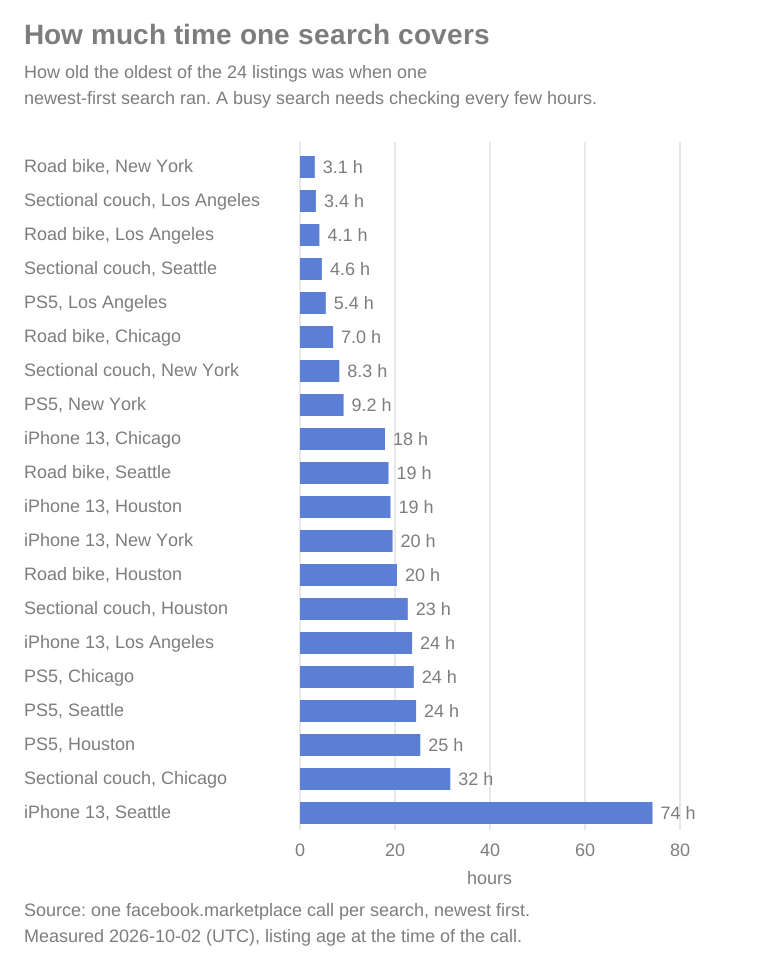
- How often to check depends on the search. One page of 24 listings covered about 3 hours for a road bike in New York and about 74 hours for an iPhone 13 in Seattle.
Built on AnyAPI
471 scraping and data APIs behind one key.
Every endpoint in this post is one call away. Pay per request in USD from a prepaid wallet, with automatic failover when a provider breaks. No subscription, no card to start.
Get ~160 free requests$0.10 of credit on signup.The good listings on Facebook Marketplace go fast. A road bike priced to sell, a sectional someone needs gone by Saturday, a PS5 under retail: by the time you open the app, three people have already asked "Is this still available?"
So you want a script that watches a search near you and tells you the minute something new shows up. That needs an API, and Meta's developer docs have two that mention Marketplace. I read both on October 2, 2026, then ran 20 searches across five cities and 20 listing lookups through AnyAPI's Marketplace endpoints, built an alert on top, and priced the rest from their own pages.
Here's who each option is for.
The best Facebook Marketplace APIs
- Meta Marketplace Partnerships for listing your own inventory
- Meta Content Library API for academic and nonprofit research
- AnyAPI for searches and new-listing alerts from code
- Apify Facebook Marketplace Scraper for scheduled exports with seller details
- Bright Data Facebook Marketplace Scraper API for large batch collection
What makes a good Facebook Marketplace API?
I'm assuming you're a reseller, a flipper, or a small shop that wants new listings for a few searches near you without refreshing the app. Maybe you're building that tool for other people. Here's what I compared.
- Search by keyword near a place. Marketplace is local, so a search that can't take a location isn't much use.
- Newest listings first. An alert only works if the newest listings come back at the top.
- Access without an application. A partner program or a research review is fine for some readers and a dead end for most.
- Price at your volume. Every rival here bills per listing or per record, so each is priced per 1,000.
- AnyAPI: 4 searches ("road bike", "sectional couch", "iphone 13", "ps5") in each of New York, Los Angeles, Chicago, Houston, and Seattle, sent once each to
facebook.marketplacesorted newest first. Then the second listing from each search went tofacebook.marketplace_item. Two place-name lookups, and 9 more searches from two versions of the alert script below. That's 51 calls, one at a time from one machine, on 2026-10-02. - Search filters other than the newest-first sort, and paging past the first 24 listings, weren't tested. Speeds come from 20 calls per endpoint, so treat them as a rough guide, not a benchmark.
- Meta's APIs weren't called. The partner APIs need a partner catalog, and Content Library needs an approved research application, so their sections are read from Meta's developer docs on 2026-10-02.
- Apify and Bright Data weren't run. Their sections are from their own pages on 2026-10-02.
The best Facebook Marketplace APIs at a glance
| Tool | Best for | Why pick it | Pricing |
|---|---|---|---|
| Meta Marketplace Partnerships | Listing your own inventory | Your products appear in Marketplace search and feed | No published price; for eligible partners |
| Meta Content Library API | Academic and nonprofit research | Meta's own search over public Marketplace listings | No fees on Meta's Secure Research Environment; access by application |
| AnyAPI | Searches and new-listing alerts from code | Keyword search near a point, newest first, and full listing details, billed per call | $1.20 per 1,000 searches ($0.05 per 1,000 listings at 24 a search) |
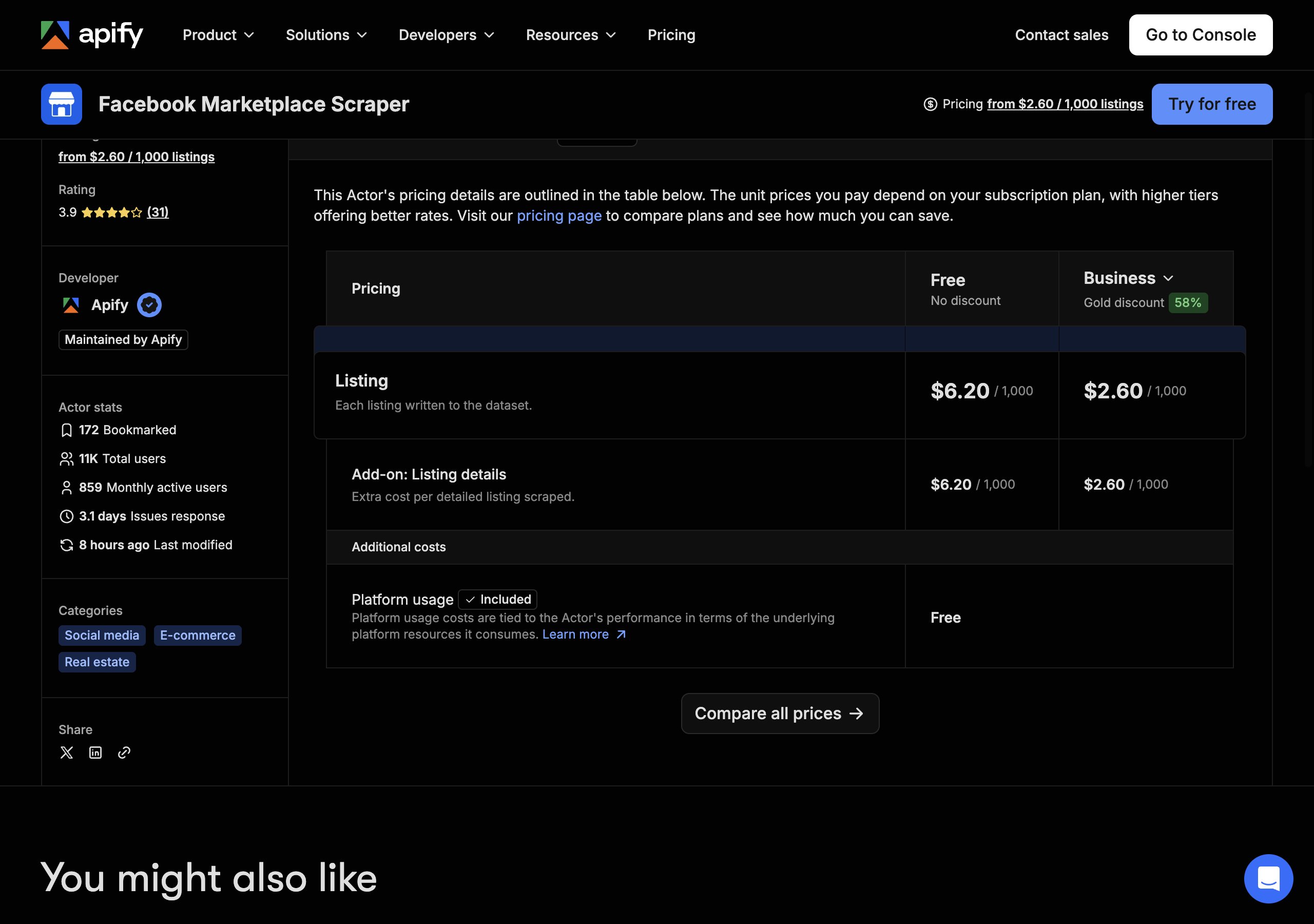
| Apify Facebook Marketplace Scraper | Scheduled exports with seller details | Runs on Apify on a schedule, with seller details and sold, live, or pending status | $6.20 per 1,000 listings on the Free plan, $2.60 on Business; listing details extra |
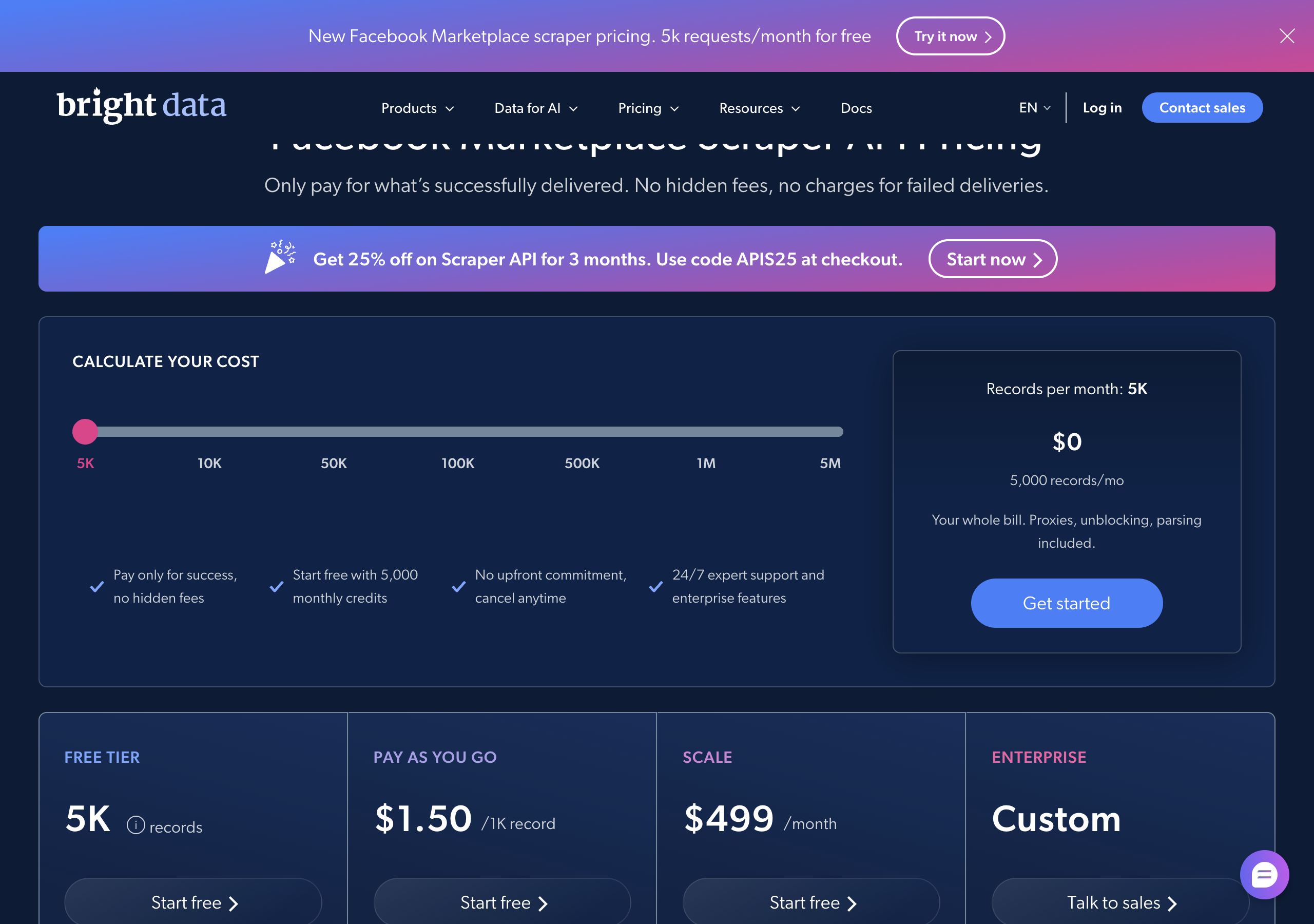
| Bright Data Facebook Marketplace Scraper API | Large batch collection | Up to 5,000 URLs in one call, delivered by API, webhook, or cloud storage | $1.50 per 1,000 records pay as you go; 5,000 free records a month |
Best Facebook Marketplace API for listing your own inventory
Meta Marketplace Partnerships
Meta Marketplace Partnerships pros:
- Your listings show up in Marketplace search and feed next to everyone else's
- Listing types for auctions, vehicles, rentals, and real estate, with shipping and condition fields
- Meta's own Graph API, so nothing breaks when Facebook changes a page
Meta Marketplace Partnerships cons:
- Write only: it doesn't search or read anyone else's listings
- For "eligible third-party partners", and Meta's Marketplace docs don't say how to become one
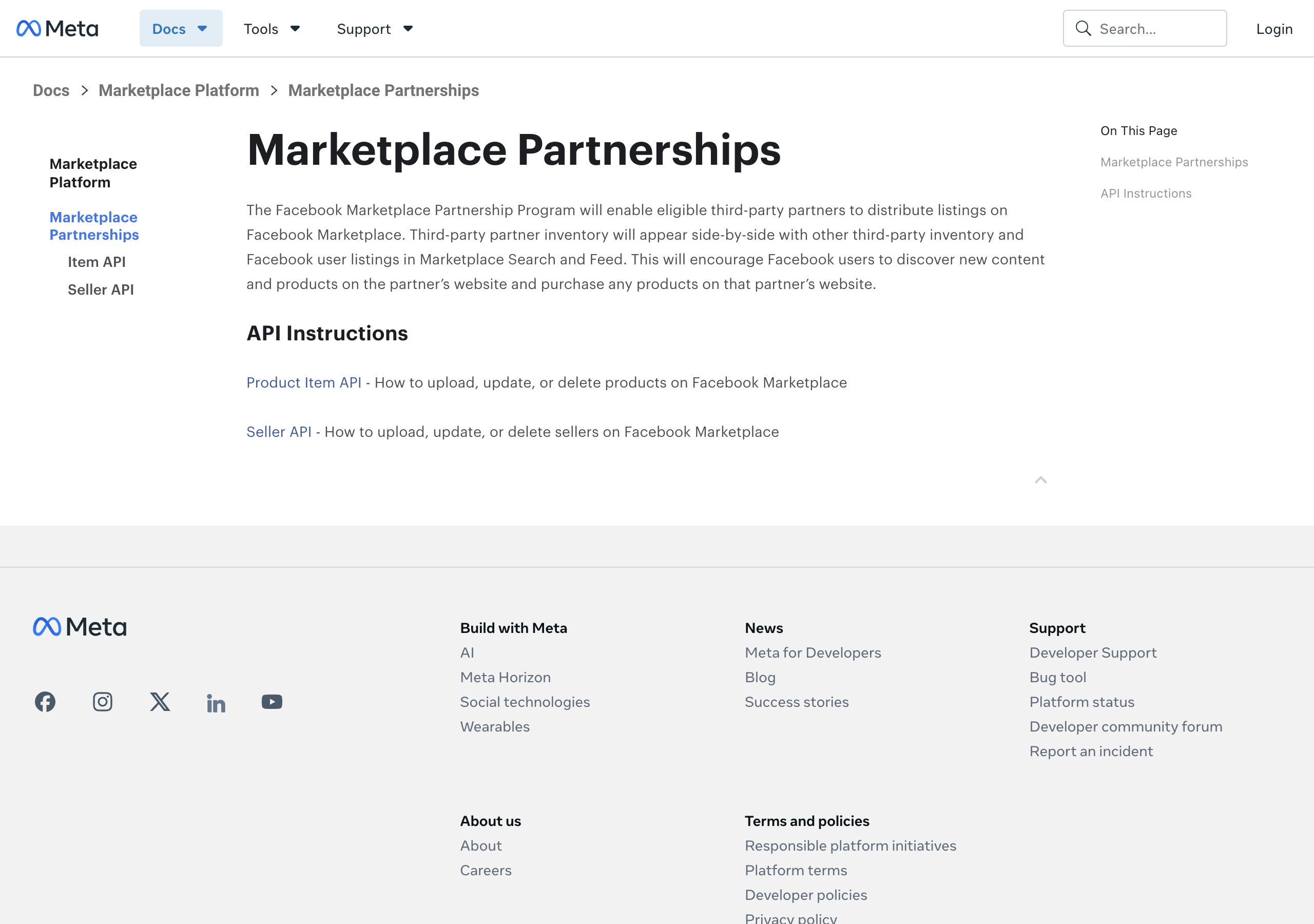
This is the API that comes up when you search Meta's docs for Marketplace, and it does the opposite of what most people searching for it want. Meta's Marketplace Partnerships page says the program "will enable eligible third-party partners to distribute listings on Facebook Marketplace", and its two APIs are described as "How to upload, update, or delete products" and "How to upload, update, or delete sellers".
The Item API is a batch POST to /{product-catalog-id}/items_batch, with fields for price, condition, shipping, location, and a checkout link back to your site. If you run a marketplace, a dealership group, or a rental site that Meta wants as a partner, this puts your inventory in front of Marketplace buyers.
If you want to watch other people's listings, skip it. Nothing in either API returns a listing you didn't upload.
Meta Marketplace Partnerships pricing: no published price. For eligible partners. Source: Marketplace Partnerships, October 2, 2026.
Best Facebook Marketplace API for academic and nonprofit research
Meta Content Library API
Meta Content Library API pros:
- Meta's own search over public Marketplace listings, by keyword, category, country, price, view count, and date
- A newest-first sort, and up to 100,000 results per query
- No fees for access or computation on Meta's Secure Research Environment
Meta Content Library API cons:
- Only for researchers at qualified academic or not-for-profit research institutions
- Runs inside Meta's research environment or an approved cleanroom, not from your own server
- Location filtering is by country, with no search near a point
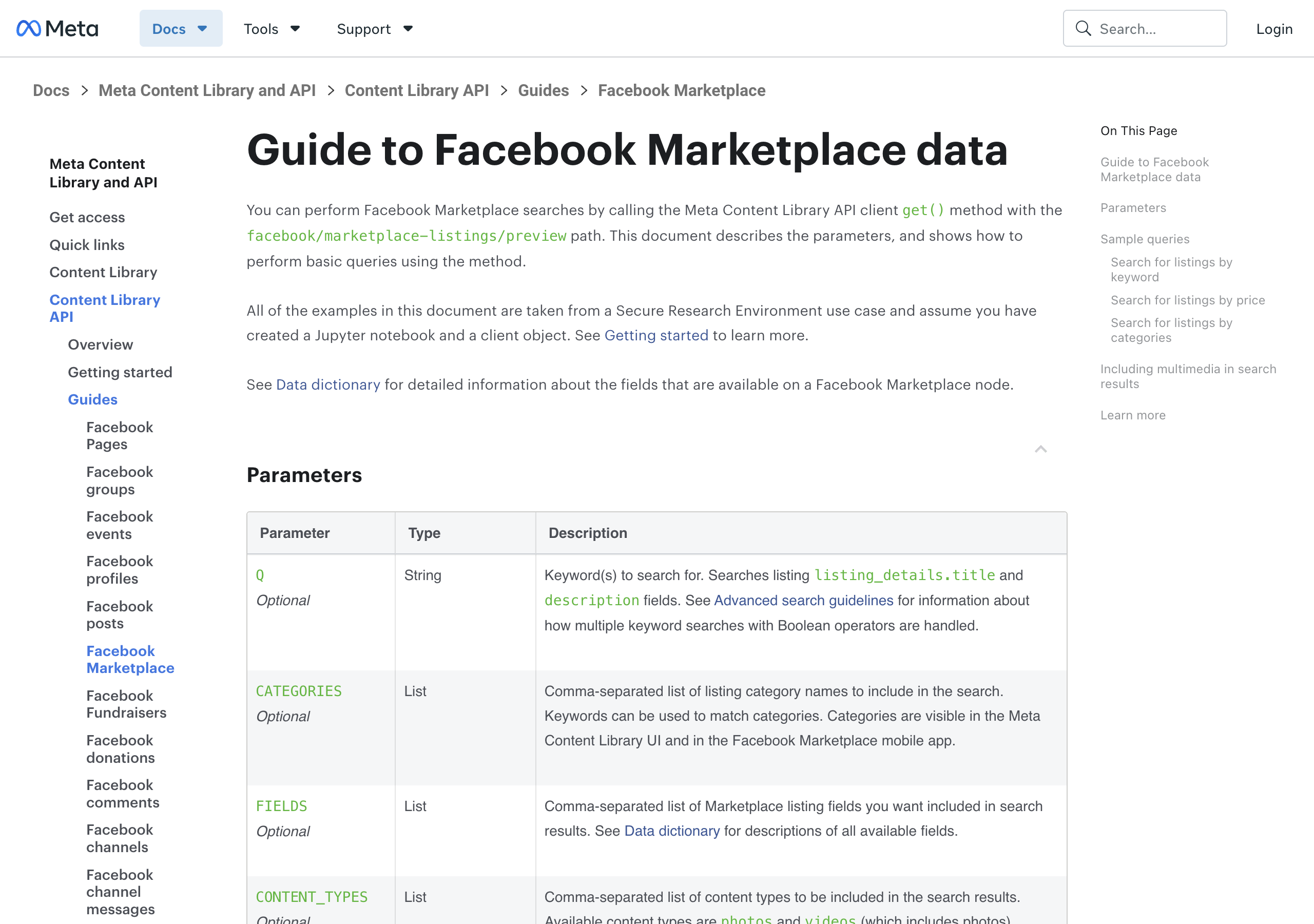
This is the closest thing Meta has to a Marketplace search API, and it's real. Meta's Marketplace guide says you "can perform Facebook Marketplace searches" through the facebook/marketplace-listings/preview path, with a newest_to_oldest sort and a price range when you pick one country.
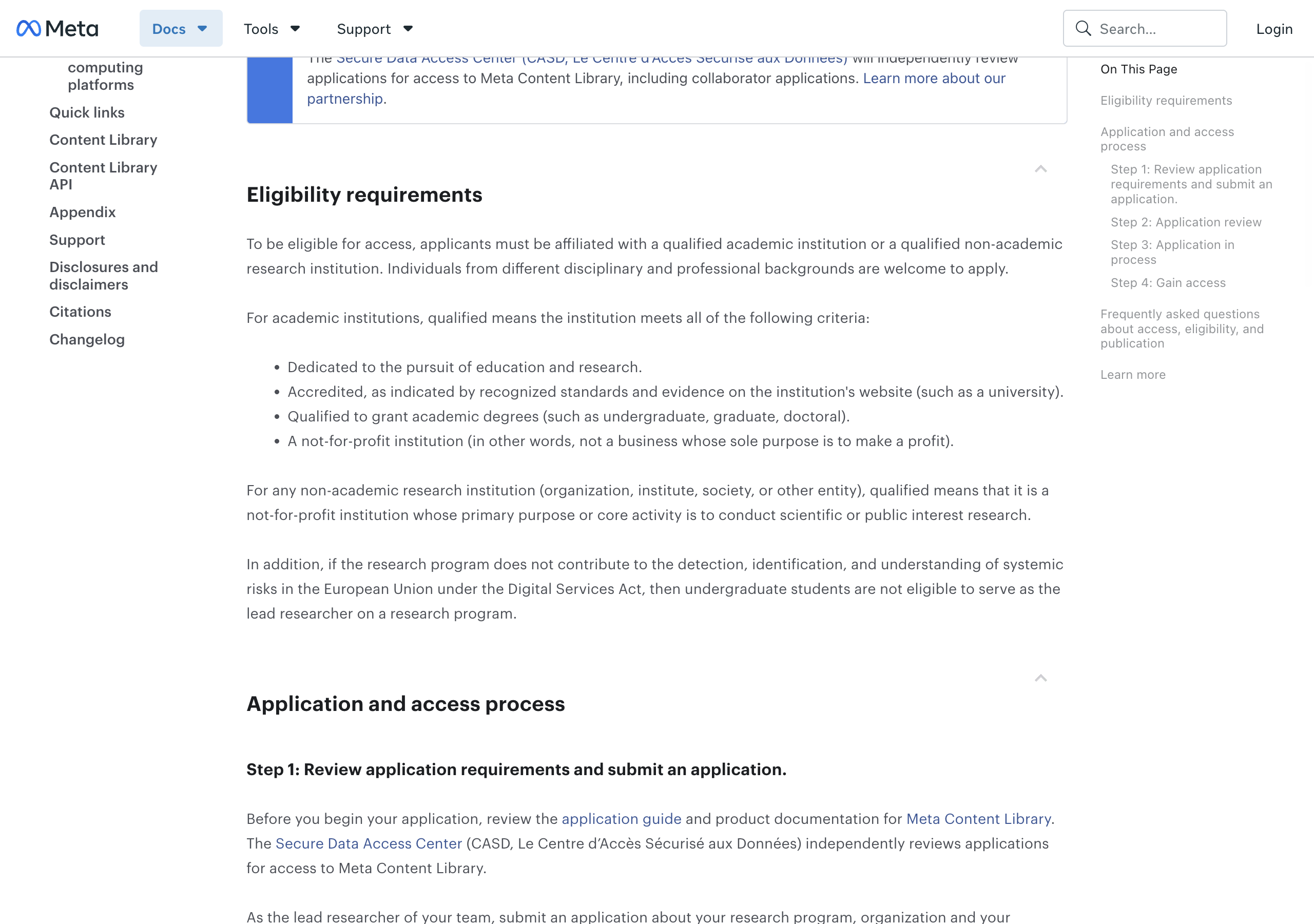
It isn't for building a product. The access page says applicants "must be affiliated with a qualified academic institution or a qualified non-academic research institution", and both kinds have to be not-for-profit. An independent review center checks applications, which it says takes 2 to 3 weeks, and Meta's own processing takes another 2 to 3. Then your code runs in a Jupyter notebook inside Meta's Secure Research Environment, or in an approved third-party cleanroom.
If you're studying local resale markets at a university, apply. If you're a reseller who wants a ping when a cheap road bike shows up, this isn't your route.
Meta Content Library API pricing: no fees on Meta's Secure Research Environment. Access is by application for qualified research institutions. Source: Get access, October 2, 2026.
Best Facebook Marketplace API for searches and new-listing alerts from code
AnyAPI
AnyAPI pros:
- 24 listings on all 20 searches, each with title, price, place, photo, posting time, and delivery options
- Search by keyword near a latitude and longitude, newest first, so an alert is a few lines of code
- Search, full listing details, and place-name lookup on one key, billed per call from a prepaid wallet
AnyAPI cons:
- Search results carry no seller; the seller's name and profile come from a listing-details call
- One call returns 24 listings, so a busy search needs checking every few hours
AnyAPI is the pick if you want Marketplace searches from your own code today, with no application and no plan. You send a keyword and a point on the map to facebook.marketplace, and listings come back as the same JSON whatever you search for.
curl -sS -X POST 'https://api.getanyapi.com/v1/run/facebook.marketplace' \
  -H "Authorization: Bearer $ANYAPI_API_KEY" \
  -H 'Content-Type: application/json' \
  -d '{"query":"ps5","lat":"34.0522","lng":"-118.2437","sort":"creation_time_descend"}'
Here's one of the 24 listings it returned for Los Angeles on 2026-10-02, trimmed, with the rest of the envelope:
{
  "output": {
    "found": true,
    "data": {
      "hasNextPage": true,
      "nextCursor": "cur_fpS5JVwXkyGZ_pObZIOu_Q",
      "listings": [
        {
          "id": "2067973223846763",
          "title": "Ps5 slim digital 1tb",
          "priceAmount": 420,
          "priceFormatted": "$420",
          "locationName": "Fontana, California",
          "createdUtc": 1790974320,
          "listingDateText": "Listed 45 minutes ago",
          "deliveryTypes": ["IN_PERSON"],
          "isSold": false,
          "isPending": false,
          "url": "https://www.facebook.com/marketplace/item/2067973223846763/"
        }
      ]
    }
  },
  "costUsd": 0.0012,
  "items": 24
}
All 20 searches came back with 24 listings in a median of 1.9 seconds, and none took longer than 2.7. Every one was charged the lowest published price.
| Endpoint | Calls on 2026-10-02 | What came back | Median time |
|---|---|---|---|
facebook.marketplace | 20, newest first | 24 listings on all 20, with title, price, place, photo, and posting time on all 480 | 1.9 s |
facebook.marketplace_item | 20, one per search | The listing on all 20, with coordinates and photos on all 20 and a description on 18 | 2.6 s |
Newest first is what makes an alert work. In 18 of the 20 searches, the top listing was under 2 hours old. Remember the posting time of the newest listing you've seen, run the same search again later, and anything posted after it is new. Here's the whole alert, in Python:
import json, os, pathlib, requests

API = "https://api.getanyapi.com/v1/run/facebook.marketplace"
KEY = os.environ["ANYAPI_API_KEY"]
STATE = pathlib.Path("newest.json")

SEARCHES = [
    {"query": "road bike", "lat": "40.7128", "lng": "-74.0060", "max_price": 600},
    {"query": "ps5", "lat": "34.0522", "lng": "-118.2437", "max_price": 400},
    {"query": "sectional couch", "lat": "47.6062", "lng": "-122.3321", "max_price": 500},
]

def newest(s):
    body = {"query": s["query"], "lat": s["lat"], "lng": s["lng"], "sort": "creation_time_descend"}
    r = requests.post(API, json=body, headers={"Authorization": f"Bearer {KEY}"}, timeout=60)
    r.raise_for_status()
    return r.json()["output"]["data"]["listings"]

state = json.loads(STATE.read_text()) if STATE.exists() else {}
for s in SEARCHES:
    key = f'{s["query"]}@{s["lat"]},{s["lng"]}'
    mark = state.get(key)
    listings = [x for x in newest(s) if x.get("createdUtc")]
    for item in listings:
        if mark and item["createdUtc"] > mark and not item["isSold"] \
                and item["priceAmount"] <= s["max_price"]:
            print(f'NEW {s["query"]}: {item["title"]} {item["priceFormatted"]} '
                  f'{item["locationName"]} {item["listingDateText"]} {item["url"]}')
    state[key] = max([mark or 0] + [x["createdUtc"] for x in listings])
STATE.write_text(json.dumps(state))
The first run only records the newest posting time, so you don't get 72 alerts at once. Compare posting times rather than listing IDs alone: a repeat search can bring back older listings you never saw, and those aren't new. I seeded it at 21:52 UTC on October 2 and ran it again at 22:20. It printed two road bikes in New York, a $100 Fuji listed 15 minutes earlier and a $325 Schwinn tandem listed 31 minutes earlier; the PS5 and couch searches had nothing new under their price caps. Swap the print for an email, a Slack message, or a push notification, and run it from cron.
How often to run it depends on the search, so check it against the chart. One page of 24 listings reached back about 3 hours for a road bike in New York and about 74 hours for an iPhone 13 in Seattle. Every 15 minutes keeps even the busiest search tested well inside one page, and three searches checked that often for 30 days is 8,640 calls, or $10.37.
If you only have a city name, facebook.marketplace_location_search turns "austin" into a list of places with coordinates, Austin, Texas among them. When a listing looks good, facebook.marketplace_item returns the full description, every photo, the condition, the exact coordinates, the seller's name, and whether the seller offers shipping. Of the 20 listings looked up, 18 had a condition set, mostly "Used - like new" and "Used - Good".
AnyAPI pricing: $1.20 per 1,000 searches, up to 24 listings each, which is $0.05 per 1,000 listings at a full page. Listing details are $1.20 per 1,000. A search the cheapest source can't answer goes to a backup, which costs up to $3.60 per 1,000. Prepaid, no plan; new accounts get free credit, no card required.
Best Facebook Marketplace API for scheduled exports with seller details
Apify Facebook Marketplace Scraper
Apify Facebook Marketplace Scraper pros:
- Seller details, and sold, live, or pending status, according to its README
- Runs on Apify, so it can run on a schedule and send data to other tools
- Maintained by Apify itself, with about 12,000 total users
Apify Facebook Marketplace Scraper cons:
- Billed per listing, and listing details cost the same again on top
- Input is a Marketplace page address you copy from Facebook, not a keyword and a point
Apify's own Facebook Marketplace Scraper takes Marketplace addresses: a city page, a search page, or a single item. You set a location and search in Facebook, copy the address, and the actor writes each listing to a dataset you can export as JSON, CSV, or Excel. Apify's store showed 859 monthly active users and a 3.9 rating from 31 reviews on October 2, 2026.
It suits a nightly export of a few categories into a spreadsheet, especially if you need who's selling. For a frequent alert, per-listing billing adds up: every check pays for every listing it writes, whether you've seen it before or not.
Apify Facebook Marketplace Scraper pricing: $6.20 per 1,000 listings on Apify's Free plan and $2.60 on Business, plus the same again per listing for the listing details add-on. Source: Apify Store, October 2, 2026.
Best Facebook Marketplace API for large batch collection
Bright Data Facebook Marketplace Scraper API
Bright Data Facebook Marketplace Scraper API pros:
- Collect by keyword or by Marketplace address, up to 5,000 addresses in one call
- Delivery by API, webhook, or cloud storage, as JSON, NDJSON, or CSV
- 5,000 free records a month, no card required
Bright Data Facebook Marketplace Scraper API cons:
- Billed per record, so repeat checks pay again for listings you already have
- The Scale plan is $499 a month
Bright Data sells Marketplace collection as a batch job: you send keywords or a list of Marketplace addresses, and it delivers listing records with price, condition, location, seller details, and images. Its page says you pay only for records it delivers.
It's built for volume. If you need hundreds of thousands of listings a month into a data warehouse, the Scale plan includes 384,000 records. For a handful of saved searches, the free 5,000 records a month may cover you.
Bright Data Facebook Marketplace Scraper API pricing: 5,000 records a month free. Pay as you go is $1.50 per 1,000 records, and Scale is $499 a month with 384,000 records included. Source: Bright Data, October 2, 2026.
Which Facebook Marketplace API should you use?
- You sell inventory and want it on Marketplace: apply to Meta's Marketplace Partnerships.
- You research resale markets at a university or nonprofit: Meta Content Library API.
- You want keyword searches near a place and new-listing alerts from your own code: AnyAPI.
- You want a scheduled export with seller details: Apify's Facebook Marketplace Scraper.
- You collect Marketplace listings by the hundred thousand: Bright Data.
Whichever you pick, sort newest first and alert on posting time. The Facebook API page lists all of AnyAPI's Facebook endpoints, and the Amazon API guide covers the other place most resellers check prices.
Frequently asked questions
- Does Facebook Marketplace have an API?
- Not one that an ordinary developer can use to search listings. Meta's Marketplace Partnership Program has an Item API and a Seller API, and both upload, update, or delete a partner's own listings. Meta Content Library API can search Marketplace listings, but on October 2, 2026, its access page limited it to researchers at qualified academic or not-for-profit research institutions.
- How do I get alerts for new Facebook Marketplace listings?
- Search the same keyword and location on a schedule, newest first, and remember the posting time of the newest listing you've seen. Anything posted after it is a new listing. A short script that does this is in the AnyAPI section of this guide, and it found new listings on its second run.
- How often should a Marketplace alert check for new listings?
- Often enough that one page of results still reaches back to your last check. On October 2, 2026, the 24 newest listings for a road bike in New York reached back about 3 hours, and for an iPhone 13 in Seattle about 74 hours. A busy search in a big city needs checking every few hours at least.
- How much does a Facebook Marketplace API cost?
- On October 2, 2026, Apify's Facebook Marketplace Scraper charged $6.20 per 1,000 listings on Apify's Free plan, and Bright Data's Facebook Marketplace Scraper API was $1.50 per 1,000 records pay as you go, with 5,000 free records a month. AnyAPI bills per search instead: $1.20 per 1,000 searches, each returning up to 24 listings.
Facebook Marketplace listings as clean JSON, $0.0012 for up to 24 listings, no plan and nothing that expires. New accounts get free credit, no card required.
Try the Facebook Marketplace API
Use data responsibly and follow AnyAPI's Acceptable Use Policy.