Best ScrapingBee alternative with no monthly credits (2026)

If you fetch more than about 140,000 JavaScript-rendered pages a month, every month, ScrapingBee's Startup plan is the cheapest way to get raw HTML back. Below that, or if your volume moves around, paying per request costs less, because ScrapingBee's credits expire at the end of every month and each request burns 1, 5, 25, or 75 of them depending on the options you turned on.
Paying per request is $0.70 per 1,000 pages, rendered, as markdown, at any volume.
On eight test pages ScrapingBee delivered 18 of 24 rendered fetches for 105 credits and failed the Cloudflare page every time, unbilled. AnyAPI delivered 42 of 48 for $0.018 and got through the Cloudflare page on a dearer provider.
Prices in this post were checked September 11, 2026. The tests ran September 13.
Built on AnyAPI
369 scraping and data APIs behind one key.
Every endpoint in this post is one call away. Pay per request in USD from a prepaid wallet, with automatic failover when a provider breaks. No subscription, no card to start.
Get ~150 free requests$0.10 of credit on signup.ScrapingBee is a scraping API in the classic shape. You send it a URL, it fetches the page through its own proxies with a headless browser if you ask for one, and it sends back the HTML. It handles the rotation and the retries, it can take a screenshot or pull fields out with extraction rules, and it has dedicated endpoints for Google, Amazon, Walmart, and as of this week Shopee. It's a well-run product with a lot of documentation behind it, and at scale it's one of the cheapest in the category.
The bill is where it gets complicated. ScrapingBee sells monthly credit bundles, and a request costs a different number of credits depending on how you configured it. Turn on JavaScript rendering, which is the default, and a page is 5 credits. Turn on premium proxies and it's 25. Stealth proxies, 75. So the $99 plan is a million credits, and that's 200,000 rendered pages or 13,000 stealth ones, and the credits you don't spend by the end of the month don't carry over.
Here's where ScrapingBee is the right buy, where paying per request wins, and the volume where the answer flips.
Where ScrapingBee is strong
ScrapingBee earns its place when you want the HTML and you fetch a lot of it.
- At volume, it's cheap. On the $99 Startup plan a plain request is $0.10 per 1,000 and a rendered one is $0.50 per 1,000. Business is $249 for three million credits, which gets a rendered page down to $0.42 per 1,000. If you fill the bundle, those are the lowest prices in this post.
- You get the raw page. HTML, a screenshot, or fields extracted with CSS rules you supply. If you're building your own parser, that's the input you want.
- It's honest about failures. ScrapingBee only bills a request that came back with a 200, 404, or 410, and its auto mode tries configurations from cheapest to dearest and charges you for the one that worked, or nothing if none did.
- Dedicated endpoints for the big stores. An Amazon product is 5 credits, a Walmart search 10, a Google search 10, a Shopee product 75. Structured JSON back, no parsing.
- Concurrency comes with the plan. 25 concurrent requests on Hobby, 400 on Business+. Plenty for a crawl.
If that's you, ScrapingBee is a fine choice. The rest of this post is for the other case.
Where AnyAPI wins
If your volume isn't steady, if you'd rather have markdown than HTML, or if the sites you want are the ones where 1 credit becomes 75, a flat price per page is simpler and usually cheaper.
Nothing expires, and one page is one price
ScrapingBee's pricing is five bundles: Hobby at $19 for 75,000 credits, Freelance at $49 for 250,000, Startup at $99 for a million, Business at $249 for three million, and Business+ at $599 for eight million. The page says it plainly in a tooltip: credits are valid for one month, and leftovers aren't rolled over.
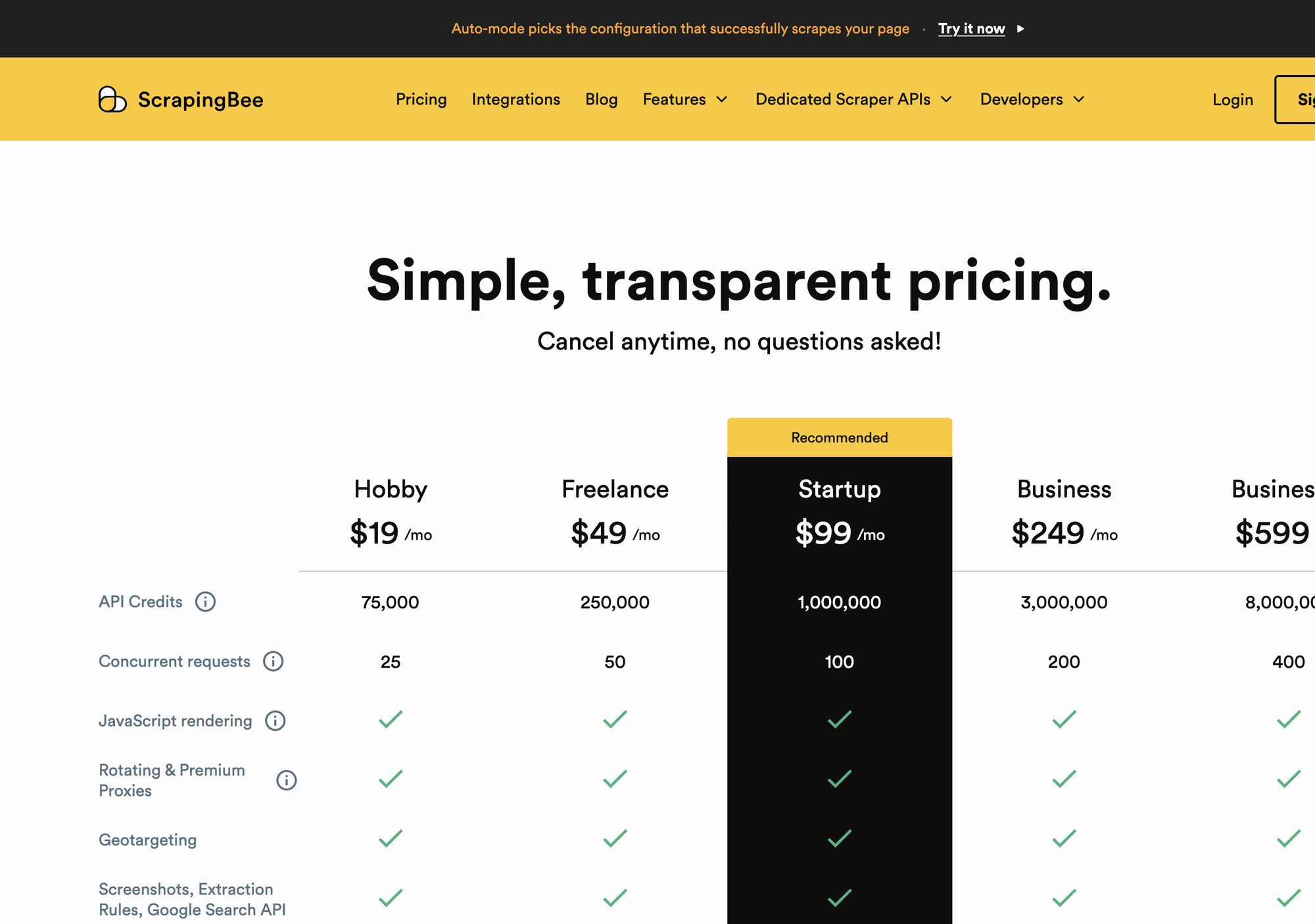
A rendered page is 5 credits, so the real price per page depends on which bundle you're in. On Hobby it's $1.27 per 1,000. On Freelance, $0.98. Paying per request is $0.70 per 1,000 rendered pages on every day of the month, with no bundle to fill.
That chart assumes you use every credit. Most people don't. Here's the same comparison as a monthly bill, with ScrapingBee on the smallest plan that fits the month's pages.
The crossover is about 140,000 rendered pages a month. Under it, the plan costs more than the pages. Over it, ScrapingBee is cheaper per page, as long as the volume holds. A month at 20,000 pages on the $49 plan is $2.45 per 1,000, three and a half times the flat rate.
The multipliers don't apply
The sites you most want an API for are the ones that block, and on ScrapingBee those are the ones that cost the most. Premium proxies are 25 credits with rendering, stealth proxies 75. On the Freelance plan that's $4.90 and $14.70 per 1,000 pages. In a test of both raw-HTML APIs in June, ScrapingBee's standard tier got through a Cloudflare-protected page zero times in six tries, which is exactly the case where you'd reach for stealth.
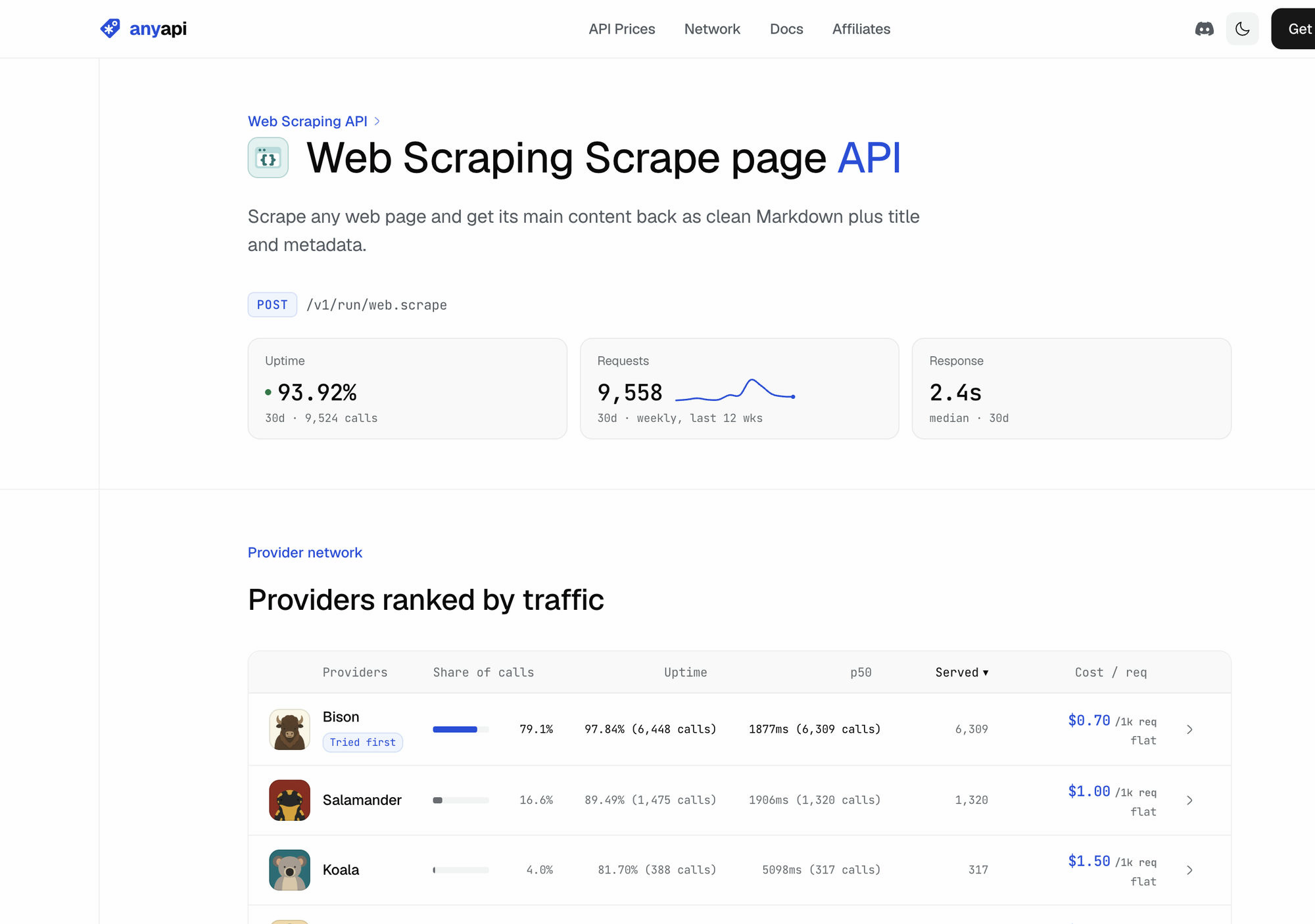
AnyAPI's page scraper has four providers behind it. The cheapest, at $0.70 per 1,000, takes the call first, and when it's blocked the request goes to the next one, up to a $1.50 per 1,000 provider that specializes in hard sites. You pay the price of the provider that answered, and a call that fails everywhere is free.
Markdown back, or the data itself
ScrapingBee gives you HTML. AnyAPI's web.scrape gives you the page's main content as markdown with the title and metadata, which is what you'd want to hand to a model or store as text. And for the platforms people scrape most, there's a dedicated endpoint that returns fields: an Instagram profile at $1.20 per 1,000, a TikTok profile at $1.20, a LinkedIn company at $1.43, a Reddit search at $0.45, a Google results page at $0.90, an Amazon product at $1.00.
One call, and what it cost
Here's a page fetched the pay-per-request way: one of ScrapingBee's own blog posts, rendered, as markdown, for $0.0007 in 2.8 seconds on September 11, 2026.
curl https://api.getanyapi.com/v1/run/web.scrape \
  -H "Authorization: Bearer $ANYAPI_KEY" \
-d '{"url": "https://www.scrapingbee.com/blog/web-scraping-101-with-python/", "formats": ["markdown"]}'import os, requests
r = requests.post(
"https://api.getanyapi.com/v1/run/web.scrape",
headers={"Authorization": f"Bearer {os.environ['ANYAPI_KEY']}"},
json={"url": "https://www.scrapingbee.com/blog/web-scraping-101-with-python/", "formats": ["markdown"]},
)
body = r.json()
print(body["costUsd"], body["output"]["data"]["title"])
# 0.0007 Python Web Scraping Tutorial for 2026 with Examples & Best Practicesconst r = await fetch("https://api.getanyapi.com/v1/run/web.scrape", {
method: "POST",
headers: { Authorization: `Bearer ${process.env.ANYAPI_KEY}` },
body: JSON.stringify({ url: "https://www.scrapingbee.com/blog/web-scraping-101-with-python/", formats: ["markdown"] }),
});
const { costUsd, output } = await r.json();
console.log(costUsd, output.data.markdown.length > 0); // 0.0007 trueOn the eight-page test below, ScrapingBee's rendered median was 2.2 seconds and AnyAPI's 1.5, so the two are close, and ScrapingBee is quicker on plain pages it fetches without a browser.
The same eight pages through ScrapingBee, ScraperAPI, and AnyAPI
Eight pages, three rounds each, on September 13, 2026, with JavaScript rendering on for all three services and the standard proxy tier on both credit vendors: a static page, two scraping sandboxes, the Hacker News front page, an e-commerce sandbox, an Amazon product page, a G2 review page behind Cloudflare, and a Best Buy search. A call counted only when the page's own text came back. AnyAPI's column is two runs, so 48 calls.
| Page | ScrapingBee, rendered | ScraperAPI, rendered | AnyAPI web.scrape |
|---|---|---|---|
| Static page, two sandboxes, Hacker News, e-commerce sandbox | 15 of 15, 1.1 to 4.5 s, 5 credits each | 13 of 15, 6.8 to 43 s, 10 to 20 credits each; two calls never returned inside two minutes | 30 of 30, 0.9 to 2.8 s, $0.0007 each |
| G2 review page behind Cloudflare | 0 of 3: a 500 after 4.5 to 5.7 s, no charge | 1 of 3: 1.9 s and 30 credits when it worked, a 500 after 29 s when it didn't | 6 of 6, 1.2 s, $0.001 each |
| Best Buy search | 3 of 3, 2.4 to 4.5 s | 3 of 3, 14 to 20 s, 20 credits each | 6 of 6, 6.2 to 12 s |
| Amazon product page | 0 of 3: a 404, billed 5 credits | 0 of 3: a 404, billed 5 credits | 0 of 6: a "Continue shopping" wall as a 200, billed $0.0007 |
| Rendered pages delivered | 18 of 24 | 17 of 24 | 42 of 48 |
| Credits or dollars for the 24 rendered calls | 105 credits, $0.03 on the Freelance plan | 265 credits, $0.13 on Hobby | $0.018 |
| Median on delivered pages | 2.2 s | 13.2 s | 1.5 s |
ScrapingBee did what its docs say it does: five credits a rendered page, every time, and a fast, unbilled failure on the site it couldn't reach. Three things in the table decide the choice.
The Cloudflare page is the whole argument for fallback. ScrapingBee's standard tier got a 500 from G2 every time and, to its credit, charged nothing; getting through would mean its stealth proxy at 75 credits a page. ScraperAPI got through once in three at 30 credits and spent 29 seconds failing the other two. AnyAPI's cheapest provider missed it every time and the next one answered every time, for $0.001 a page instead of $0.0007. Same job, no setting to change.
Rendering is where ScraperAPI's credits go. A rendered page cost 10 credits on the sandboxes and 20 on the static page and the Best Buy search, so the same 24 calls that were 105 credits on ScrapingBee were 265 on ScraperAPI, and two of them never came back inside two minutes. ScrapingBee's rendered pages were 5 credits every time, which matches the June test. Speed followed the same order, 1.5 seconds here, 2.2 on ScrapingBee, 13 on ScraperAPI rendered, but that's the subtext; the credit table is the bill.
A 404 is billed on both credit vendors. Amazon answered the product URL with a 404 for both, and both charged for it, 5 credits on each. AnyAPI's provider got a 200 with a "Continue shopping" wall and charged $0.0007. Nobody got the product. If Amazon is the job, the Amazon product endpoint at $1.00 per 1,000 is the call to make, not a page fetch.
Other ScrapingBee alternatives worth a look
ScrapingBee's closest rivals sell the same thing, HTML back through someone else's proxies, on the same credit-bundle model with different multipliers. These are the ones that publish a usable number, read from their pricing pages on September 13, 2026, at the entry paid tier with every credit used.
| Service | How you pay | Entry price | Plain page, per 1,000 | Rendered page, per 1,000 | Free tier | Failed calls |
|---|---|---|---|---|---|---|
| ZenRows | Monthly credits, 1 month rollover | $19 for 45,000 | $0.42 | $2.11 | 5,000 credits a month | Free; 404 and 410 are billed |
| Scrapfly | Monthly credits | $30 for 200,000 | $0.15 | $0.90 | 1,000 credits | Free |
| Zyte API | Per request, priced by how hard the site is | None | $0.13 to $1.27 | $1.01 to $16.08 | $5 for 30 days | Free |
| ScrapingAnt | Monthly credits | $19 for 100,000 | $0.19 | $1.90 | 10,000 credits a month | Free |
| Crawlbase | Monthly plan or a balance that never expires | $99 for 200,000 | $0.50 | $0.99 | 5,000 requests | Free |
| Bright Data Web Unlocker | Per success, no minimum | None | $1.50 | $1.50 | 5,000 a month | Free, unless you set your own headers |
| Oxylabs | Monthly results | $49 | $1.15 | $1.35 | 2,000 results | Free |
AnyAPI web.scrape | Per call | None | $0.70, always rendered | $0.70 | A small starter balance | Free |
ZenRows is the closest match in shape: a monthly credit bundle where rendering costs 5 credits and a premium proxy 10, so a rendered page on the $19 plan is $2.11 per 1,000. Two things it does that ScrapingBee doesn't: unused credits roll over for a month, and the free tier is 5,000 credits every month rather than once. Its pricing page shows the annual price until you click Monthly, so the $16 you'll see first is the yearly rate.
Scrapfly is the cheapest rendered page in this table on a plan, at $0.90 per 1,000 on $30 a month, and it lets you cap what any request can spend with a cost_budget parameter. Its anti-bot layer is free when the site isn't blocking and unpriced when it is, which is the part you'd want a number for. Residential proxies with rendering are 30 credits, or $4.50 per 1,000.
Zyte API prices per request by how hard Zyte rates the site, from $0.13 per 1,000 for a simple page to $1.27 for an advanced one, and $1.01 to $16.08 with a browser. No plan, no minimum, failures free. It's the best buy for easy sites at volume and the worst for a hard one, and you don't choose the tier, Zyte does.
ScrapingAnt is $19 for 100,000 credits with 10,000 free every month, plain pages at $0.19 per 1,000 and rendered at $1.90. Its multiplier table is the steepest here: a rendered page through a residential proxy is 125 credits, or $23.75 per 1,000.
Crawlbase is the one with a balance that never expires, on a ladder that starts at $3.00 per 1,000 and falls to $0.50 at a million, alongside a $99 plan. Residential proxies and CAPTCHA handling are in every request, and a site's difficulty tier multiplies the price by up to 20.
Bright Data's Web Unlocker and Oxylabs are the enterprise pair. Bright Data is $1.50 per 1,000 whether or not the page needs a browser, with 5,000 free a month and unlimited concurrency, so below that volume it's free and above it it's the dearest plain page in the table. Oxylabs is a monthly results plan from $49, with Amazon pages at $0.50 per 1,000 and everything else at $1.15. The best Bright Data alternative covers that side of the market.
The short version: plain pages at volume, Zyte for easy sites or Scrapfly on a plan. A free tier you can build on, ScrapingAnt or Bright Data's 5,000. A balance that never expires, Crawlbase. One price per rendered page with no bundle to fill, pay per request. ScrapingBee's other direct rival is priced in the best ScraperAPI alternative.
ScrapingBee vs paying per request, at a glance
| What you deal with | ScrapingBee | Paying per request |
|---|---|---|
| What you're billed for | Monthly credit bundle, 1 to 75 credits a request | One price per successful call, in USD |
| Subscription | $19 to $599 a month | None |
| Unused credits | Expire at month end | Nothing to expire |
| Rendered page, per 1,000 | $1.27 on Hobby, $0.98 on Freelance, $0.42 on Business | $0.70 at any volume |
| Hard sites | 25 or 75 credits a page | Falls back to a dearer provider, up to $1.50 per 1,000 |
| What comes back | HTML, screenshot, or CSS-extracted fields | Markdown, title, and metadata |
| Instagram, LinkedIn, Reddit as JSON | Fetch and parse the HTML yourself | Dedicated endpoints, one shape |
| Failed requests | Not billed | Not billed |
| Concurrency | 25 to 400 on the plan | Per-key rate limit |
| A month you scrape nothing | Your plan price | $0 |
Limitations and tradeoffs
Steady volume past 140,000 pages a month, and you want HTML? Stay on ScrapingBee. Its Startup and Business plans are the cheapest rendered page in this post, and its extraction rules and store endpoints are good.
Volume that varies, markdown output, or data from platforms? Pay per request. You never size a bundle, a quiet month is $0, and a blocked site costs you a slightly dearer provider rather than a 75-credit multiplier.
Two limits on AnyAPI's side. The page scraper returns markdown and metadata rather than raw HTML or a screenshot, so if your parser needs the DOM, ScrapingBee is the right input. And the endpoint page shows 93.9% uptime over the last 30 days after fallback, which means some pages still block every provider.
For the head-to-head with ScrapingBee's closest rival, see ScrapingBee vs ScraperAPI, tested. For the whole field on one job, 7 Apify alternatives on real per-request cost, and for a page-to-markdown crawler, the best Firecrawl alternative.
Frequently asked questions
- How much does ScrapingBee cost in 2026?
- ScrapingBee has five monthly plans: Hobby at $19 for 75,000 API credits, Freelance at $49 for 250,000, Startup at $99 for 1,000,000, Business at $249 for 3,000,000, and Business+ at $599 for 8,000,000, plus a custom enterprise tier. New accounts get 1,000 free credits. There's no annual billing and no pay-as-you-go. Checked September 11, 2026.
- How many credits does a ScrapingBee request cost?
- One credit for a plain request, 5 with JavaScript rendering, which is on by default, 10 for a premium proxy without rendering and 25 with it, and 75 for a stealth proxy. AI extraction adds 5 credits. The Amazon product endpoint is 5 credits, a Walmart or Google search 10, a Shopee product 75.
- Do ScrapingBee credits roll over?
- No. The pricing page says API credits are valid for one month and leftovers aren't rolled over to the next month. If you run out early you can upgrade for the current month or renew early.
- Does ScrapingBee charge for failed requests?
- No. It only charges for requests that return a 200, 404, or 410 status. In auto mode it tries configurations from cheapest to most expensive and charges for the one that worked, or nothing if all of them fail.
- Is paying per request cheaper than ScrapingBee?
- Below roughly 140,000 rendered pages a month, yes: AnyAPI's web.scrape is $0.70 per 1,000 at any volume, against $1.27 per 1,000 on ScrapingBee's Hobby plan and $0.98 on Freelance if every credit is used. Above that volume, ScrapingBee's Startup plan at $0.50 per 1,000 is cheaper, provided you fill it every month.
Use data responsibly and follow AnyAPI's Acceptable Use Policy.