The best Oxylabs alternatives in 2026, priced per call

- At enterprise volume, stay on Oxylabs or Bright Data. Oxylabs' Amazon rate, $0.50 per 1,000 on its $49 plan and $0.30 on Business, is the cheapest in this comparison, and it delivered all 46 of its test calls.
- Under a few hundred thousand calls a month, the $49 floor is the bill. Oxylabs has no pay-as-you-go tier, and a month's unused results don't carry over.
- For Google results and rendered pages with no plan, pay per request. AnyAPI starts at $0.40 per 1,000 Google searches and $0.70 per 1,000 rendered pages, against $1.00 and $1.35 on Oxylabs Micro. The same 46-call test cost $0.030 against $0.047.
- For Oxylabs' model on a smaller plan, use Decodo. $19 a month buys 25,000 rendered requests.
Built on AnyAPI
402 scraping and data APIs behind one key.
Every endpoint in this post is one call away. Pay per request in USD from a prepaid wallet, with automatic failover when a provider breaks. No subscription, no card to start.
Get ~150 free requests$0.10 of credit on signup.Oxylabs is the pick if you scrape at enterprise scale. Below that, you pay $49 a month whether you use it or not.
Oxylabs' Web Scraper API fetches a page or a Google search and returns HTML or parsed JSON. Most people looking for an alternative want that API without the monthly plan.
I ran the same 46 calls through Oxylabs and AnyAPI (pages, Google searches, and Amazon products) and priced four more options from their own pages.
We run a scraping API ourselves, so we test vendors like these the way a paying customer would, on our own accounts.
- Oxylabs: besides the 46-call test below, we ran 36 calls on September 26, 2026 across its ChatGPT, Perplexity, Gemini, and Google AI Mode sources, then its Google Shopping, Google Lens, Airbnb, Alibaba, and TikTok Shop sources.
- Bright Data: we've used its Web Unlocker, SERP API, and Web Scraper API on our own account.
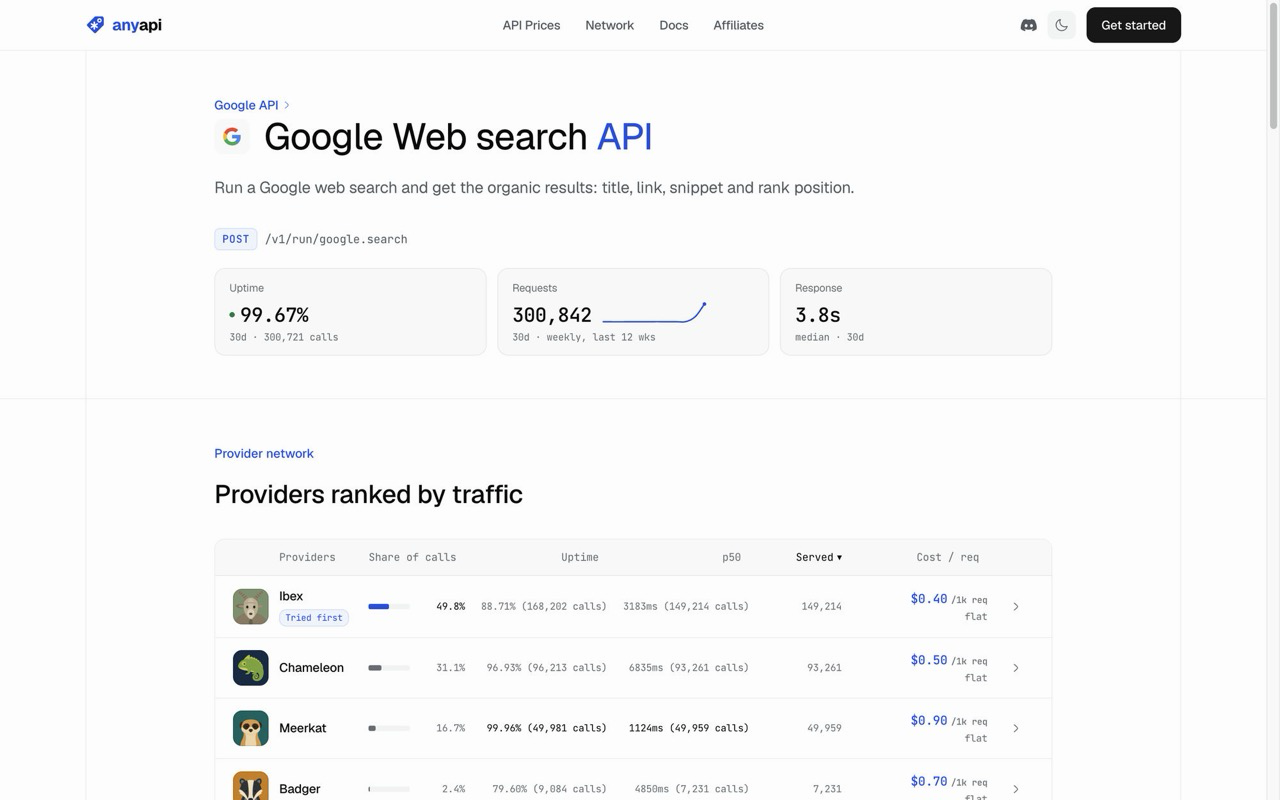
- Google search: our endpoint answered about 300,000 searches in the last 30 days across four sources, and its page shows each one's live uptime and speed.
The best Oxylabs alternatives
 Oxylabs for Amazon and enterprise scale
 Bright Data for a free tier and per-success billing
 AnyAPI for Google and rendered pages with no plan
 Decodo for Oxylabs' model on a smaller plan
 Zyte API for easy sites at high volume
 ZenRows for a monthly plan with rollover
What makes a good Oxylabs alternative?
Scraping APIs overlap so much that your shortlist might look different from mine.
I'm assuming you call one from code for Google results, product pages, or whatever site you need, somewhere between a few thousand and a few hundred thousand calls a month. Here's what I looked for:
- Delivered pages: the page's own content came back, not a bot wall or an error page.
- Price per 1,000 by job: Google searches, JavaScript-rendered pages, and Amazon products, on each vendor's entry tier.
- What you pay for nothing: plan floors, whether unused volume expires, and whether a blocked page is billed.
- Where you can't go: sites the vendor refuses.
I didn't grade proxy quality for your own scraper, geo-targeting depth, or support.
The live test was 46 calls a side on two services. That's enough to see a bot wall, not enough to rank six vendors on reliability.
The best Oxylabs alternatives at a glance
| Tool | Best for | What it returns | Standout feature | Pricing |
|---|---|---|---|---|
| Oxylabs | Amazon and enterprise scale | Any page; parsed JSON for  Google, Google,  Amazon, Amazon,  Walmart, Walmart,  Zillow, Zillow,  ChatGPT, and more ChatGPT, and more | Parsed Google results with SERP features | From $49 a month for 98,000 results |
| Bright Data | A free tier and per-success billing | Any page; a separate SERP API, and scrapers for 800+ sites | 5,000 free requests a month | $1.50 per 1,000, no minimum |
| AnyAPI | Google and rendered pages with no plan | Structured JSON from 402 endpoints, including Google, Amazon,  LinkedIn, LinkedIn,  TikTok, and TikTok, and  Google Maps, plus any page as Markdown Google Maps, plus any page as Markdown | The same fields whichever source answers | From $0.40 per 1,000 searches, $0.70 per 1,000 pages |
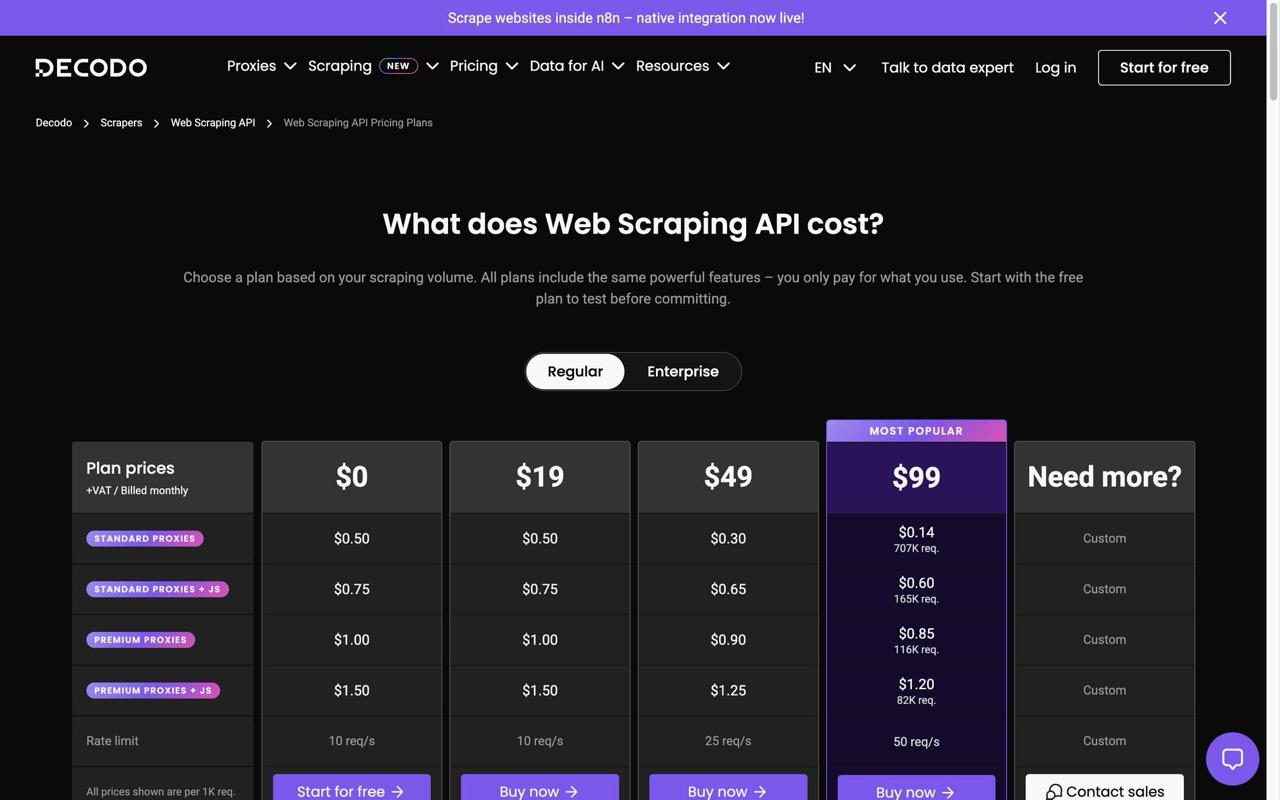
| Decodo | Oxylabs' model on a smaller plan | Any page; 100+ templates, including Google, Amazon, TikTok,  Reddit, and Reddit, and  YouTube YouTube | $19 entry plan | $0.75 per 1,000 rendered on the $19 plan |
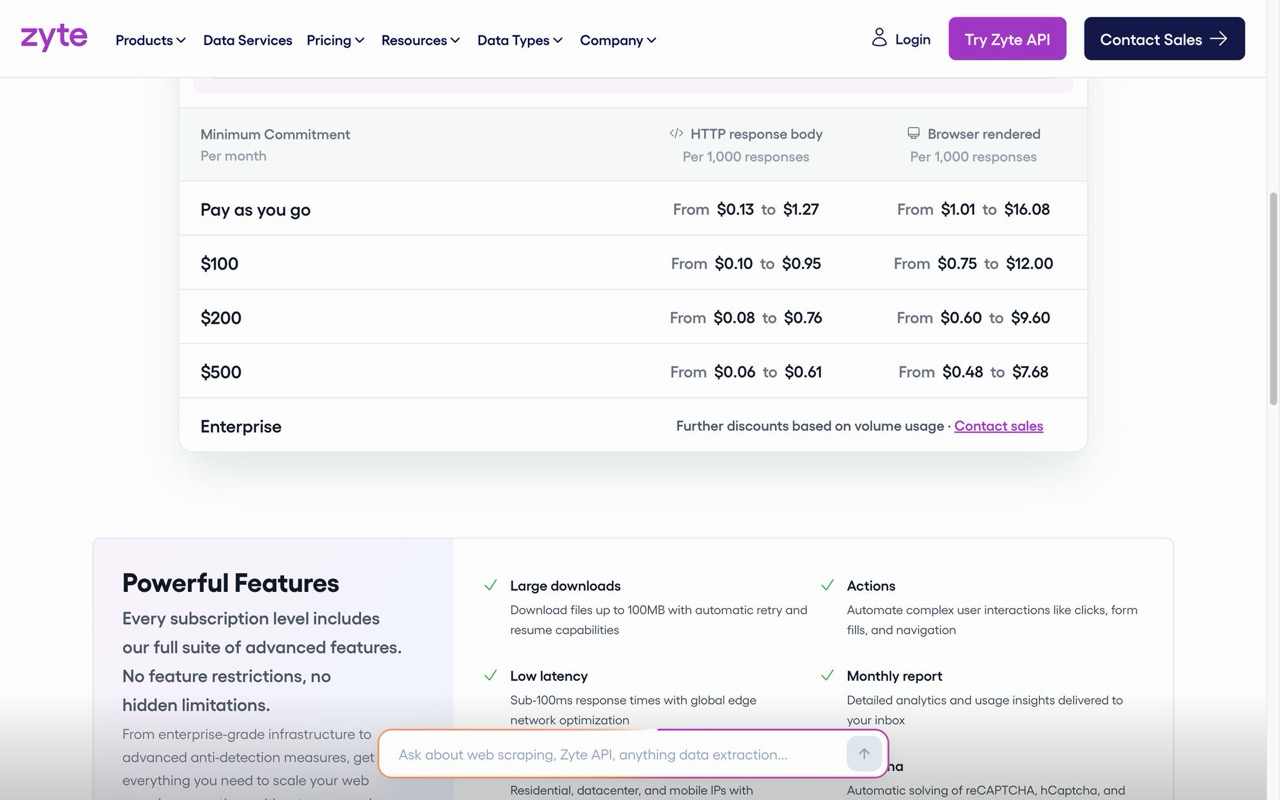
| Zyte API | Easy sites at high volume | Any page; AI extraction of products, articles, jobs, and search results | Priced per site difficulty | $0.13 to $16.08 per 1,000 |
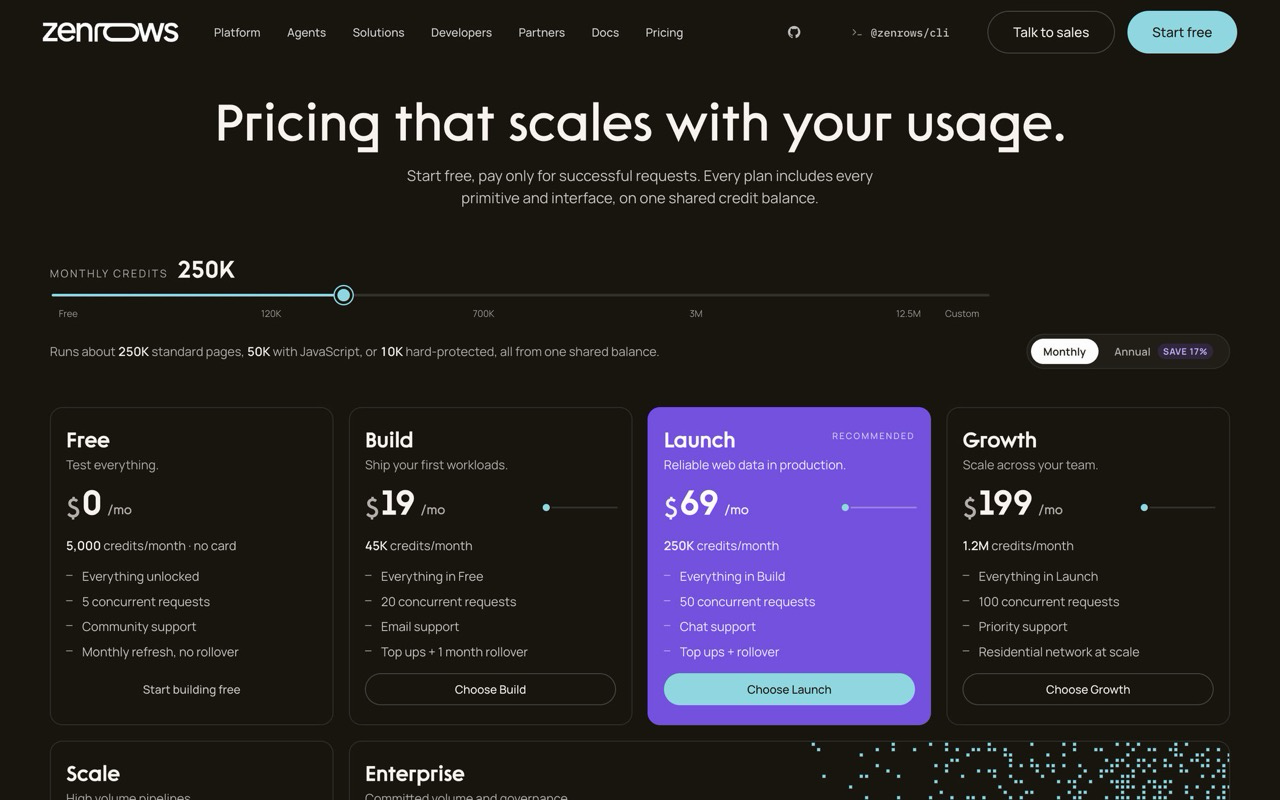
| ZenRows | A monthly plan with rollover | Any page as HTML, Markdown, or JSON | Unused credits roll over a month | $19 a month for 45,000 credits |
Here's what each job costs per 1,000, Oxylabs' entry plan against paying per request:
| Job | Oxylabs Micro | AnyAPI | Cheaper |
|---|---|---|---|
| Google search | $1.00 | from $0.40 | AnyAPI |
| Rendered page | $1.35 | $0.70 | AnyAPI |
| Amazon product | $0.50 | $1.00 | Oxylabs |
Oxylabs (best for Amazon and enterprise scale)
Oxylabs pros:
- Delivered all 46 test calls
- Parses Google's SERP features into their own keys
- The cheapest Amazon rate here
Oxylabs cons:
- No pay-as-you-go, and unused results expire
- Bills a blocked page like a good one
- Refuses LinkedIn without a KYC check
Oxylabs scrapes any page. For a long list of named sites it hands back parsed JSON instead of HTML: Google (search, news, images, Scholar, and Trends), Amazon, Walmart,  eBay, Zillow, and even ChatGPT answers.
If scraping is your business, it's the one to beat. Every call in the test came back with the page's own content, including a Cloudflare-protected G2 review page and an Amazon product page that walled AnyAPI's page fetch.
| Job (calls a side) | Oxylabs delivered | AnyAPI delivered | Oxylabs median | AnyAPI median |
|---|---|---|---|---|
| Rendered page (16) | 16 | 14 | 10.8 s | 1.5 s |
| Google search (20) | 20 | 20 | 4.3 s | 2.0 s |
| Amazon product (10) | 10 | 10 | 4.2 s | 3.5 s |
It isn't quick about it, but a batch job won't notice.
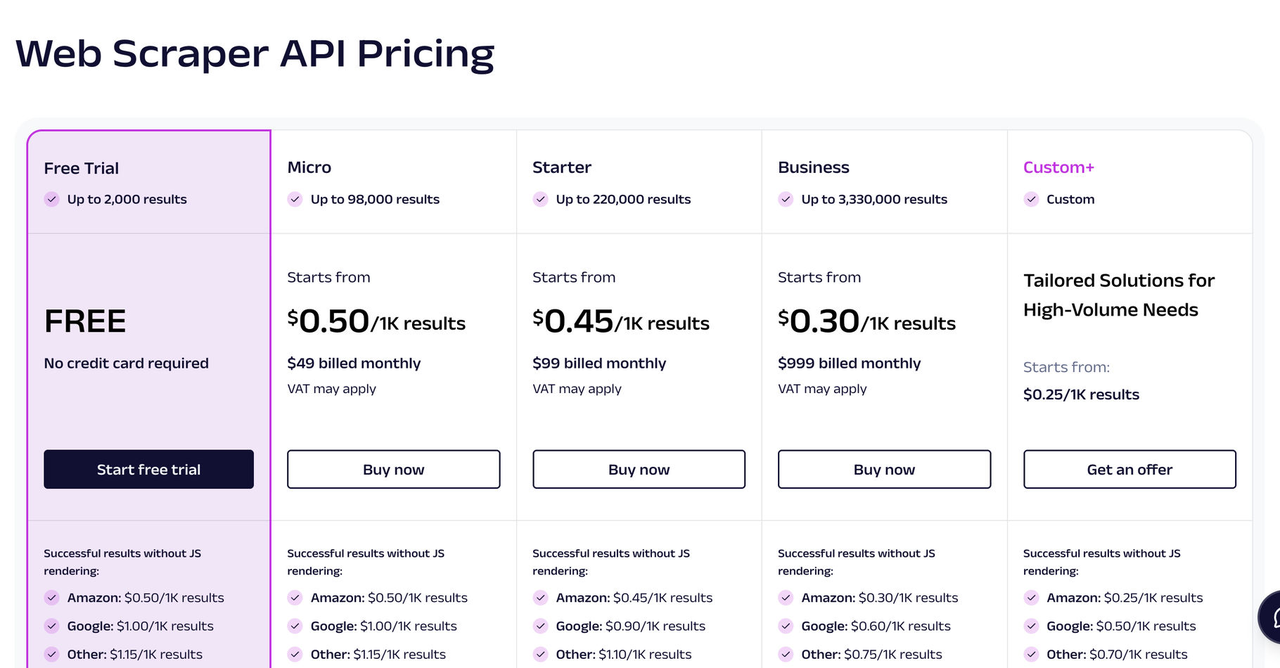
For a small team, the plan is the problem. There's nothing below Micro, and Oxylabs' terms of service say a month's amount "will not be transferred to the following month." So a month where you make 1,000 calls still costs $49.
Blocked pages cost you too. Its billing help page counts "all results from the target site with 2xx or 4xx status codes" as successful, so a 403 draws down your plan like a real page.
The list of sources on its site is longer than the list that works. Here's what came back when we tried them:
| Source | What happened |
|---|---|
| ChatGPT | 9 of 9 answers, each with 12 to 24 cited sources, at the ordinary rendering rate |
 Perplexity Perplexity | Returned the prompt itself as the answer on 4 of 9 calls, still counted as a success |
| AI Overviews | Failed 3 of 6 fetches |
| AI Mode | Answered 1 of 6, taking 80 to 150 seconds |
| Google Shopping | Failed all 5 calls, including the example from Oxylabs' own docs |
| Airbnb, Alibaba, TikTok Shop | HTML only, no parsed JSON |
So test the exact source you need on the free trial before you buy a plan for it.
Some sites are off the table entirely. LinkedIn, streaming, banking, government, gaming, and ticketing are restricted targets, rejected "with HTTP 400 before any scraping happens" unless you pass a KYC check.
Is Oxylabs overkill for a side project? Yes. Is it the one I'd pick for millions of pages a month, especially on Amazon? Also yes.
Oxylabs pricing: Free trial up to 2,000 results; Micro $49 a month for up to 98,000 results; Starter $99 for up to 220,000; Business $999 for up to 3,330,000; on Micro, Amazon $0.50, Google $1.00, other sites $1.15, and JavaScript-rendered $1.35 per 1,000
Bright Data (best for a free tier and per-success billing)
Bright Data pros:
- 5,000 free requests a month
- Bills only a success
- Rendering included in the price
Bright Data cons:
- The dearest plain page here past the free tier
- Pricing spread across many products
Bright Data is the other big enterprise name. It sells the same range Oxylabs does, split into separate products, each priced on its own:
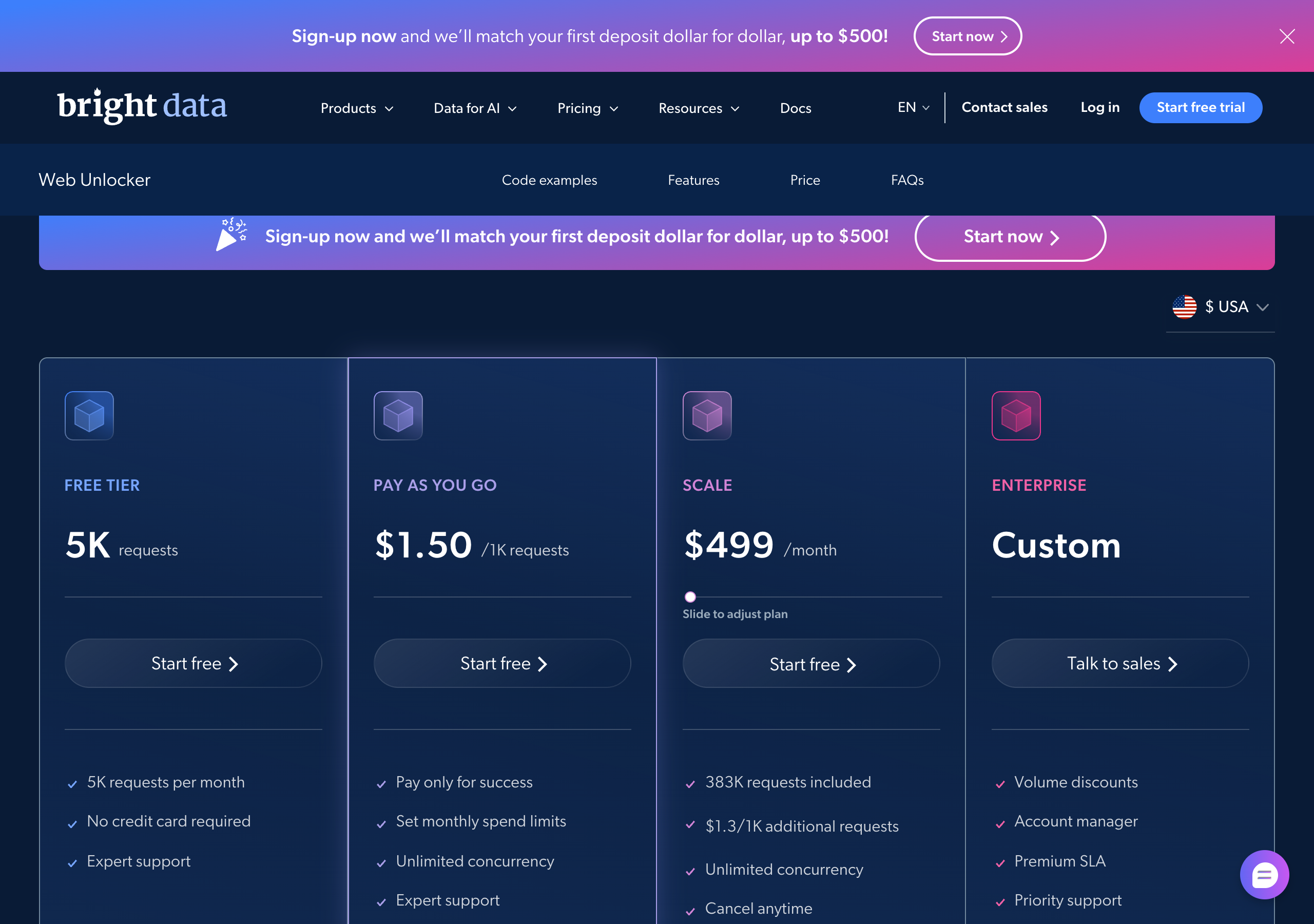
- Web Unlocker: any page as HTML, Markdown, or JSON, at $1.50 per 1,000 with rendering included. It only bills a success.
- SERP API: parsed Google results.
- Web Scraper API: structured data from 800+ named sites.
Two things from our own account: the SERP API needs its own zone, set up apart from Web Unlocker's. And a Web Scraper API call that runs past 60 seconds hands you a snapshot ID to poll instead of the data.
Under 5,000 pages a month it costs nothing, the easiest place to start if your volume is small or uneven. Past that, a flat $1.50 is simple to budget and not cheap.
The best Bright Data alternative walks through its full price list.
Bright Data pricing: 5,000 requests a month free; $1.50 per 1,000 pay as you go; Scale $499 a month including 383,000 requests, then $1.30 per 1,000
AnyAPI (best for Google and rendered pages with no plan)
AnyAPI pros:
- Google and rendered pages with no plan
- Every endpoint returns the same fields whichever source answers
- Delivered 44 of 46 test calls, including the Cloudflare page
AnyAPI cons:
- Amazon, fetched as a plain page, hit a bot wall and was still billed
google.searchreturns organic results only, without the SERP features Oxylabs parses
AnyAPI is a catalog of 402 data APIs you pay for per call. Each one returns the same structured JSON whichever source serves it: Google results, Amazon products, LinkedIn profiles and companies, TikTok and Instagram posts, Google Maps places, and a page scraper that returns any URL as Markdown or HTML.
It suits someone making calls rather than running a scraping operation. The same 46 calls cost about 3 cents against nearly 5 at Oxylabs' Micro rates, mostly because Google searches and rendered pages are cheaper per call.
Amazon is where it slipped. Fetched as a plain page, Amazon's product URL came back as a "Continue shopping" wall both times, and each was billed a fraction of a cent.
The Amazon product endpoint returned all ten products correctly. So on AnyAPI, send Amazon to that endpoint and keep the page scraper for everything else.
If you depend on Oxylabs' parsed AI Overviews or "People also ask" boxes, AnyAPI's Google search won't give you those. For the organic results, it costs less than half of Oxylabs' Google rate.
AnyAPI pricing: Pay per request with no plan; Google search from $0.40, page scraper $0.70, Amazon product $1.00 per 1,000; LinkedIn company $1.43 per 1,000; starter balance at signup
Decodo (best for Oxylabs' model on a smaller plan)
Decodo pros:
- A $19 entry plan
- 100+ ready-made templates, including TikTok, Reddit, and YouTube
Decodo cons:
- Still a monthly plan
- Premium proxies with rendering cost twice the standard rate
Decodo (formerly Smartproxy) sells what Oxylabs sells, a monthly plan of scraping requests over its own proxies, with a much lower floor.
It returns any page as HTML, JSON, CSV, Markdown, or a screenshot. Its 100+ templates parse Google,  Bing, Amazon, Walmart, TikTok, Reddit, YouTube, and more.
The $19 plan's 25,000 rendered requests work out to about 75 cents per 1,000. If you like how Oxylabs works and just need less of it, start here.
Decodo pricing: Free 2,000 standard or 1,000 rendered requests; $19 a month (25,000 rendered, $0.75 per 1,000); $49 (75,000); $99 (165,000); 14-day money-back guarantee
Zyte API (best for easy sites at high volume)
Zyte API pros:
- Very cheap simple pages, pay as you go
- AI extraction of products, articles, job postings, and search results
Zyte API cons:
- Zyte decides how hard a site is, and the price follows
- The hardest sites cost more here than anywhere else
Zyte API returns any page as raw or browser-rendered HTML. Its AI extraction turns product pages, articles, job postings, and search results into typed JSON without you writing a parser.
It prices each request by how difficult Zyte rates the site, in five tiers from Simple to Advanced. For easy sites at volume nothing on this list is cheaper, at 13 cents per 1,000, and a monthly commitment lowers the rate further.
For a hard site it flips. A rendered page on the top tier is about $16 per 1,000, and you'll only find out which tier a site lands in by looking at the bill.
Zyte API pricing: HTTP $0.13 to $1.27 per 1,000 pay as you go; browser-rendered $1.01 to $16.08; lower rates from a $100 monthly minimum; $5 free for 30 days
ZenRows (best for a monthly plan with rollover)
ZenRows pros:
- Unused credits roll over for one month
- 5,000 free credits every month
ZenRows cons:
- Rendering costs five credits a page
- The pricing page leads with the yearly price
ZenRows returns any page as HTML, Markdown, or JSON, and can pull structured fields automatically on a list of supported sites.
You pay with a monthly bundle of credits: a plain page is one credit, rendering five, and premium proxies ten. The one-month rollover is exactly what Oxylabs won't do, so a quiet month doesn't cost you anything.
Per rendered page, though, it's the dearest entry plan here, at about $2.10 per 1,000.
ZenRows pricing: Free 5,000 credits a month; $19 a month ($16 billed yearly) for 45,000 credits; rendering 5 credits, premium proxies 10, both 25
Which Oxylabs alternative should you use?
- Scraping millions of pages, buying proxies too, or living on Amazon: Oxylabs.
- Under 5,000 pages a month: Bright Data's free tier.
- Google results and rendered pages, a few thousand to a few hundred thousand a month, no plan: AnyAPI.
- Oxylabs' model, just smaller: Decodo.
- Easy sites at very high volume: Zyte API.
- A monthly plan that forgives a quiet month: ZenRows.
The limits of this comparison
- The live test was 23 inputs run twice on two services, on September 27, 2026. Bright Data, Decodo, Zyte, and ZenRows are priced from their own pages the same day, not tested.
- Oxylabs' cost for the test ($0.047) applies its Micro rates to the calls made; the free trial itself didn't bill. AnyAPI's $0.030 is what the wallet was charged.
- A call counted as delivered when the page's own content came back. Both sides returned about eight organic results a Google search; Oxylabs also returned SERP features that AnyAPI's
google.searchdoesn't. - Speed is a median of 46 calls from one machine at one time.
For more of the scraping market, the best Bright Data alternative, the best ScraperAPI alternative, and the cheapest SERP API price the rest.
Frequently asked questions
- How much does Oxylabs Web Scraper API cost in 2026?
- Oxylabs' Web Scraper API has a free trial of up to 2,000 results with no credit card, then Micro at $49 a month for up to 98,000 results, Starter at $99 for up to 220,000, and Business at $999 for up to 3,330,000. On Micro, Amazon is $0.50 per 1,000 results, Google $1.00, other sites $1.15, and JavaScript-rendered results $1.35. Checked September 27, 2026.
- Do unused Oxylabs results roll over?
- No. Oxylabs' terms of service say each calendar month's amount of services stays valid for one month and will not be transferred to the following month if you don't use it.
- Does Oxylabs charge for blocked requests?
- Oxylabs counts every result from the target site with a 2xx or 4xx status code as successful and bills it, so a 403 or 404 from the site draws from your plan. Failures from Oxylabs' own systems, 5xx and 6xx status codes, are free.
- Can Oxylabs scrape LinkedIn?
- Not by default. Oxylabs lists professional and social networks such as LinkedIn among its restricted targets, and a request to a restricted target is rejected with HTTP 400 before any scraping happens. Some can be unlocked after a KYC procedure with Oxylabs' support team.
Use data responsibly and follow AnyAPI's Acceptable Use Policy.